Friday, September 26, 2008

Westcott's "Switchman's Nightmare" – Inspirational Layout #2

Although I wasn't actively doing any model railroading in the late 1970s, I was still reading books and magazines and thinking about layouts. Like probably everyone in the hobby at that time (and many today), I owned a copy of Kalmbach's 101 Track Plans for Model Railroaders. Once, while visiting out-of-town friends, I came down with a nasty flu bug. While my friends went out for the day's activities, I resigned myself to the TV and reading, including another pass through the copy of 101 Trackplans I had brought along on the trip.

I had been through the book a couple of times at this point, focused mainly on the larger layouts in the later pages. So I decided to take a look at the smaller plans in the front of the book. Loop. Loop. Loop. Hey, wait a minute. Maybe it was my somewhat febrile state, but I started to see something different in plan #6, Linn Westcott's "Switchman's Nightmare".


For the first time, I pictured how cars placed in the yard at the right might be delivered to industries and vice-versa. And for some reason, the tracks at the lower left struck me as a large industry this time, rather than another yard as I had seen it before. Grabbing some scratch paper, I drew crude representations of short trains and tore the paper into little bits. As I moved these around the diagram in the book, I started to really understand what a runaround was, why those switch leads at the upper left and lower right where there, and how even a small layout without a continuous run might be fun.

Although the fever (both literal and model railroading) passed, the concepts of the Switchman's Nightmare layout stayed with me. As I learned more about multi-spot industries and prototypical operations, I began to see possibilities for more complexity and interest in Westcott's compact shelf switching layout.

Part of the appeal of this layout is its structural simplicity: runaround; yard tracks; and industry tracks, creatively overlapped to make the best use of the limited space. This basic structure has been used in hundreds (maybe thousands) of layouts, including John Allen's more-famous but less-realistic (in my view) Timesaver switching game. (It's interesting to me to note that the Switchman's Nightmare predates the Timesaver by about a decade.)

Even though regular readers know how much I dislike the traditional HO 4X8 track plan, an interesting exercise is to use the Switchman's Nightmare configuration as a an HO 4X8.


I've used similar configurations in a number of small layouts or as part of larger layouts, including the 1'X6' N scale Alameda Belt Line design from Model Railroad Planning 2005. Another interesting adaptation I've done was an HO version sized and configured much like Westcott's original but set up as a diesel service facility for a client with only a modest space but a mess o' engines to display.


The basic Switchman's Nightmare layout can be improved, where space permits, by the addition of a bit of length to allow for longer and more useful switch leads and runaround. I've seen a version on the web built by a club that had removable extensions to be added to the switch leads at each end when used at shows. Designating the tracks on the lower left as the multiple tracks of a large industry (factory, paper mill, brewery, etc., etc.) with sure spots could provide a lot of operating interest. And yeah, the switchback industries at the upper right bug me a little but could be easily addressed.

That a very simple trackwork configuration could offer such richness of operation was, and continues to be, a delightful surprise and ongoing inspiration. Just proves that "there's almost always room for operations" -- and that definitely places Westcott's little gem in my list of Inspirational Layouts. When the series returns, something completely different.

Monday, September 22, 2008

Whither the NMRA National?

I've been thinking a bit lately about the NMRA National Convention concept. I've attended three now, beginning in 1996 in Long Beach, then 2005 in Cincinnati and recently this year's event in Anaheim. The NMRA National is a bit of a model railroading smorgasbord, and I tend to graze the offerings, rather than indulge in all of it.

But that still leaves a lot of activities for me during the convention. Because I operate a modest model railroad-related business, the convention offers a chance to connect with current, past, and prospective clients, although much of that can be done through other means. I enjoy catching-up with friends from distant parts of the country and globe. I've always liked layout visits, but since I'm not one for bus tours, I usually only see layouts on the Layout Design SIG self-guided tours. It's fun to offer some short layout design help sessions as part of the LDSIG's activities. And with all of these, the thing I enjoy most is presenting and attending clinics.

The Host Committee of the Los Angeles Division of the Pacific Southwest Region did a fine job of organization and I enjoyed the events and activities of the convention. I also took a brief turn around the National Train Show (held in conjunction with the convention) and saw a few interesting things, including the modular layout set-ups that are my favorite part of any train show.

I'm not well-connected with the volunteer leadership of the NMRA (now there's a thankless job!), so I am not sure what their expectations were for attendance at the convention and participation by vendors at the National Train Show. But a few people were talking about the fact that the convention was more lightly-attended than hoped and that there weren't as many vendors at the train show as hoped-for. Part of this is probably that it was held on the west coast. I've certainly heard anecdotal reports that some attendees and vendors don't like to venture west of the Mississippi. (Of course, they don't mind asking those of us who live on the west coast to make the reciprocal trek.)

In any case, some of this discussion got me to thinking about the NMRA National Convention and what I would suggest to the NMRA if they were my marketing client and my task was to increase participation in the Convention. Now I don't know if any of the things I am going to mention are even possible to change or eliminate, or if there are reasons I'm not aware of that things are the way they are. So, unburdened by the constraints the NMRA likely actually faces, I'll blithely proceed to give my observations and opinions on four main points.

The hobby has changed

First, I think the hobby has changed in a fundamental way from the time that NMRA conventions began in 1935 and even from the 1960s and 1970s. There are a vastly broader range of interests, scales, backgrounds, products, etc., etc., than even a few years ago. This specialization of the hobby means that fewer of us are doing the exact same thing. There was a time when it seemed model railroading was almost entirely slightly whimsical western layouts. Then came the HO Appalachian coal haulers.

But today, we have eye-popping variety and more information than ever to let each of us explore our personal interests within the hobby even more deeply. Not just operations, but the intricacies of Time Table and Train Order. Not just diesel modeling, but duplicating exact phases of particular locomotives at a specific time and place. Not just a general interest in western prototypes, but participation in historical societies dedicated to preserving information on the day-to-day activities of a specific real-life railroad.

The NMRA National Convention is very tentatively beginning to become a "big tent" under which a number of specific groups offer activities, such as the Layout Design and Operations Special Interest Groups, the Railroad Prototype Modelers, and others. This is a terrific change from a decade or so ago when the SIGs were seen as rivals to the NMRA (sometimes, by both sides!).

But these SIG functions are still ancillary activities, in some cases exclusively for existing members of the groups. The Convention could be a chance for the NMRA to highlight these groups and many more, better communicating the diversity in the hobby and attracting more participation though partnerships with the SIGs, historical societies, and the like. Why not work to bring the Toy Train fans, the Narrow Gaugers, the N Scalers together in some way for a "Convention of Conventions"? Bigger buzz, bigger crowds, bigger benefit for the hobby in the long term … even if each of these constituencies has to give something up in the short term.

The world has changed

Second, I think it is important to acknowledge that the world has changed. The growth of the Internet has implications for the Convention and the Train Show. With forums and email, meeting and staying in touch with like-minded model railroaders does not require a national face-to-face get-together once a year. We can instantly connect with other modelers and see images of what they are working on – even on a daily basis, if we choose. And the same is true of model railroading vendors. Even the smallest garage-shop manufacturer can put up a website for practically nothing and be accessible to modelers around the world. No need to spend the significant time and money on travel and a booth at the Train Show.

In both cases, the Internet removes some impetus for the Convention and Train Show but conversely creates a terrific tool for promotion and partnerships. I can't remember seeing a single on-line ad for Anaheim in 2008. It's a huge effort, perhaps too much for a volunteer organization, but the NMRA could do a much better job of reaching out through the Internet to the many varied constituencies to bring them together for a more engaging and interesting Convention.

The seasons change

Third, it's always seemed odd to me that the Convention and train show are held in (usually) July. July! Not only is the weather a bit unpleasant (hot and/or muggy) almost anywhere in the US in July, it is the nadir of model railroading activity for most people. Typically people's model railroading juices get flowing in the fall and through the winter. I've been given two reasons for this date. One explanation is that this allows teachers and students to attend the Convention, which takes place during the week. The other is that convention facility costs are at their lowest in the middle of summer, when most people are on vacation.

Whatever the reasoning behind the July choice, I'm pretty sure that it doesn't make sense in today's world. People are more mobile, and even teachers can take time off in the fall and winter. Yes, students would have trouble participating during the week, but who says the Convention must take place primarily Monday through Friday (see below)? And most students would be better reached through the web and other activities than a convention that very, very few of them can afford, especially when travel is included. In my opinion, the Convention should move to the fall, when general modeling interest is higher.

Time for a change?
And the fourth topic to address, perhaps the elephant in the room, is the National Train Show. The Train Show dominates Friday and the weekend, which could be the prime days for people to participate in the Convention. It seems to me that the Train Show is the tail wagging the Convention dog. Now it may be that the fees the vendors pay to exhibit at the train show are an important component of the NMRA's operating budget, so maybe you gotta dance with the one that brung ya.

From its website, the National Train Show describes itself thusly: "The show's only purpose is to promote the hobby in a professional manner, to the hobby industry and to the public at large." Is this a mission that should still be carried out as a commercial show? Couldn't that be, indeed, shouldn't that be, the purpose of the Convention? Should the NMRA with its Train Show be in competition with the other train shows around the country?

What would be the best use of the weekend of the Convention, if the goal is to increase the hobby? Wouldn't it be to put the best parts of the Convention into these prime hours, when more can attend? Aren't there enough other opportunities for manufacturers to communicate with the trade through the Internet, the annual iHobby Expo (Rosemont) Show, and other venues? And aren't there plenty of opportunities for manufacturers to communicate to their customers though magazine ads, the Internet, and the multitude of other train shows that have sprung up in the last decade or two? The National Train Show only dates to 1988 and I don't know what preceded it. But I wonder if it isn't time to consider its relationship with the Convention and make some changes.

It won't change overnight
I recognize there is plenty of inertia to keep things as they are and I am not naive enough to think that this blog entry will change them. But even small steps toward creating a "bigger tent" of partnerships, using the Internet more effectively, changing to a more appropriate date, and considering how better to use the weekend days for the Convention itself could pay dividends. I've enjoyed my three NMRA National Conventions so far and hope to enjoy many more. These changes might make it attractive for many more to enjoy the Convention as well.

Thanks for reading all the way through. The Inspirational Layouts series will return in the next post.

Thursday, September 11, 2008

Smaus' "Port of LA" – Inspirational Layout #1

By 1990, I was thinking off-and-on about building what would have been yet another generic model railroad – but there was no real "spark" to my ideas. My coworkers and I frequented an Italian restaurant located in a shopping center alongside a hobby shop. After lunch, I would often wander into the shop and take a look at the magazine rack. What I saw while leafing through the December 1990 issue of Model Railroader literally froze me in my tracks. I actually momentarily felt as if I was in one of those scenes in a movie where a crucial newspaper headline whirls suddenly into view.


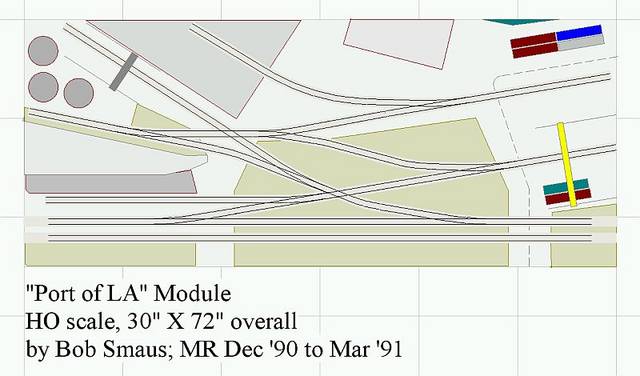
Bob Smaus' "Port of LA" project layout as described in Model Railroader Dec 1990-Mar 1991. Photo from the A-line/Proto Power West site.

Bob Smaus' photos of his 30"X72" HO module hit me hard. Here was a slightly gritty, workaday setting, down by the docks. Tracks purposefully crossed one another in a bustling industry scene. And all in a few square feet.


Click here for a better view of the HO module track plan

This was the firm, swift kick I needed to jump back into thinking seriously about the hobby. Real industries with real work to do — not generic-looking quaint little fantasy factories covered in novelty siding. And it seemed, well, buildable.

As I followed the project series over the next three issues I began to think more about why real railroads exist – to move goods from industry to industry, not just run around in circles. It helped that the Port of LA project was set in my home region of Southern California. So much of the rest of what I had been seeing in the model press at the time was Appalachian coal hauling and creaky Colorado narrow gauge. Smaus' little layout felt more like something to which I could personally relate. And although I didn't realize it at the time, the nascent seeds of a port railroad that had been planted years before were beginning to sprout. (More on that later in this series.)

Bob Smaus is a supremely talented modeler, skilled photographer, and a great writer (his day job was as an editor at L.A.'s major daily newspaper). He used all those skills to bring the Port of LA module to life in a way that affected me deeply. It's not an overstatement to say that I am in the hobby today because of seeing this series.

The Port of LA was also featured in the Kalmbach book 6 HO Railroads You Can Build. The module itself eventually found its way to A-Line/Proto Power West, where it has been used in promoting their products. And of course, Bob went on to build his fabulous SP Southern California themed layout (MR, July 2006, et al). [His very first layout effort hadn't been too shabby either: MR, Oct 1989.]

Of course, packing all of this action into 15 square feet of module that can also function on its own makes for a lot of compromises. In looking at the track plan now with more experience, I recognize the significant limitations of the multi-switchback scheme, where some industry tracks must be emptied before others can be switched. In fact, some industries would probably be disrupted just to use the convoluted runaround path. A container yard track only about 16" long in HO is pretty limiting, and it would certainly be more realistic to extend the layout into more space, creating "breathing room" between the different industries and easing some of these issues (as Mark Lawler did in building a representation of Smaus' Port of LA into his N scale layout).

But those practical layout design considerations and concerns were for another day, far down the road. As an inspiration, a motivator, even a slightly adrenaline-fueled model railroading jump start, Bob Smaus' Port of LA module takes a leading position in my list of Inspirational Layouts. And that crystal-clear San Fernando Valley Fall day in November 1990 when I first saw the layout article still ranks as one of my favorite model railroad memories.

Tuesday, September 09, 2008

Inspirational Layouts -- Introduction

Model Railroader magazine's year-long series on Landmark Layouts has been interesting. For the most part, I find the editors' selections hard to argue with. Most of these layouts and/or their builders changed the hobby for the better. In addition, most of these layouts are/were of very high quality (for their time) and advanced new ideas and concepts, from scenery to operations to replicating prototypes.

By the nature of the designation, the Landmark Layouts MR selected are something of a "best of" list. As I considered them, I found myself thinking about a handful of layouts that I have personally found uniquely inspirational. They are not the largest, most finished, or necessarily the most innovative — and some might not find their way onto anyone's list of top layouts for those reasons.

These are layouts (in some cases track plans only) that motivated me to build, that opened my thinking, and that helped me develop the vision and concepts for my current personal design. Note that these are not necessarily "perfect" designs. Many have elements (one might call them quirks or flaws) that would annoy me over time and I certainly wouldn’t choose some of those configurations for myself or a client design. But there is something about the overall approach that influenced me greatly when I first saw them and still does today.

There are many other fine layouts which I admire, an amazing number of which are within driving distance from me in the bay area (and one within walking distance!). They offer many lessons to be learned and operating experiences to enjoy. But the inspirational layouts gave me a creative whack on the side of the head and caused me to see the hobby, and my potential path within it, in a new way — even though many of these layouts and plans are much more modest.

I'll cover these inspirational layouts in blog entries over the coming weeks, sometimes with a track plan, and discuss the reasons they grabbed me and didn't let go. I'll try to communicate the positive and, well, inspiring elements of these designs, along with perhaps a few comments about their weaknesses. Watch for the first Inspirational Layout blog post later this week.

Wednesday, September 03, 2008

A Bridge (Route) too Far?

One of the interesting things about working with people on custom model railroad track plans is seeing the hobby from others' viewpoints. Sometimes it's a window back in time. A fellow has been conversing with me about a layout he'd like to set in the desert West, basically from Las Vegas to Reno. A look at a railroad atlas shows no railroad on that route – and a look at a highway atlas shows why.

This is pretty sparsely populated territory, to put it charitably. In fact, Darius Ogden Mills, one of the backers of the real life narrow gauge Carson and Colorado (which eventually became the SP's famous last remaining narrow gauge in the area) remarked that they had built their railroad "… three hundred miles too far or three hundred years too soon". And my prospective client's proposed survey seems just as remote, seeing as it mostly follows Route 95, called by some the loneliest road in America. (Nevada's connecting Route 50 vies for the same dubious honor).

OK, there would probably be some mineral and military business along the way (maybe the odd classified shipment of parts from downed UFOs to Area 51), but hardly enough to justify a four- or five-hundred mile rail investment in real life. When I met with the prospective client at the NMRA Convention in Anaheim in July, I asked, "So what were you thinking of as traffic generators on this layout?"

He looked at me as if I could not possibly have asked a dumber question. (For some reason, this happens to me a lot, so I am familiar with the expression). "Why, it's a bridge route, of course," he replied. "It connects the Union Pacific in Las Vegas to the Southern Pacific in Reno." Then he went on to name a number of well-known layouts based on the premise of connecting two Class 1s, noting that he could justify dozens of trains a day across the high desert based on the size of the two connecting roads.

Ah, yes, the pure bridge route. Famed in model railroading lore and relatively rare in real life. As I thought back, I remembered that when I was reading model magazines in the 1970s and 1980s, the bridge route concept came up a lot. Sometimes as an excuse for trackage rights (which is not the same thing as a bridge route, strictly speaking), sometimes as justification for heavy through traffic in an area otherwise lacking in on-line sources. And it's certainly true that this has been used as the basis for many layouts over the years.

Nowadays, many people recognize that the Class 1 railroads would rather keep traffic on their own rails as much as possible, so cars will be hauled hundreds of "extra" miles in a roundabout fashion to where the Class 1s have an existing connection and interchange. While there are a few true bridge routes that existed over the years due to accidents of ownership history or geography, they are pretty rare. Shortlines and smaller railroads are much more likely to exist as feeders to one or more Class 1s than as an alternate routing between them. I've mentioned Central California Traction and the Modesto and Empire Traction in the blog in the past. These railroads have connections to multiple Class 1s, but don't typically bridge traffic from one of those large railroads to the other. Instead, they connect their on-line industries to multiple Class 1s through interchange at multiple points.

This realistic pattern makes for a more interesting justification and concept to me than straining credibility with a bridge route, as well as creating more of the industry switching and interchange activity I enjoy. But hey, that's just me. And my client? Well, he's still itchin' for that dry and dusty bridge route, so we'll see how it all comes out. (And he's good-natured about seeing these musings on the blog) It will be a little time-travel for me back to the layout concepts of the '70s. Just hope I don't have to wear the clothes -- again.

Saturday, August 23, 2008

Remembering the First

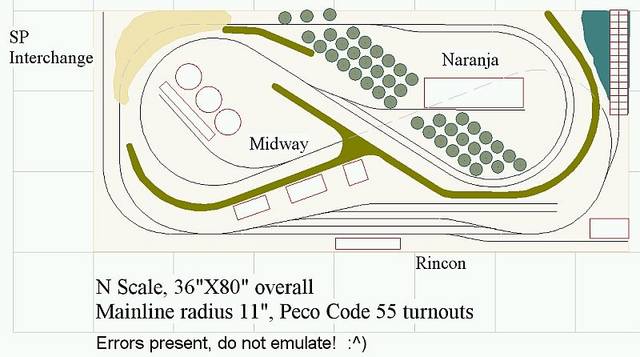
Ah, young love. So intense, at times so misguided. I was reminded of one of my first model railroad "crushes" the other day. Going through some old papers, I found a printout of my first serious layout design. It was done with crude turnout templates in Powerpoint(!) and probably dates from about 1989-90. I describe the plan as "serious" and not "good" because there are definitely some issues. But I remember being intensely focused on the concept for a few weeks. As with any old flame, some memories are more than a little embarrassing, but there are some warm thoughts, too.

I sketched out the plan in 3rdPlanIt and (remarkably) everything fits – but I resisted the urge to correct or improve anything. Twenty years later, some of the details are a little hazy anyway. The overall track locations were suggested by a layout I had seen in an NTRAK publication, which had a sort of a hilly pretzel overcrossing configuration separated by a backdrop from a narrow yard area along one long edge. Benchwork was to be a hollow core door. I had only just started thinking about the hobby again after a long time away and was considering N scale for the first time.


I had recently lived in Carpinteria, CA and the design vaguely suggests that area. The pier or wharf near Rincon was inspired by a short, high pier the Chevron company owned near Carpinteria to load men and equipment onto boats for transfers to the offshore oil platforms nearby. In my reimagining, this pier would somehow serve railcars. An interchange connection was imagined to the SP (which actually runs through the area) and the main on-line industries were citrus packing and some sort of oil-related industry. Both were important industries in the region. I tried to divide the small footprint into a few different scenes, although the backdrops might have proved a little tricky in actual construction.

I see a number of obvious things I would do differently today. The stub-ended yard tracks should point in the opposite direction, at least given where the interchange connects and where "Midway" is located. I think I may have imagined this as a shortline that would work the interchange, build a train, run out to Midway and Naranja, then runaround and return (or was it the other way around?). Too many tracks are parallel to the edges of the benchwork, and the model railroad cliché of "an industry track in every corner" is well-represented.

Hidden or secluded sections completed a continuous run and the roughly 2% grade should have been workable. I don't remember what I was thinking of calling it, but the "Rincon Northern" might have been appropriate (the California coast runs roughly East-West in the area). I also don't recall if I simply wasn't thinking of staging at that point or had purposely left it out in favor of the shortline-with-interchange idea.

This little plan was never built. I became involved with a friend's layout based on the Santa Maria Valley Railroad (see Model Railroad Planning 2004 or view the layout plan online here) and my own interests turned to more prototype-inspired designs. Looking back, I think it would have been a great boost for my own modeling if I had taken the time to build and operate this simple little project, even with the flaws. In any case, it was fun to revisit a past infatuation. [And a great way to procrastinate on the clean-up I was supposed to be doing the day I rediscovered this track plan.]


Speaking of firsts, I was enjoying Gillian Welch's album Time (the Revelator) last week. Her haunting bluegrass/folk/alt-county style with musical partner David Rawlings is well displayed in this album, which includes the slightly melancholy reminiscence "My First Lover". Welch might be best known for her work on the soundtrack to the movie Brother, Where Art Thou, but her music is a very intriguing mix and not limited to old-timey tunes. Rawlings adds sparse but moving fills and creative leads on acoustic guitar that build the atmosphere of each tune. Great record!

Friday, August 15, 2008

Cardiff Giant Layouts and other Fairy Tales

The Internet is a mixed bag for model railroading. It provides tremendous benefits in research and information. But it has also given rise to a particular brand of tall tale that just leaves me shaking my head. Every few months a thread surfaces in a forum describing someone's plans to build a big layout. And when I say "plans", I really mean, "hallucinations".

Many of these folks don't actually have the skills or time available for such an undertaking, and almost by definition they don't have the financial wherewithal. But they are just sure the owner of that abandoned lot behind Aunt Tilly's house won't mind if they throw up a post frame mini-warehouse and start building a layout.

Next come weeks of on-line hand-wringing over which brand of locomotives are best suited to the envisioned 60 scale miles of main line, what manner of sheetrock screws to use to build the mezzanine for the crew lounge, and whether an elevator or just an escalator would be preferable to move operators between the three levels of layout without falling too far behind their train. And how will we build floor supports for the hot tub in the dispatcher's office?

And the forum-ites jump right in – offering that particular wild mix of speculation and overwrought amateur engineering that the Internet incubates like fungus in a fetid hothouse. Soon the forum is filled with talk of gluelam beams and solar panels vs. in-house biomass co-gen plants for powering the twenty-five thousand kilowatts of layout lighting. Heady stuff, that!

And somehow, nobody ever asks a few simple questions of the original dreamer. Is there really time, space and money for a project of this scope? How long will it take? Are you at a place in your life where you are sure that future education, job opportunities or relationships won't require a move within that timeframe? Might you not be better off with a more modest layout today, perhaps built in sections, to allow for life's twists and turns? Nope, everybody's just too happy to go along with the fantasy.

After a few weeks or months of delirium, the original poster and his grandiose dream disappear, undone by some unforeseen reality check. And then the next romantic arrives and the process begins anew.

Why do so many join in, when most must know that what's being proposed is unlikely at best? I guess we all want to believe in fairy tale giants – creatures bigger and more powerful than mere mortals. George Hull's Cardiff Giant was an elaborate hoax that tens of thousands bought into at 50 cents a pop, to the tune of $30,000 (in 1869 dollars!). Fossilized stone giants might be slightly harder to accept than the quixotic plans of some model railroad dreamers, but it seems there is always a gullible crowd for Gulliver‑esque layout fables.

Monday, July 28, 2008

Beverly Hills 502.50

It’s known more for movie stars, shopping, and as the location for a slightly sleazy 1990s TV show, but there was also a gritty side to Beverly Hills. And no, I’m not talking about Jed and all his kin. It turns out there was some real-life railroading going on in Beverly Hills (SP Milepost 502.5), Santa Monica, and West Los Angeles into the 1970s.

Mike Jarel has written a very interesting article in the most recent Trainline magazine (#96, Summer 2008), published by the Southern Pacific Historical and Technical Society, that traces the area’s history as remnants of the Pacific Electric’s interurban service (among others). Jarel grew up nearby and worked on the SP in the area, so the article is definitely written from a knowledgeable perspective.

By the 1960s, Southern California was booming and the need for rail deliveries of building materials, appliances, food products and the like was growing rapidly. Pacific Electric operated its own freight service (dieselized after 1956) in what it called the Western District until the full absorption into the SP in 1965, when the parent road took over operations.

There were small yards, runarounds, some street running, and a variety of industries sprinkled around the area. I’m really fascinated by these small urban terminal switching areas, and this is another example from a somewhat unlikely locale. The small yard at Sentous (near the intersection of today’s San Diego and Santa Monica Freeways) served multiple locals, with haulers from the larger downtown yards picking up and setting out blocks of cars. The industries and railroad facilities were of model-able size and included some very recognizable customers.

A series of Free-Mo modules duplicating some of these areas would be a great start on a model railroad that could be easily expanded or might have to be moved one day. By coincidence, my friend Trevor Marshall’s article in the August 2008 issue of Railroad Model Craftsman describes just such an approach (based on a different prototype and area, Peterboro, ON). Sentous yard could be modeled or represented by a pivoting sector plate as Trevor and Pierre Oliver did on the Peterboro project.

An approach like this could certainly provide more long-term operating enjoyment than the mindless loops on plywood sheets usually promoted by the commercial press for modest layouts. But don’t get me started on that. Instead, kudos to Mike Jarel, Trainline and its editor John Signor, and to Trevor Marshall and RMC for showcasing some very interesting prototypes and layout concepts this month.

Thursday, July 10, 2008

See you in Anaheim

For those of you planning to attend the NMRA Convention next week in Anaheim, I hope you’ll drop by one of my clinics to say hello. I’m presenting two clinics, “Creating an Operating Session” and “Layout Design from the Prototype”. I’m also participating as a panelist with a number of former editors of the Layout Design SIG’s Layout Design Journal to discuss “Layout Design Trends”.

The operations-oriented clinic will attempt to cover everything from car movement to train control to crew management and human factors. Obviously, an hour-long clinic will just scratch the surface of the topic, but hopefully it will be useful for those beginning to explore operations on their own layouts.

The clinic on designing from the prototype will hopefully interest those considering prototype-based layouts, freelanced layouts, and everything in between. I’ll try to share a bit about the thought process I find myself going through with most projects. Model railroad layout design is all about the trade-offs and compromises, and there are multiple junctures in the process where this comes into play.

The layout design trends panel discussion (Tuesday at 4pm) will be an interesting look inside the minds of a number of accomplished modelers and hobby thinkers. And me. Some preliminary email discussions among the panelists suggest that we will bring at least a few different viewpoints to the table. Model railroad layout design ain’t rocket science, but there are some interesting new ideas as well as older ideas being applied in new ways.

Hope to see you there.

Greatest. Baseball. Announcer. Ever. I’ve been spending time in Southern California recently helping out with some family matters and have had a chance to catch a few L.A. Dodgers broadcasts. Even though I was always much more of an Angels fan growing up, Dodgers broadcaster Vin Scully is still the very best there has ever been at his craft, in my opinion. Scully never over-hypes a moment and has an instinctive knack for drawing the listener or viewer into the game with a pertinent fact or stat delivered in a relaxed and engaging manner.

Scully gives the game itself “room to breathe” – and with that, he smoothly communicates the ebb-and-flow rhythm that’s the natural pace of baseball pitch-to-pitch. It’s like watching the game with an old friend who happens to be incredibly knowledgeable (and has a research team backing him up). I imagine Scully will be retiring sometime soon, so it’s been great to have a chance to enjoy his understated excellence again. Thanks, Vin!

Tuesday, July 01, 2008

Modules and Sections and Dominoes, Oh My!

This is going to be one of those model railroad layout design screeds that makes me feel slightly better but has no discernible impact on the hobby whatsoever. Ready? Here goes: the terms in the title above are not synonyms!!

Sections are just what the name implies. They are chunks of layout. They’ve been built separately for easier transportation, construction, etc. They often have legs so that they may stand alone, but could be suspended from a wall or between other sections. Sections may be flat-topped or open grid or some combination or variation. (Typically, they are not L-girder for obvious reasons.) Sections may be any shape or size. A sectional layout typically is built to fit together in one particular configuration – the sections are not interchangeable without some rework or addition of new bridging sections for a new space.

Modules are sections of layout that have been designed to a standard like NTRAK, Free‑Mo, or (many) others so that they may be interchangeably combined with other modules to form a layout. Some of these standards are national or international in scope, others defined by a single club, informal group, or individual. These standards define the track and electrical connections for mating ends. In some cases, the size and/or aspect ratio of modules are specified, but this is not universal. Adjoining modules may be built by the same or different people … but the interface between them is standardized. That’s what makes them modules. Sometimes people choose to build multi-module sets where the intermediate interfaces may not be built to the standard, but the ends are, to permit connections with modules built by others. The key is the standard interface at the ends. Ergo, all modules are sections, but not all sections are modules.

The term “domino” was borrowed by David Barrow to describe 2’X4’ flat-topped layout sections with legs. See, they look like a domino – with the flat top and 2X4 aspect ratio – just like a domino, get it? Thus, all dominoes are sections, but not all sections are dominoes. (By the way, dominoes may be an OK way to build some types of layout, but they are a really bad way to design a layout, in my humble opinion. But that’s a rant for another day.)

["Doorminoes", by the way, are a pretty cool idea: layouts or layout sections built on hollow core doors. Doorminoes have been used and popularized by Dave Clemens, among others.]

Let’s review:
- Sections are chunks of layout; size, shape, and track and electrical interfaces between sections are not standardized
- Modules are sections built to a standardized defined trackwork and electrical interface for interchangeability
- Domino is a term to describe a specific aspect ratio flat-topped section

OK, got it?

Hey, I do feel a little better.