Showing posts with label Inspirational Layouts. Show all posts

Sunday, November 09, 2008

Schoof's "Free Haven Terminal" – Inspirational Layout #8

As I've discussed the layouts in this series, I've described how a number of them started me thinking more about terminal switching areas and rail-marine environments. But one in particular was the key that unlocked my inner rail-marine modeler -- Russell Schoof's Free Haven Terminal from Model Railroader, October 1990 (also in 48 Top Notch Track Plans, Kalmbach, 1993).


Track plan copyright Model Railroader magazine, used with permission

Click here for a larger image in a new window

Schoof's layout packs a lot into 10X11 feet in HO, albeit with the use of some pretty tight curves. A decent-sized yard offers some room to work, and a variety of industries and terminals provide reasonable destinations for a good mix of freight cars. Some industries are larger, with realistic multiple tracks. Separate inbound- and outbound freight houses are a rarity on other model railroad track plans, but were common in real life during the less-than-carload (LCL) era. The published plan also has some secluded staging below, reached by a John Armstrong-style "vertical turnout" at the left of the diagram.

There are a few shortcomings that I would try to correct if adapting Schoof's Free Haven Terminal plan for my own use. I might opt for staging behind the backdrop on the same level ("surround staging") with a lift-gate across the room entrance to allow a continuous-path option. With that change in staging, the way the track goes off-scene through the walls of one of the freight houses could be reworked to be a little less contrived. Some of the industries are a bit generic, so choosing signature industries that would add more port-side personality would help. A dedicated yard lead would be a help with multiple crews working. And certainly there would be room to work in a car float, one of my favorite rail-marine features, to add an element of interchange. There are a few other quibbles, but the overall concept is very sound.

I'm apparently not the only one who has been inspired by this design. A group of four French modelers has built a very fine N scale sectional layout called the Free Heaven Harbor Terminal that shares many features of Schoof's Free Haven Terminal design, even the passage through the freight house to staging. Here's their track plan and a scene from their former website. (Their former address has been taken over by a malware site, so don't look for it.) The layout was also featured in a french-language magazine.


Another element that makes Model Railroader's article on Schoof's Free Haven Terminal article so inspiring to me is the inclusion of suggestions for operation and some of the neat "artist's conception" perspective line illustrations that were often featured in MR articles of the era. These provide a hint of what the final layout might be like and add to the rail-marine atmosphere (even though some of the views are admittedly from angles that might not actually be possible on the layout).

Like many of my inspirational layouts, the Free Haven Terminal seems of an eminently "do-able" scope. I've been impressed and educated by dozens of other layouts in person and in the press, many of them large, decades-long efforts. But this handful of mostly more modest inspirational layouts still excites and motivates me personally to get off my duff and build something. I hope they've done a bit of the same for you.

Read the entire Inspirational Layouts series

Sunday, October 26, 2008

Alameda and Galveston – Inspirational Locales #7

For something a little different in this series, two real-life locales that continue to inspire me in model railroading. Both were covered in magazine articles with accompanying model railroad layout plans, but it's the prototypical locales themselves that had the lasting influence. These are the places that helped set the stage for my later interest in rail-marine and portside railroading.

The Alameda Belt Line on its namesake island near Oakland in California has been in the back of my mind since reading about it in Barry Wood's article in the April 1980 Model Railroader. This little line had a lot of interesting elements: ownership by, and interchange with, the Santa Fe and Western Pacific (via car float and car ferry for much of its life); character-filled industries; an interesting competition with the Southern Pacific; and a reasonably compact scope. My interest in it has only increased since moving to the Bay Area.

Wood's article included a track plan, primarily focusing on the Alaska Basin area of the prototype. While it's a pretty good plan, it was set in an era after the car floats and ferry had stopped running and did not reflect some of what I feel were the signature elements of the prototype, like the dual interlaced wyes. The area Wood focused on is still pretty interesting, with a wide variety of industries, some quite large:


I've been including some aspects of the ABL in my plans for my own N scale Oakland Harbor Belt Layout for some time. For example, the Alaska Basin area will look something like this when I get back to the garage version of the OHB.


Click here to read more about Alaska Basin on the OHB.

One of my friends has said, "Byron, you're obsessed with the ABL. Why not just model it instead of making something up?" Fair question -- and if there were decent Alco S-2s in N scale who knows if I might have taken that path -- but then again, the freedom of proto-freelancing offers the chance to include more traffic and other engaging elements lacking in the real-life ABL.

Galveston Island, Texas is another fascinating rail-marine environment, well described in Cyril Durrenberger's and Tom Eishenhour's May 1983 MR article on the Galveston Wharves Terminal Railway (GWT). While this article also includes a reasonable track plan, the real attraction to me was the map spread across the top of two facing pages: huge industries, wharves, piers, grain elevators, and container facilities; four major interchanging roads (SP, ATSF, BN, GH&H [MP-controlled]); and wide variety of commodities.

The concentration of railroading created by the port facilities makes for an amazing variety and scope of potential modeling. Maybe a little too much scope, in fact … while the ABL might be too small, Galveston is probably just too big. I've done one custom design inspired by Galveston so far, but it's hard to capture even a hint of the signature elements of the prototype on a mid-size or smaller trackplan. Maybe another opportunity will present itself one day. Today the GWT is known as the Galveston Railroad (AAR reporting marks GVSR). Those reporting marks are seen on thousands of Golden West Service cars across the country.

So, while it wasn't the model railroad track plans that appealed to me in these cases, the attractions of the real-life rail-marine prototypes were definitely a huge inspiration to my modeling concepts and vision today.

Next time, I'll conclude this series with a layout that, while far from perfect, puts many of the elements described so far into practice. Anyone have a guess which layout it might be?

Sunday, October 19, 2008

Rick Mugele's "City Belt" – Inspirational Layout #6

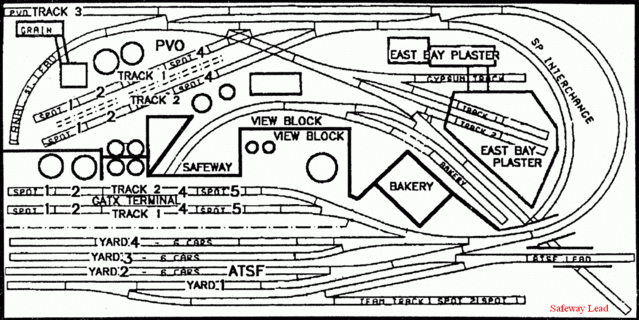
If you were to combine an innovative design imagination, the experience of real-life railroading, an interest in small-space operations, and an intriguing locale, you might, if you were very lucky, end up with Rick Mugele's HO 42"X80" City Belt switching layout. Besides the visible trackage seen here, one double-ended and two single-ended tracks are tucked below the visible yard, providing interchange and additional industries assumed to reside "beyond the benchwork".


Click here for a better view of the HO City Belt switching layout

Rick Mugele is a real-life railroader (now on the BNSF), and for years he has cranked out amazingly compact designs that challenge conventional thinking and stretch the envelope of what's possible. By 1995, when I encountered his City Belt design in a back issue of the Layout Design SIG's Layout Design News (LDN-8, August 1991), I was beginning to realize that model railroad operations could be a lot more engaging than I had imagined. Mugele's article described the real-life concept of "sure spots": cars aren't dumped willy-nilly into sidings, rather in many places they are required to be placed at a particular door, over an unloading grate, or below a discharge spout. The City Belt was provided as an example, based on real–life industries in Oakland and Richmond in California served by the (then) ATSF.

As compact as it is, the City Belt layout contains a couple of dozen "sure spots" – offering the same operations interest as much larger layouts that lack this added sophistication and realism of precisely spotting cars as on the prototype. This small layout includes key realism-boosting features that are lacking in the majority of the switching layout designs proliferating unchecked on the Internet (and even in the commercial press).

These all-too-seldom-seen desirable features include interchanges and yards – places for the loads and empties to travel to- and from. Industries are (relatively) large, with multiple tracks and multiple spots on many of those tracks, just like the real thing. Even in these tight quarters, there are no double-ended switchbacks that would require one industry to be emptied before another may be switched. For example, the "Safeway Lead" (my designation) extends into the lower right corner to allow room to work without disturbing cars already placed at other industries. And a pair of run-arounds allow everything to be shuffled as required to be placed into spot order for the facing- and trailing-point industries.

It took me a while to fully appreciate another interesting feature: Mugele's use of double-sided backdrops. Combined with the different levels of trackwork, it allows a clever and efficient "overlap" of layout space. For example, the lead into the Safeway building passes below the visible yard directly above it and the Safeway complex's walls form an industrial building bay at GATX as well as creating the backdrop between the scenes.

Beyond these design elements, Mugele's City Belt radically changed my thinking about operations. Besides just transportation (moving cars in trains), there was also the idea of distribution: efficiently picking up and placing cars at individual industries. And the idea that cars came from, and went to, "somewhere else" was clearly more realistic than moving a car from the vinegar plant three feet to the pickle factory and back again. I could see that even a small urban-themed layout could offer operating enjoyment by replicating some of the tight quarters and intricate switching of the real thing. (And Denton's Kingsbury Branch a couple of years later just added fuel to the fire!)

As much as I admire the City Belt, it's probably packed a bit too tightly to be practical for most builders as drawn. Curves wind down to less than 15" radius and grades are a stout 4 to 5% or more. But building this same layout in a 5'X8' or 5'X9' in HO would allow one to ease many of these issues and improve accessibility to the hidden track. Or, as suggested by Frank Jozaites in LDN-8, the yard could be swung off to the side as a shelf on an adjoining wall, a very nice improvement if space is available. In N scale, the layout might fit well on a hollow-core door (and would be a real improvement over many of the switching layout designs proffered for that space).

The most creative layout designers not only render innovative track plans, they show us ways to make whatever layout space we have more engaging and satisfying. Rick Mugele certainly falls into that category, and his City Belt still inspires me today.

Sunday, October 12, 2008

Sperandeo's San Jacinto Dist. – Inspirational Layout #5

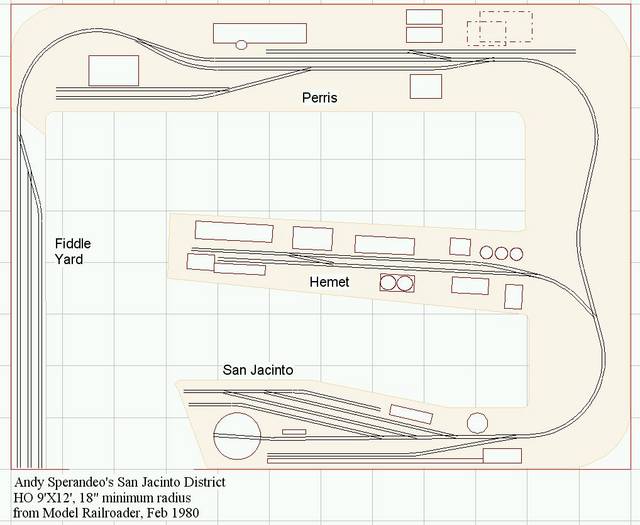
When the student is ready, the track plan appears. Or reappears, in this case. When I first saw Andy Sperandeo's 9X12 HO ATSF San Jacinto District plan in the February 1980 Model Railroader, it didn't make much of an impression. (Especially compared to the Carrabasset & Dead River in the same issue).

But by the time I encountered the plan again in the early 1990s, in Kalmbach's Track Planning Ideas from Model Railroader (1981), I had learned enough about model railroad layout planning to see and appreciate the track plan's innovative points.


The modest amount of trackwork that had seemed sort of boring before now looked much more realistic. Linking the plan to real places and the actual types of industries found in those locations created more interest. A layout based on out-and-back branch line switching, rather than endless round-and-round, seemed attractive. And the accessible staging, which had seemed like a waste of perfectly good layout space to me earlier, now enabled the engaging flow of traffic to- and from the "rest of the world". (This might have been the first time I was exposed to the concept of a fiddle yard, where consists might be reset between sessions.)

The San Jacinto District was not the first layout I had seen with most of these elements, but I was beginning to see how creating a track plan was an exercise in balance. Sperandeo's track plan was one of the few "theoretical" designs in that era to realistically address the need for adequate aisles, for sufficient staging to create the desired operations intensity, and a variety of operating schemes to address seasonality (and add operating interest). Sperandeo's track plan also exuded a personality – the atmosphere of southern California branch line railroading. This was a refreshing change from many of cookie-cutter layouts I had been seeing that seemed to all be set in the same generic eastern burg.

I was getting an inkling that there was more to model railroading than packing in loops of track. (Would that the masses posting their sorry CAD creations on the Internet might learn the same lesson.) Operating trackage, staging, room for scenery, operational theme, aisles for crew members, etc, all had to be considered in coming up with the track plan. Andy Sperandeo's relatively modest San Jacinto District plan inspired me to build my own knowledge of the myriad subtleties of layout design – a foundation I call upon nearly every day.


One of the more intriguing streaming audio channels I've come across is Frank's Americana on Live 365. Self-billed as "Cooking the music of the world in the melting pot of American life!", the channel mixes a wide variety of styles and eras. While bluegrass and newgrass are strongly represented, one might also hear Swing, Big Band, Jazz, and Rock. Ralph Stanley to Flying Burrito Brothers to James Gang to Louis Prima would not be an unusual set. There are occasional clinkers (some '60s Top-40 hits I just don't need to hear again -- ever), but there are far more nuggets than dross.

Tuesday, October 07, 2008

Denton's "Kingsbury Branch" – Inspirational Layout #4

1996 was a pretty stressful year: new baby; pressure-packed job at an Internet giant; and an impending household move. It was clearly going to be a while before any layout was started, but I was still planning on building the proto-freelanced N scale Midland Pacific* once things settled down. And then another seed was planted that would eventually shift me away from the branchline/secondary mainline concept to a more urban terminal-switching theme.


Kingsbury Branch layout photo from Bill Denton's former website


Bill Denton's Milwaukee Road Kingsbury Branch in the January 1997 Model Railroader was another revelation. In a very compact space – and in N scale – Denton had created an appealing replica of a real-life area that worked as an operating layout. The urban scenery was realistic without requiring scale acres of benchwork. And the concentrated activity typical of a real urban terminal provided plenty of engaging operating potential without unduly straining plausibility.


Track plans from Bill Denton's former site
The Kingsbury Branch is built in two portable sections, each measuring 21 inches deep by 6 feet long. An unscenicked 4‑track staging yard connects at the left of the upper section shown here (which also provides "room to work" for the industry tracks at the far left of that section). Denton's original inspiration came from an article by Randy Willis in the April 1975 issue of Model Railroader on the real-life area. From photos in that article and visits to the area, Denton developed a track plan that emulates the real thing in many respects, handlaying code 55 turnouts and code 40 industrial tracks to maximize appearance. He also decided to kitbash and scratchbuild, rather than using off-the-shelf structure kits, to try to replicate the buildings more accurately.

Looking at the layout photos, I realized that the urban buildings were strikingly effective as backdrops, towering over the railroad passing below. The busy trackwork intersected the street grid at interesting angles and suggested a real business with real work to do. And the many sidings, sufficient runarounds, "off-spot" tracks, and numbered door "sure spots" added realistic operating interest without resorting to tedious switching puzzles. Denton described the operation of the layout in a follow up article in the May 1998 MR. He has taken the layout to various train shows and events, a real benefit of the sectional approach. (The original intention was that these sections were to eventually become part of a larger home layout, but I don't know if that ever occurred.)

Of course, it didn't hurt that Denton is an excellent modeler and photographer. The images in the MR articles showed me that N scale urban railroading could appear very realistic in a very small space. While I didn't give up the Midland Pacific idea immediately, a new concept of urban railroading began to form. Bill Denton's Kingsbury Branch completely changed my perception of N scale and opened my eyes to the possibilities of urban railroading in a very inspirational way.

*My layout design and operating plans for the Midland Pacific were covered in detail in the Layout Design SIG's Layout Design Journal # 35, December 2006.

Sunday, October 05, 2008

Hayden's "C&DR" – Inspirational Layout #3

One might be reminded of the Sesame Street ditty: "One of these things is not like the others …" Bob Hayden's proto-freelanced HOn30 Carrabasset and Dead River Railway (C&DR) layouts might seem unlikely inspirations, given my current personal focus on industrial urban layouts intended for operation. Sometimes, though, an inspiring layout is one that tells you not only something about your dreams, but also something about your inescapable realities.


View of the Carrabasset and Dead River from Allen Keller's Great Model Railroads #26.

I discovered the C&DR on the cover of the February, 1980 Model Railroader. The story inside described the development of the first C&DR, from a rented garage in San Francisco to Dave Frary's basement near Boston. Although I knew nothing about the Maine two-footers at the time, the layout photos were amazingly evocative of a unique time and place, separated by gauge and locale from the rest of North American railroading.

Trains were short and engines idiosyncratic. And the idea that a layout could evolve so dynamically over time as the builders' ideas changed and experience grew was a very new and exciting concept.

For a brief time, I was enthusiastic about modeling in HOn30 myself. "Brief" as in about a week -- once I discovered the paucity of commercial offerings in the local hobby shops, my ardor quickly cooled. And more importantly, I began to realize that it took a special combination of skills to make such an unusual prototype believable. Those early C&DR layouts benefited not only from Hayden's vision, but from both Hayden's and Dave Frary's exceptional modeling and scenery skills as well (thus the C&DR is justifiably one of MR's Landmark Layouts).

The low-key imagineered C&DR prototype encouraged space between scenes and uncrowded towns. But for that concept to succeed, the scenery had to be top-notch -- which in this case, it was, the builders having literally written the book on model railroad scenery. Even though the idea of an isolated and charismatic little railroad was very appealing, I began to recognize that pulling it off successfully would require space and modeling talent that I currently lacked. And the absence of meaningful interchange is an operating limitation that I could see would be unsatisfying.

So in a roundabout way, my interest and enthusiasm for the C&DR has translated into a focus on a more achievable (for me) concept: an industrial switching-oriented layout, the Oakland Harbor Belt. The OHB concept can justifiably cram more operating interest into my limited space and may not be as demanding of scenery skills to pull off convincingly.

The appeal of isolated little railroads continues for me, of course, in the form of my recurring infatuation with Hawaiian railroads. As I have read and enjoyed the many articles on the C&DR, I still find the layouts very inspiring and motivating. Hayden's unique concept and the builders' masterful implementation (aided and abetted by Frary's fine photography) always encourage me to get building. And certainly that qualifies the multiple instantiations of the Carrabasset and Dead River concept as very inspirational layouts, indeed.

Friday, September 26, 2008

Westcott's "Switchman's Nightmare" – Inspirational Layout #2

Although I wasn't actively doing any model railroading in the late 1970s, I was still reading books and magazines and thinking about layouts. Like probably everyone in the hobby at that time (and many today), I owned a copy of Kalmbach's 101 Track Plans for Model Railroaders. Once, while visiting out-of-town friends, I came down with a nasty flu bug. While my friends went out for the day's activities, I resigned myself to the TV and reading, including another pass through the copy of 101 Trackplans I had brought along on the trip.

I had been through the book a couple of times at this point, focused mainly on the larger layouts in the later pages. So I decided to take a look at the smaller plans in the front of the book. Loop. Loop. Loop. Hey, wait a minute. Maybe it was my somewhat febrile state, but I started to see something different in plan #6, Linn Westcott's "Switchman's Nightmare".


For the first time, I pictured how cars placed in the yard at the right might be delivered to industries and vice-versa. And for some reason, the tracks at the lower left struck me as a large industry this time, rather than another yard as I had seen it before. Grabbing some scratch paper, I drew crude representations of short trains and tore the paper into little bits. As I moved these around the diagram in the book, I started to really understand what a runaround was, why those switch leads at the upper left and lower right where there, and how even a small layout without a continuous run might be fun.

Although the fever (both literal and model railroading) passed, the concepts of the Switchman's Nightmare layout stayed with me. As I learned more about multi-spot industries and prototypical operations, I began to see possibilities for more complexity and interest in Westcott's compact shelf switching layout.

Part of the appeal of this layout is its structural simplicity: runaround; yard tracks; and industry tracks, creatively overlapped to make the best use of the limited space. This basic structure has been used in hundreds (maybe thousands) of layouts, including John Allen's more-famous but less-realistic (in my view) Timesaver switching game. (It's interesting to me to note that the Switchman's Nightmare predates the Timesaver by about a decade.)

Even though regular readers know how much I dislike the traditional HO 4X8 track plan, an interesting exercise is to use the Switchman's Nightmare configuration as a an HO 4X8.


I've used similar configurations in a number of small layouts or as part of larger layouts, including the 1'X6' N scale Alameda Belt Line design from Model Railroad Planning 2005. Another interesting adaptation I've done was an HO version sized and configured much like Westcott's original but set up as a diesel service facility for a client with only a modest space but a mess o' engines to display.


The basic Switchman's Nightmare layout can be improved, where space permits, by the addition of a bit of length to allow for longer and more useful switch leads and runaround. I've seen a version on the web built by a club that had removable extensions to be added to the switch leads at each end when used at shows. Designating the tracks on the lower left as the multiple tracks of a large industry (factory, paper mill, brewery, etc., etc.) with sure spots could provide a lot of operating interest. And yeah, the switchback industries at the upper right bug me a little but could be easily addressed.

That a very simple trackwork configuration could offer such richness of operation was, and continues to be, a delightful surprise and ongoing inspiration. Just proves that "there's almost always room for operations" -- and that definitely places Westcott's little gem in my list of Inspirational Layouts. When the series returns, something completely different.

Thursday, September 11, 2008

Smaus' "Port of LA" – Inspirational Layout #1

By 1990, I was thinking off-and-on about building what would have been yet another generic model railroad – but there was no real "spark" to my ideas. My coworkers and I frequented an Italian restaurant located in a shopping center alongside a hobby shop. After lunch, I would often wander into the shop and take a look at the magazine rack. What I saw while leafing through the December 1990 issue of Model Railroader literally froze me in my tracks. I actually momentarily felt as if I was in one of those scenes in a movie where a crucial newspaper headline whirls suddenly into view.


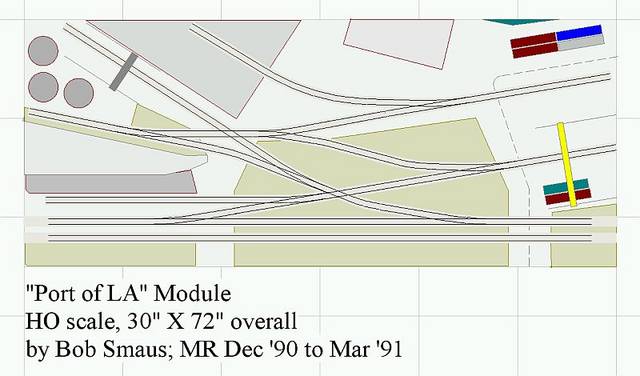
Bob Smaus' "Port of LA" project layout as described in Model Railroader Dec 1990-Mar 1991. Photo from the A-line/Proto Power West site.

Bob Smaus' photos of his 30"X72" HO module hit me hard. Here was a slightly gritty, workaday setting, down by the docks. Tracks purposefully crossed one another in a bustling industry scene. And all in a few square feet.


Click here for a better view of the HO module track plan

This was the firm, swift kick I needed to jump back into thinking seriously about the hobby. Real industries with real work to do — not generic-looking quaint little fantasy factories covered in novelty siding. And it seemed, well, buildable.

As I followed the project series over the next three issues I began to think more about why real railroads exist – to move goods from industry to industry, not just run around in circles. It helped that the Port of LA project was set in my home region of Southern California. So much of the rest of what I had been seeing in the model press at the time was Appalachian coal hauling and creaky Colorado narrow gauge. Smaus' little layout felt more like something to which I could personally relate. And although I didn't realize it at the time, the nascent seeds of a port railroad that had been planted years before were beginning to sprout. (More on that later in this series.)

Bob Smaus is a supremely talented modeler, skilled photographer, and a great writer (his day job was as an editor at L.A.'s major daily newspaper). He used all those skills to bring the Port of LA module to life in a way that affected me deeply. It's not an overstatement to say that I am in the hobby today because of seeing this series.

The Port of LA was also featured in the Kalmbach book 6 HO Railroads You Can Build. The module itself eventually found its way to A-Line/Proto Power West, where it has been used in promoting their products. And of course, Bob went on to build his fabulous SP Southern California themed layout (MR, July 2006, et al). [His very first layout effort hadn't been too shabby either: MR, Oct 1989.]

Of course, packing all of this action into 15 square feet of module that can also function on its own makes for a lot of compromises. In looking at the track plan now with more experience, I recognize the significant limitations of the multi-switchback scheme, where some industry tracks must be emptied before others can be switched. In fact, some industries would probably be disrupted just to use the convoluted runaround path. A container yard track only about 16" long in HO is pretty limiting, and it would certainly be more realistic to extend the layout into more space, creating "breathing room" between the different industries and easing some of these issues (as Mark Lawler did in building a representation of Smaus' Port of LA into his N scale layout).

But those practical layout design considerations and concerns were for another day, far down the road. As an inspiration, a motivator, even a slightly adrenaline-fueled model railroading jump start, Bob Smaus' Port of LA module takes a leading position in my list of Inspirational Layouts. And that crystal-clear San Fernando Valley Fall day in November 1990 when I first saw the layout article still ranks as one of my favorite model railroad memories.

Tuesday, September 09, 2008

Inspirational Layouts -- Introduction

Model Railroader magazine's year-long series on Landmark Layouts has been interesting. For the most part, I find the editors' selections hard to argue with. Most of these layouts and/or their builders changed the hobby for the better. In addition, most of these layouts are/were of very high quality (for their time) and advanced new ideas and concepts, from scenery to operations to replicating prototypes.

By the nature of the designation, the Landmark Layouts MR selected are something of a "best of" list. As I considered them, I found myself thinking about a handful of layouts that I have personally found uniquely inspirational. They are not the largest, most finished, or necessarily the most innovative — and some might not find their way onto anyone's list of top layouts for those reasons.

These are layouts (in some cases track plans only) that motivated me to build, that opened my thinking, and that helped me develop the vision and concepts for my current personal design. Note that these are not necessarily "perfect" designs. Many have elements (one might call them quirks or flaws) that would annoy me over time and I certainly wouldn’t choose some of those configurations for myself or a client design. But there is something about the overall approach that influenced me greatly when I first saw them and still does today.

There are many other fine layouts which I admire, an amazing number of which are within driving distance from me in the bay area (and one within walking distance!). They offer many lessons to be learned and operating experiences to enjoy. But the inspirational layouts gave me a creative whack on the side of the head and caused me to see the hobby, and my potential path within it, in a new way — even though many of these layouts and plans are much more modest.

I'll cover these inspirational layouts in blog entries over the coming weeks, sometimes with a track plan, and discuss the reasons they grabbed me and didn't let go. I'll try to communicate the positive and, well, inspiring elements of these designs, along with perhaps a few comments about their weaknesses. Watch for the first Inspirational Layout blog post later this week.