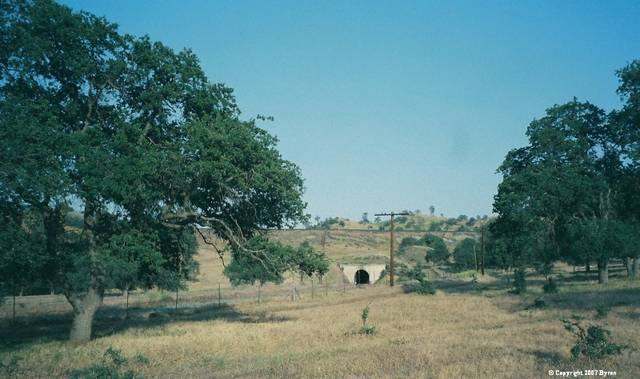
I'd been emailing with a potential client about a custom track planning project for a while. His vision was for a freelanced layout with a bit of everything, to be built with Kato Unitrack. No specific theme except to have fun and explore the hobby. So far, so good.
But then he began to have second thoughts. Basically his worries came about because he had "heard" that nitpickers and prototype modelers "don't like freelanced layouts or click track" and he didn't want to be criticized. Where had he "heard" that? Internet forums, of course.
Yes, the "Nitpickers pushed me down and took my lunch money" meme is alive and thriving on the Internet.
And pretty much only there.
Many of those posting about the "mean old nitpickers" have themselves never completed any layout, prototype or freelance, generic or specific. But they rave on about the sinister layout police who savage layout owners for failing to live up to some unwritten set of rules.
I recognize that playing the victim has powerful appeal in today's society. In model railroading, it helps some excuse years of inaction. It helps others gain some Internet fame and notoriety (trivial and childish as it is) through hundreds (or thousands) of whining posts.
And it's pretty much totally false.
In fact, I've seen just the opposite first hand multiple times. On one specific occasion I remember from years ago, I happened to be on a layout tour with some very well-known and highly-skilled prototype modelers. One of the layouts on the tour was a freelanced design built with Atlas SnapTrack. To be honest, the layout didn't offer much in visual appeal or operating interest to most, though it suited the owner's interests. But the experienced modelers visiting still took a few minutes to offer a couple of thoughts and thank the owner for being open.
No, the experienced folks didn't spend an hour there and I'm sure it wasn't their favorite layout of the day. But they were courteous, respectful and pleasant. Just as 99% of modelers would be.
The "evil nitpickers" rants on the Internet have done much more harm to potential layout builders than have any actual nitpickers. So forum trolls, please. I recognize that it’s asking way too much for you to be accurate or knowledgeable. But maybe you could at least some up with something fresh.
[By the way, the fellow I was emailing with went forward with the design project, actually built it with Unitrack, and is having a great time. Meanwhile, the forum trolls are … not.]
Showing posts with label Observation. Show all posts
Showing posts with label Observation. Show all posts
Monday, September 12, 2011
Thursday, September 02, 2010
Summer Update
I'm looking forward to fall and the unofficial restart of the model railroading season. Sorry for the paucity of blog posts, between some family issues and the dreaded kitchen remodel, it's been something of a lost summer. This is one year that I'm very happy that summer is almost over!
Thanks go out to my patient clients, who have been extremely gracious. I've finished some very interesting track plan projects recently and more are in store for later this year, including two designs focused on some of the ultimate railfan spots in the US. Should be interesting!
The Layout Design Bootcamp I presented at the NMRA Milwaukee Convention with Seth Neumann and the Layout Design SIG seemed to be well-received -- thanks to those of you who attended and stopped by afterwards to say hello. Readers may download notes and references from the session at the above link.
Portions of the Layout Design Bootcamp will also be included in the Layout Design SIG's Layout Design Journal #40, to be published later in the fall. I've also returned to the Journal as editor beginning with LDJ-41.
And as the household belongings slowly recede from the garage and the kitchen contents from the home office, I hope to actually work in some actual modeling later in the year. I know, I know, you'll believe it when you see it … me, too!
Thanks go out to my patient clients, who have been extremely gracious. I've finished some very interesting track plan projects recently and more are in store for later this year, including two designs focused on some of the ultimate railfan spots in the US. Should be interesting!
The Layout Design Bootcamp I presented at the NMRA Milwaukee Convention with Seth Neumann and the Layout Design SIG seemed to be well-received -- thanks to those of you who attended and stopped by afterwards to say hello. Readers may download notes and references from the session at the above link.
Portions of the Layout Design Bootcamp will also be included in the Layout Design SIG's Layout Design Journal #40, to be published later in the fall. I've also returned to the Journal as editor beginning with LDJ-41.
And as the household belongings slowly recede from the garage and the kitchen contents from the home office, I hope to actually work in some actual modeling later in the year. I know, I know, you'll believe it when you see it … me, too!


Tuesday, June 15, 2010
A Free Lunch is a Stolen Lunch
 I notice a trend lately of folks taking advantage of free trial offers of model railroad CAD software to plan their layouts. And I use the phrase "taking advantage" literally.
These folks are using a number of workarounds to avoid paying for the software. I'm not talking about open source or manufacturer-sponsored software such as XtrkCAD or Atlas' RTS, this is software from entrepreneur developers trying to make a go of it.
And I'm also not talking about a try-before-buy situation: these forum posters make it clear that they never plan to purchase the product (thanks to their "clever" workaround).
I recognize that there is a prevailing view, from music to movies to software, that it's just plain old-fashioned to pay for someone's creative output. Just download, man, otherwise you’re a sucker.
But these are small companies or individuals creating and marketing CAD programs. All the folks who so proudly trumpet their workaround techniques are stealing intellectual property from those hard-working developers (and encouraging others to do the same).
So just a thought, if you "love" the software so much and "use it all the time", please pay for it and support the people who've done the work for you. Or these products will disappear from being loved (and starved of funds) to death.
 I've been in a bit of a blues/rock mood lately and discovered a great album on Pandora that I had completely missed when it was released in 1993. Paul Rodgers is one of rock's great voices, probably best-known for his work with Free and Bad Company. But his solo album Muddy Water Blues: A Tribute to Muddy Waters
  is an amazing listening experience.
It's a collection of Muddy Waters tunes with an all-star cast of guitarists, from Buddy Guy to David Gilmour to a mesmerizing Jeff Beck. Blues purists beware, these are not "authentic" covers of the original tunes, but completely new approaches that are more modern and rock-influenced in style.
Rodgers is in fine voice throughout and the guitarists are certainly inspired by the material and opportunity. Apparently the original record company folded around the time this album was released and it never received much attention, but it's certainly worth a purchase now that it is back in print -- please don't steal it!
(By the way, a gentleman named Philip Snyder has done an excellent track-by-track review of the recording on Amazon.com. Be sure to check it out if you visit the Amazon page.)
Monday, May 17, 2010
One Track Mind
I've been doing quite a bit of work on operating ideas for my custom track planning clients lately. I didn't realize how focused I had become in my thinking until I stopped by the dry cleaners today with clothes in one hand and a laundry ticket in the other.
"Some to pick up and some to set out", I told the clerk.
… the quizzical look on his face told me he's not a model railroader.
"Some to pick up and some to set out", I told the clerk.
… the quizzical look on his face told me he's not a model railroader.
Thursday, December 31, 2009
A Better Start for Beginners
As I noted a while back, the searches that lead folks to my website, as well as threads on model railroad forums, suggest that there are a lot of newcomers to the hobby at this time of year. In addition, many people seem to find their way back to the hobby around the holidays. That's certainly understandable and a positive thing – we need new (and returning) blood to keep the hobby going.
But we seem to have some challenges in helping these newbies find their bearings and get started. Often, these folks are led to an HO 4X8 from 101 Track Plans, an Atlas track plan book, or similar sources. Or worse yet, encouraged to download a CAD program and design their own layout.
I am asking myself if these are really the best paths we can offer to newcomers. The first part of this question is, should we be recommending that absolute newcomers immediately start building a layout? That's always been the "standard" procedure, but does it serve everyone well? Some of these newcomers don't even have an idea of what scale they wish to pursue, let alone type of layout, era, prototype, etc.
Could it be that some might actually benefit from some more exposure to the hobby before beginning their own home layout? This could come formally through club membership or informally by helping out at an in-process layout. They might learn more (and more quickly) if they weren't trying to figure everything out from scratch. And if they were part of a modular club, they could get hands-on experience and a chunk of layout that could possibly be used later at home.
And if they are bound and determined to build a layout as a first step, would these newbies not perhaps be better-served by being directed to one of the start-to-finish layout books such as Marty McGuirk's new N scale layout-building guide -- or a Model Railroader magazine project?
Even though I have been critical of the track plans chosen for some of these efforts (and still am frustrated by some of them), perhaps these soup-to-nuts guides are a better choice, track plan warts and all, than sending the newbie down a path that ends with a neglected half-finished Plywood Pacific covered in dust in the corner of a basement.
I've seen quite a few of those forlorn abandoned HO 4X8s over the years. And it makes me wonder if there isn't some better path. I certainly don't have the answer, but I think it's worth considering before we send another complete beginner down a layout-building path.
But we seem to have some challenges in helping these newbies find their bearings and get started. Often, these folks are led to an HO 4X8 from 101 Track Plans, an Atlas track plan book, or similar sources. Or worse yet, encouraged to download a CAD program and design their own layout.
I am asking myself if these are really the best paths we can offer to newcomers. The first part of this question is, should we be recommending that absolute newcomers immediately start building a layout? That's always been the "standard" procedure, but does it serve everyone well? Some of these newcomers don't even have an idea of what scale they wish to pursue, let alone type of layout, era, prototype, etc.
Could it be that some might actually benefit from some more exposure to the hobby before beginning their own home layout? This could come formally through club membership or informally by helping out at an in-process layout. They might learn more (and more quickly) if they weren't trying to figure everything out from scratch. And if they were part of a modular club, they could get hands-on experience and a chunk of layout that could possibly be used later at home.
And if they are bound and determined to build a layout as a first step, would these newbies not perhaps be better-served by being directed to one of the start-to-finish layout books such as Marty McGuirk's new N scale layout-building guide -- or a Model Railroader magazine project?
Even though I have been critical of the track plans chosen for some of these efforts (and still am frustrated by some of them), perhaps these soup-to-nuts guides are a better choice, track plan warts and all, than sending the newbie down a path that ends with a neglected half-finished Plywood Pacific covered in dust in the corner of a basement.
I've seen quite a few of those forlorn abandoned HO 4X8s over the years. And it makes me wonder if there isn't some better path. I certainly don't have the answer, but I think it's worth considering before we send another complete beginner down a layout-building path.
Sunday, May 10, 2009
Madera Flyer
I recently finished up an N scale layout design for a contemporary era shortline. One of the elements I wanted to include was a job that would require a shoving platform, since the real-life railroad serving as inspiration for this layout owns one.
For those unfamiliar with the term, these cars are used at the end of trains for long shoving moves to give the crew a place to perch. This role was once served by cabooses, obviously, but those have pretty much gone by the wayside in modern railroading.

Photo from Frank Orona's Railpictures gallery
As seen by the photo above, some of the shoving platforms are pretty spartan, with barely any shelter for the trainmen. Others are ratty-looking older cabooses that have had little tender loving care over the years. Sometimes these old cabooses are gutted and welded closed, so basically only the platforms are usable.
 Photo from the Cabooses of Alabama web page
Then there is the Madera Flyer. In May of 2008 I was driving between Southern California and the Bay Area and stopped at the UP's (former SP) Fresno Yard for a few minutes of casual railfanning. A lone diesel appeared, moving at a fairly fast clip with a single car and what appeared to be a bright Armour Yellow caboose in tow. While the crew started organizing a train from cars in the yard, I maneuvered for a slightly closer look.

Emblazoned on the side of a very spiffy-looking caboose that didn't seem to be of either UP or SP origin were the words "Madera Flyer". Shoving platform, indeed! In searching the web, I found Alex R.'s interesting write up of the ex-MoPac caboose and its duties. (Photos above and below are from his blog.)

Modern-day railroading has lost much of the atmosphere and character many of us strive for in our layouts. But there are still some real-life railroaders who are proud of their traditions, craft, and equipment, and it shows in examples like the Madera Flyer.
For those unfamiliar with the term, these cars are used at the end of trains for long shoving moves to give the crew a place to perch. This role was once served by cabooses, obviously, but those have pretty much gone by the wayside in modern railroading.
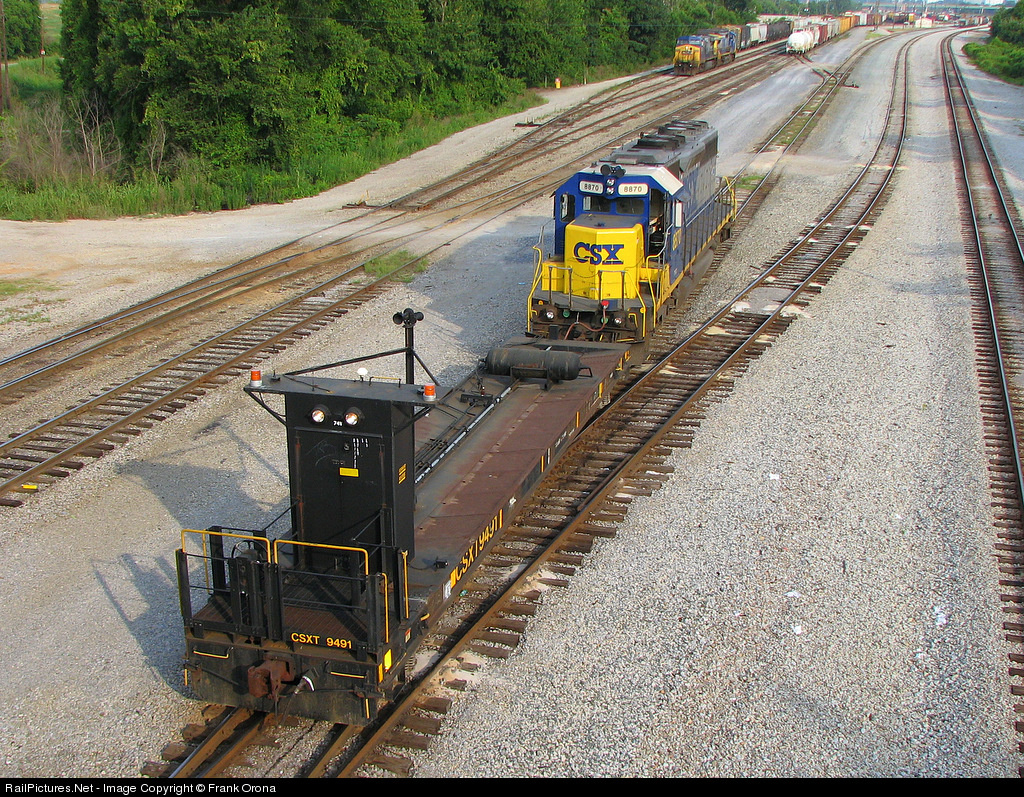
Photo from Frank Orona's Railpictures gallery
As seen by the photo above, some of the shoving platforms are pretty spartan, with barely any shelter for the trainmen. Others are ratty-looking older cabooses that have had little tender loving care over the years. Sometimes these old cabooses are gutted and welded closed, so basically only the platforms are usable.
Photo from the Cabooses of Alabama web pageThen there is the Madera Flyer. In May of 2008 I was driving between Southern California and the Bay Area and stopped at the UP's (former SP) Fresno Yard for a few minutes of casual railfanning. A lone diesel appeared, moving at a fairly fast clip with a single car and what appeared to be a bright Armour Yellow caboose in tow. While the crew started organizing a train from cars in the yard, I maneuvered for a slightly closer look.
Emblazoned on the side of a very spiffy-looking caboose that didn't seem to be of either UP or SP origin were the words "Madera Flyer". Shoving platform, indeed! In searching the web, I found Alex R.'s interesting write up of the ex-MoPac caboose and its duties. (Photos above and below are from his blog.)
Modern-day railroading has lost much of the atmosphere and character many of us strive for in our layouts. But there are still some real-life railroaders who are proud of their traditions, craft, and equipment, and it shows in examples like the Madera Flyer.
Friday, October 17, 2008
"Old" Media or "New"? The Answer is "Yes"
Model railroading media is a bit of a two-headed beast. On the one hand, many model railroaders tend to be technology-savvy. OK, let's face it, we're geeks (at least many of us). On the other hand, the hobby also attracts an older demographic that is often not as computer-friendly. So for every cry of, "Just publish everything on-line", there's an answer of "I like my paper magazines".
Personally, I don't think this is an either/or question. Certainly, circulation for all genres of printed media (not just model railroading publications) is down with the advent of the Internet. But I don't agree with those who claim that printed magazines will disappear in the next few years. And the reason I believe printed media will survive is that there is still an important difference in user experience between online media and printed publications. That difference might be described as "hunter" versus "gatherer".
In my experience, using on-line media is a hunting expedition – I'm usually looking for specific things that pique my interest. I'm not likely to read every forum posting, for example. Instead, I'll look through the topics to find the two or three that interest me and look only at those. Part of this is the sheer volume of chaff, but some of it is just the times, places, and tools that pertain when I am consuming this media (sitting in front of the screen).
Conversely, for me the printed publication lends itself to a "gatherer" approach. I'll thumb through all the pages of a magazine and linger briefly on a wider variety of topics, including some that might not otherwise interest me during a more purposeful "hunt". I can browse through a book or magazine while waiting at the dentist's office, before retiring, or while in theeuphemism. For me, this less-structured, more exploratory way of consuming media is vital: it exposes me to new ideas and different approaches I wouldn’t necessarily delve into through more directed on-line reading.
And importantly, much of the on-line material is inherently self published – there usually are no editors for web pages (more's the pity). For me, editors often add value by contributing rigor, context, and focus. I appreciate printed publications partly because most have passed through an editorial step (although sometimes with the smaller publications it's hard to tell!). I also think there's value in the structure of a book or printed magazine. The author's and editor's construction, pacing, and organization add flavor and meaning to the objective facts.
So my basic premise is that print won't die anytime soon – partly because it provides a different kind of experience (at least for those like me). What I think will happen is continued evolution of both on-line and print media in model railroading. As an example, I think Kalmbach has done a decent job of extending their Model Railroader and Trains brands into cyberspace. This is challenging for a publication that has historically depended largely on print ad revenue to survive. And make no mistake, business plan transformation is orders of magnitude tougher than the nuances of on-line fonts and formats. [As an aside, one of the major issues roiling the newspapers isn't primarily that readers are abandoning them – it's that Craigslist and eBay took the classified advertising!] Kalmbach has had some on-line stumbles along the way, but the company is miles ahead of its model railroading publication competitors. I think they have done a reasonable job of bringing some of their editing and publishing strengths to the Internet. (And it's interesting to note that as Kalmbach incorporates more ads to create a viable revenue stream online, there are complaints from users. We do want it all, and all for free, don't we?)
On the Internet side, consider Joe Fugate's new ad-supported electronic magazine, Model Railroad Hobbyist, set to premier in January. On the surface, it's a pure "new media" model. But Joe has a long history not only as a video and web technology practitioner, but also as an editor and publisher of enthusiast printed publications, both in model railroading (the LDSIG's Layout Design Journal in the late '90s) and in other fields. I think (and hope) that Joe will bring some of the editing discipline typical of the print world to his e-zine venture. In my mind, Joe has the skills and experience to build this into a unique and successful publication.
I think we'll find that the ultimate result isn't wholly either/or, on-line or print. We'll see blending and crossover. As a writer, I've got a foot planted firmly in each camp, with future articles scheduled for publication both on-line and in print. I do spend a lot of time looking at the screen … but there are times to settle down with a great printed book or magazine, too.
The Inspirational Layouts series returns in the next post.
Personally, I don't think this is an either/or question. Certainly, circulation for all genres of printed media (not just model railroading publications) is down with the advent of the Internet. But I don't agree with those who claim that printed magazines will disappear in the next few years. And the reason I believe printed media will survive is that there is still an important difference in user experience between online media and printed publications. That difference might be described as "hunter" versus "gatherer".
In my experience, using on-line media is a hunting expedition – I'm usually looking for specific things that pique my interest. I'm not likely to read every forum posting, for example. Instead, I'll look through the topics to find the two or three that interest me and look only at those. Part of this is the sheer volume of chaff, but some of it is just the times, places, and tools that pertain when I am consuming this media (sitting in front of the screen).
Conversely, for me the printed publication lends itself to a "gatherer" approach. I'll thumb through all the pages of a magazine and linger briefly on a wider variety of topics, including some that might not otherwise interest me during a more purposeful "hunt". I can browse through a book or magazine while waiting at the dentist's office, before retiring, or while in the
And importantly, much of the on-line material is inherently self published – there usually are no editors for web pages (more's the pity). For me, editors often add value by contributing rigor, context, and focus. I appreciate printed publications partly because most have passed through an editorial step (although sometimes with the smaller publications it's hard to tell!). I also think there's value in the structure of a book or printed magazine. The author's and editor's construction, pacing, and organization add flavor and meaning to the objective facts.
So my basic premise is that print won't die anytime soon – partly because it provides a different kind of experience (at least for those like me). What I think will happen is continued evolution of both on-line and print media in model railroading. As an example, I think Kalmbach has done a decent job of extending their Model Railroader and Trains brands into cyberspace. This is challenging for a publication that has historically depended largely on print ad revenue to survive. And make no mistake, business plan transformation is orders of magnitude tougher than the nuances of on-line fonts and formats. [As an aside, one of the major issues roiling the newspapers isn't primarily that readers are abandoning them – it's that Craigslist and eBay took the classified advertising!] Kalmbach has had some on-line stumbles along the way, but the company is miles ahead of its model railroading publication competitors. I think they have done a reasonable job of bringing some of their editing and publishing strengths to the Internet. (And it's interesting to note that as Kalmbach incorporates more ads to create a viable revenue stream online, there are complaints from users. We do want it all, and all for free, don't we?)
On the Internet side, consider Joe Fugate's new ad-supported electronic magazine, Model Railroad Hobbyist, set to premier in January. On the surface, it's a pure "new media" model. But Joe has a long history not only as a video and web technology practitioner, but also as an editor and publisher of enthusiast printed publications, both in model railroading (the LDSIG's Layout Design Journal in the late '90s) and in other fields. I think (and hope) that Joe will bring some of the editing discipline typical of the print world to his e-zine venture. In my mind, Joe has the skills and experience to build this into a unique and successful publication.
I think we'll find that the ultimate result isn't wholly either/or, on-line or print. We'll see blending and crossover. As a writer, I've got a foot planted firmly in each camp, with future articles scheduled for publication both on-line and in print. I do spend a lot of time looking at the screen … but there are times to settle down with a great printed book or magazine, too.
The Inspirational Layouts series returns in the next post.
Monday, September 22, 2008
Whither the NMRA National?
I've been thinking a bit lately about the NMRA National Convention concept. I've attended three now, beginning in 1996 in Long Beach, then 2005 in Cincinnati and recently this year's event in Anaheim. The NMRA National is a bit of a model railroading smorgasbord, and I tend to graze the offerings, rather than indulge in all of it.
But that still leaves a lot of activities for me during the convention. Because I operate a modest model railroad-related business, the convention offers a chance to connect with current, past, and prospective clients, although much of that can be done through other means. I enjoy catching-up with friends from distant parts of the country and globe. I've always liked layout visits, but since I'm not one for bus tours, I usually only see layouts on the Layout Design SIG self-guided tours. It's fun to offer some short layout design help sessions as part of the LDSIG's activities. And with all of these, the thing I enjoy most is presenting and attending clinics.
The Host Committee of the Los Angeles Division of the Pacific Southwest Region did a fine job of organization and I enjoyed the events and activities of the convention. I also took a brief turn around the National Train Show (held in conjunction with the convention) and saw a few interesting things, including the modular layout set-ups that are my favorite part of any train show.
I'm not well-connected with the volunteer leadership of the NMRA (now there's a thankless job!), so I am not sure what their expectations were for attendance at the convention and participation by vendors at the National Train Show. But a few people were talking about the fact that the convention was more lightly-attended than hoped and that there weren't as many vendors at the train show as hoped-for. Part of this is probably that it was held on the west coast. I've certainly heard anecdotal reports that some attendees and vendors don't like to venture west of the Mississippi. (Of course, they don't mind asking those of us who live on the west coast to make the reciprocal trek.)
In any case, some of this discussion got me to thinking about the NMRA National Convention and what I would suggest to the NMRA if they were my marketing client and my task was to increase participation in the Convention. Now I don't know if any of the things I am going to mention are even possible to change or eliminate, or if there are reasons I'm not aware of that things are the way they are. So, unburdened by the constraints the NMRA likely actually faces, I'll blithely proceed to give my observations and opinions on four main points.
The hobby has changed
First, I think the hobby has changed in a fundamental way from the time that NMRA conventions began in 1935 and even from the 1960s and 1970s. There are a vastly broader range of interests, scales, backgrounds, products, etc., etc., than even a few years ago. This specialization of the hobby means that fewer of us are doing the exact same thing. There was a time when it seemed model railroading was almost entirely slightly whimsical western layouts. Then came the HO Appalachian coal haulers.
But today, we have eye-popping variety and more information than ever to let each of us explore our personal interests within the hobby even more deeply. Not just operations, but the intricacies of Time Table and Train Order. Not just diesel modeling, but duplicating exact phases of particular locomotives at a specific time and place. Not just a general interest in western prototypes, but participation in historical societies dedicated to preserving information on the day-to-day activities of a specific real-life railroad.
The NMRA National Convention is very tentatively beginning to become a "big tent" under which a number of specific groups offer activities, such as the Layout Design and Operations Special Interest Groups, the Railroad Prototype Modelers, and others. This is a terrific change from a decade or so ago when the SIGs were seen as rivals to the NMRA (sometimes, by both sides!).
But these SIG functions are still ancillary activities, in some cases exclusively for existing members of the groups. The Convention could be a chance for the NMRA to highlight these groups and many more, better communicating the diversity in the hobby and attracting more participation though partnerships with the SIGs, historical societies, and the like. Why not work to bring the Toy Train fans, the Narrow Gaugers, the N Scalers together in some way for a "Convention of Conventions"? Bigger buzz, bigger crowds, bigger benefit for the hobby in the long term … even if each of these constituencies has to give something up in the short term.
The world has changed
Second, I think it is important to acknowledge that the world has changed. The growth of the Internet has implications for the Convention and the Train Show. With forums and email, meeting and staying in touch with like-minded model railroaders does not require a national face-to-face get-together once a year. We can instantly connect with other modelers and see images of what they are working on – even on a daily basis, if we choose. And the same is true of model railroading vendors. Even the smallest garage-shop manufacturer can put up a website for practically nothing and be accessible to modelers around the world. No need to spend the significant time and money on travel and a booth at the Train Show.
In both cases, the Internet removes some impetus for the Convention and Train Show but conversely creates a terrific tool for promotion and partnerships. I can't remember seeing a single on-line ad for Anaheim in 2008. It's a huge effort, perhaps too much for a volunteer organization, but the NMRA could do a much better job of reaching out through the Internet to the many varied constituencies to bring them together for a more engaging and interesting Convention.
The seasons change
Third, it's always seemed odd to me that the Convention and train show are held in (usually) July. July! Not only is the weather a bit unpleasant (hot and/or muggy) almost anywhere in the US in July, it is the nadir of model railroading activity for most people. Typically people's model railroading juices get flowing in the fall and through the winter. I've been given two reasons for this date. One explanation is that this allows teachers and students to attend the Convention, which takes place during the week. The other is that convention facility costs are at their lowest in the middle of summer, when most people are on vacation.
Whatever the reasoning behind the July choice, I'm pretty sure that it doesn't make sense in today's world. People are more mobile, and even teachers can take time off in the fall and winter. Yes, students would have trouble participating during the week, but who says the Convention must take place primarily Monday through Friday (see below)? And most students would be better reached through the web and other activities than a convention that very, very few of them can afford, especially when travel is included. In my opinion, the Convention should move to the fall, when general modeling interest is higher.
Time for a change?
And the fourth topic to address, perhaps the elephant in the room, is the National Train Show. The Train Show dominates Friday and the weekend, which could be the prime days for people to participate in the Convention. It seems to me that the Train Show is the tail wagging the Convention dog. Now it may be that the fees the vendors pay to exhibit at the train show are an important component of the NMRA's operating budget, so maybe you gotta dance with the one that brung ya.
From its website, the National Train Show describes itself thusly: "The show's only purpose is to promote the hobby in a professional manner, to the hobby industry and to the public at large." Is this a mission that should still be carried out as a commercial show? Couldn't that be, indeed, shouldn't that be, the purpose of the Convention? Should the NMRA with its Train Show be in competition with the other train shows around the country?
What would be the best use of the weekend of the Convention, if the goal is to increase the hobby? Wouldn't it be to put the best parts of the Convention into these prime hours, when more can attend? Aren't there enough other opportunities for manufacturers to communicate with the trade through the Internet, the annual iHobby Expo (Rosemont) Show, and other venues? And aren't there plenty of opportunities for manufacturers to communicate to their customers though magazine ads, the Internet, and the multitude of other train shows that have sprung up in the last decade or two? The National Train Show only dates to 1988 and I don't know what preceded it. But I wonder if it isn't time to consider its relationship with the Convention and make some changes.
It won't change overnight
I recognize there is plenty of inertia to keep things as they are and I am not naive enough to think that this blog entry will change them. But even small steps toward creating a "bigger tent" of partnerships, using the Internet more effectively, changing to a more appropriate date, and considering how better to use the weekend days for the Convention itself could pay dividends. I've enjoyed my three NMRA National Conventions so far and hope to enjoy many more. These changes might make it attractive for many more to enjoy the Convention as well.
Thanks for reading all the way through. The Inspirational Layouts series will return in the next post.
But that still leaves a lot of activities for me during the convention. Because I operate a modest model railroad-related business, the convention offers a chance to connect with current, past, and prospective clients, although much of that can be done through other means. I enjoy catching-up with friends from distant parts of the country and globe. I've always liked layout visits, but since I'm not one for bus tours, I usually only see layouts on the Layout Design SIG self-guided tours. It's fun to offer some short layout design help sessions as part of the LDSIG's activities. And with all of these, the thing I enjoy most is presenting and attending clinics.
The Host Committee of the Los Angeles Division of the Pacific Southwest Region did a fine job of organization and I enjoyed the events and activities of the convention. I also took a brief turn around the National Train Show (held in conjunction with the convention) and saw a few interesting things, including the modular layout set-ups that are my favorite part of any train show.
I'm not well-connected with the volunteer leadership of the NMRA (now there's a thankless job!), so I am not sure what their expectations were for attendance at the convention and participation by vendors at the National Train Show. But a few people were talking about the fact that the convention was more lightly-attended than hoped and that there weren't as many vendors at the train show as hoped-for. Part of this is probably that it was held on the west coast. I've certainly heard anecdotal reports that some attendees and vendors don't like to venture west of the Mississippi. (Of course, they don't mind asking those of us who live on the west coast to make the reciprocal trek.)
In any case, some of this discussion got me to thinking about the NMRA National Convention and what I would suggest to the NMRA if they were my marketing client and my task was to increase participation in the Convention. Now I don't know if any of the things I am going to mention are even possible to change or eliminate, or if there are reasons I'm not aware of that things are the way they are. So, unburdened by the constraints the NMRA likely actually faces, I'll blithely proceed to give my observations and opinions on four main points.
The hobby has changed
First, I think the hobby has changed in a fundamental way from the time that NMRA conventions began in 1935 and even from the 1960s and 1970s. There are a vastly broader range of interests, scales, backgrounds, products, etc., etc., than even a few years ago. This specialization of the hobby means that fewer of us are doing the exact same thing. There was a time when it seemed model railroading was almost entirely slightly whimsical western layouts. Then came the HO Appalachian coal haulers.
But today, we have eye-popping variety and more information than ever to let each of us explore our personal interests within the hobby even more deeply. Not just operations, but the intricacies of Time Table and Train Order. Not just diesel modeling, but duplicating exact phases of particular locomotives at a specific time and place. Not just a general interest in western prototypes, but participation in historical societies dedicated to preserving information on the day-to-day activities of a specific real-life railroad.
The NMRA National Convention is very tentatively beginning to become a "big tent" under which a number of specific groups offer activities, such as the Layout Design and Operations Special Interest Groups, the Railroad Prototype Modelers, and others. This is a terrific change from a decade or so ago when the SIGs were seen as rivals to the NMRA (sometimes, by both sides!).
But these SIG functions are still ancillary activities, in some cases exclusively for existing members of the groups. The Convention could be a chance for the NMRA to highlight these groups and many more, better communicating the diversity in the hobby and attracting more participation though partnerships with the SIGs, historical societies, and the like. Why not work to bring the Toy Train fans, the Narrow Gaugers, the N Scalers together in some way for a "Convention of Conventions"? Bigger buzz, bigger crowds, bigger benefit for the hobby in the long term … even if each of these constituencies has to give something up in the short term.
The world has changed
Second, I think it is important to acknowledge that the world has changed. The growth of the Internet has implications for the Convention and the Train Show. With forums and email, meeting and staying in touch with like-minded model railroaders does not require a national face-to-face get-together once a year. We can instantly connect with other modelers and see images of what they are working on – even on a daily basis, if we choose. And the same is true of model railroading vendors. Even the smallest garage-shop manufacturer can put up a website for practically nothing and be accessible to modelers around the world. No need to spend the significant time and money on travel and a booth at the Train Show.
In both cases, the Internet removes some impetus for the Convention and Train Show but conversely creates a terrific tool for promotion and partnerships. I can't remember seeing a single on-line ad for Anaheim in 2008. It's a huge effort, perhaps too much for a volunteer organization, but the NMRA could do a much better job of reaching out through the Internet to the many varied constituencies to bring them together for a more engaging and interesting Convention.
The seasons change
Third, it's always seemed odd to me that the Convention and train show are held in (usually) July. July! Not only is the weather a bit unpleasant (hot and/or muggy) almost anywhere in the US in July, it is the nadir of model railroading activity for most people. Typically people's model railroading juices get flowing in the fall and through the winter. I've been given two reasons for this date. One explanation is that this allows teachers and students to attend the Convention, which takes place during the week. The other is that convention facility costs are at their lowest in the middle of summer, when most people are on vacation.
Whatever the reasoning behind the July choice, I'm pretty sure that it doesn't make sense in today's world. People are more mobile, and even teachers can take time off in the fall and winter. Yes, students would have trouble participating during the week, but who says the Convention must take place primarily Monday through Friday (see below)? And most students would be better reached through the web and other activities than a convention that very, very few of them can afford, especially when travel is included. In my opinion, the Convention should move to the fall, when general modeling interest is higher.
Time for a change?
And the fourth topic to address, perhaps the elephant in the room, is the National Train Show. The Train Show dominates Friday and the weekend, which could be the prime days for people to participate in the Convention. It seems to me that the Train Show is the tail wagging the Convention dog. Now it may be that the fees the vendors pay to exhibit at the train show are an important component of the NMRA's operating budget, so maybe you gotta dance with the one that brung ya.
From its website, the National Train Show describes itself thusly: "The show's only purpose is to promote the hobby in a professional manner, to the hobby industry and to the public at large." Is this a mission that should still be carried out as a commercial show? Couldn't that be, indeed, shouldn't that be, the purpose of the Convention? Should the NMRA with its Train Show be in competition with the other train shows around the country?
What would be the best use of the weekend of the Convention, if the goal is to increase the hobby? Wouldn't it be to put the best parts of the Convention into these prime hours, when more can attend? Aren't there enough other opportunities for manufacturers to communicate with the trade through the Internet, the annual iHobby Expo (Rosemont) Show, and other venues? And aren't there plenty of opportunities for manufacturers to communicate to their customers though magazine ads, the Internet, and the multitude of other train shows that have sprung up in the last decade or two? The National Train Show only dates to 1988 and I don't know what preceded it. But I wonder if it isn't time to consider its relationship with the Convention and make some changes.
It won't change overnight
I recognize there is plenty of inertia to keep things as they are and I am not naive enough to think that this blog entry will change them. But even small steps toward creating a "bigger tent" of partnerships, using the Internet more effectively, changing to a more appropriate date, and considering how better to use the weekend days for the Convention itself could pay dividends. I've enjoyed my three NMRA National Conventions so far and hope to enjoy many more. These changes might make it attractive for many more to enjoy the Convention as well.
Thanks for reading all the way through. The Inspirational Layouts series will return in the next post.
Friday, January 11, 2008
Marketing Math
What kind of a bizarre parallel universe is it where 7 is greater than 117? 23 greater than 1500? 7 months longer than 10 years? Wherever that strange universe may be, it's apparently where model railroad product managers dwell. How else to explain the recent decisions by Athearn and Atlas to develop new HO scale models of the GP‑40X and RS‑36 respectively, but not to offer the Alco S‑2/4 in N scale?
For those trying to keep score at home, here's how it breaks down. A mere seven railroads purchased RS‑36s new, compared with 117 who bought S‑2s. And with the resale market, there might be another 100 or more prototypes that rostered S‑2s at some time.
The GP‑40X sold even more poorly in the real world -- a mere 23 units vs. over 1500 S‑2s. And the GP‑40X's ephemeral production span of seven months does not compare favorably with the S‑2's ten-year production run. (Throw in the similar S‑4 and that expands to 21 years -- about 36 times longer than the GP-40X!)
So how can tooling-up and producing these new HO models of pretty rare prototypes be seen as a better business decision than releasing a quality S‑2 in N scale*? HO chauvinists will point to the smaller market for N scale. OK, maybe … but here's where the math gets interesting. If a recent survey by a model railroading market participant is correct, there are about 2.79 times more HO scale buyers than N scale buyers. Let's give HO'ers the benefit of the doubt and round up to three.
OK, now let's apply this to the numbers above. If there were 1500 real-life S‑2s produced versus 23 GP‑40Xs (and we apply the 3X HO vs. N ratio), the market for N scale S-2s is a whopping 2000%+ larger. But maybe numbers produced isn't the best measure. OK, let's take number of road names for the marginally more successful of the two prototypes, the RS‑36. If 117 prototype railroads bought S‑2s new and just 7 bought RS‑36s (and remembering to apply the 3-to-1 HO market size advantage), the N scale S‑2 market size is still more than 500% greater than is the HO scale RS‑36 market size. That's even before considering the many hand-me-down owners of S‑2s over the years.
Yes, I understand that bringing out a new model requires more than just the tooling for a new body shell: the availability of an appropriate drive train and chassis is also a factor. And the S‑2 is a physically small model in N scale (though not smaller than Kato's recent successful N scale NW‑2), increasing the design challenge.
Estimating market sizes is difficult. I often make market estimates for my technology marketing consulting clients and there are always uncertainties. But a 500% to 2000% larger market potential seems like a pretty straightforward decision to me. Why do model railroad manufacturers stubbornly leave this money on the table? You'll have to ask them -- and I hope that you do.
*No, I haven’t forgotten about the old Arnold S‑2 (although I'd like to). But these are of very old design, suffer from cracked gears, and most samples run like rusty meat-grinders. No offense to the meat-grinders. I have one of these in custom SP paint that has had hours of custom care and rebuilding by an expert. It still runs like a train-set Tyco. And even that's a huge improvement over the out-of-the-box performance.
For those trying to keep score at home, here's how it breaks down. A mere seven railroads purchased RS‑36s new, compared with 117 who bought S‑2s. And with the resale market, there might be another 100 or more prototypes that rostered S‑2s at some time.
The GP‑40X sold even more poorly in the real world -- a mere 23 units vs. over 1500 S‑2s. And the GP‑40X's ephemeral production span of seven months does not compare favorably with the S‑2's ten-year production run. (Throw in the similar S‑4 and that expands to 21 years -- about 36 times longer than the GP-40X!)
So how can tooling-up and producing these new HO models of pretty rare prototypes be seen as a better business decision than releasing a quality S‑2 in N scale*? HO chauvinists will point to the smaller market for N scale. OK, maybe … but here's where the math gets interesting. If a recent survey by a model railroading market participant is correct, there are about 2.79 times more HO scale buyers than N scale buyers. Let's give HO'ers the benefit of the doubt and round up to three.
OK, now let's apply this to the numbers above. If there were 1500 real-life S‑2s produced versus 23 GP‑40Xs (and we apply the 3X HO vs. N ratio), the market for N scale S-2s is a whopping 2000%+ larger. But maybe numbers produced isn't the best measure. OK, let's take number of road names for the marginally more successful of the two prototypes, the RS‑36. If 117 prototype railroads bought S‑2s new and just 7 bought RS‑36s (and remembering to apply the 3-to-1 HO market size advantage), the N scale S‑2 market size is still more than 500% greater than is the HO scale RS‑36 market size. That's even before considering the many hand-me-down owners of S‑2s over the years.
Yes, I understand that bringing out a new model requires more than just the tooling for a new body shell: the availability of an appropriate drive train and chassis is also a factor. And the S‑2 is a physically small model in N scale (though not smaller than Kato's recent successful N scale NW‑2), increasing the design challenge.
Estimating market sizes is difficult. I often make market estimates for my technology marketing consulting clients and there are always uncertainties. But a 500% to 2000% larger market potential seems like a pretty straightforward decision to me. Why do model railroad manufacturers stubbornly leave this money on the table? You'll have to ask them -- and I hope that you do.
*No, I haven’t forgotten about the old Arnold S‑2 (although I'd like to). But these are of very old design, suffer from cracked gears, and most samples run like rusty meat-grinders. No offense to the meat-grinders. I have one of these in custom SP paint that has had hours of custom care and rebuilding by an expert. It still runs like a train-set Tyco. And even that's a huge improvement over the out-of-the-box performance.
Tuesday, August 21, 2007
A pleasant surprise
 I've written quite a bit in my life: marketing and business plans, technical documentation, ad copy, articles on technology, ghost-written book chapters, even the odd model railroading article. But it was a neat surprise to open my copy of Model Railroader's How to Build Realistic Layouts: Freight Yards special issue this week. Obviously, I knew what my article "A Baker's Dozen Yard Ideas" would include -- I wrote the text and prepared some of the rough illustrations. But Andy Sperandeo and the folks at Kalmbach matched up portions of the text with file photography and new illustrations that added a lot to the piece. It's rare that I write something and feel that the final result is significantly better or more engaging than what I submitted, but in this case, it surely was.
The rest of the magazine is pretty interesting, too. I don't know if these special more-than-a-magazine-not-quite-a-book issues sell well from a marketing standpoint. But it was a real pleasure to see my work showcased in this one.
(Parenthetically, I have also been a bit surprised that a few folks don't seem to know that a "baker's dozen" is thirteen. When I was a kid, it was common for one additional donut or other baked treat to be included when a dozen of the same item was purchased (this carries on for donuts at our local purveyor). In this era of pre-packaged foods (and healthier eating!), perhaps it's not surprising that the phrase is less well-known. Interestingly, the baker's dozen seems to have originated in England out of a fear of penalties for selling a customer short.)
Friday, July 06, 2007
"Every day, in every way ...
… I'm getting better and better." Interesting aphorism, huh? Has sort of a '60s-'70s vibe, like "Have a nice day" and "I'm OK, you're OK". But in fact the saying and the concept are quite old, as I learned while re-reading a favorite book, The Lying Stones of Marrakech by the late paleontologist and essayist Stephen Jay Gould*. This self-help concept was developed in the 1920s by French physician Emile Coué, who found that patients who repeated this positive phrase daily along with receiving medication did better than those who received only medication.
Gould contrasted Coué's idea of incremental day-to-day improvements with the history of science, which tends to develop in discontinuous "bursts". Interesting how model railroad projects seem to benefit from both types of development: the half-hour-a-day squeezed out of a busy schedule as well as the multi-day building binge. (The latter usually in response to some sort of external deadline.)
Hopefully you're doing better at both the "every day, in every way" projects and the "big burst" projects than I've been able to manage recently. But the decks are reasonably clear this weekend, so I hope to make some progress. I'll let you know.
*Besides being a ground-breaking scientist and one of the best essayists in history, Gould was also distantly related to the railroading Goulds, Jay and George Jay, whose robber-baron efforts helped shape the railroad landscape of the late 19th- and early 20th century. Arguably, it's train related.
 While building benchwork in the garage I've been listening to some older CDs that provide the right kind of intensity for the task. A fun re-discovery was Living Colour's 1988 album Vivid. Heavy guitar riffs, powerful vocals, and a solid funk-infused rhythm section. The group disbanded in 1995, but apparently has reformed for some concerts recently. Always one of my favorite music videos, although the late-'80s fashions are a tad dated (who would have dreamed Body Glove shorty jumpsuits weren't going to take off in the mainstream?)
Gould contrasted Coué's idea of incremental day-to-day improvements with the history of science, which tends to develop in discontinuous "bursts". Interesting how model railroad projects seem to benefit from both types of development: the half-hour-a-day squeezed out of a busy schedule as well as the multi-day building binge. (The latter usually in response to some sort of external deadline.)
Hopefully you're doing better at both the "every day, in every way" projects and the "big burst" projects than I've been able to manage recently. But the decks are reasonably clear this weekend, so I hope to make some progress. I'll let you know.
*Besides being a ground-breaking scientist and one of the best essayists in history, Gould was also distantly related to the railroading Goulds, Jay and George Jay, whose robber-baron efforts helped shape the railroad landscape of the late 19th- and early 20th century. Arguably, it's train related.
 While building benchwork in the garage I've been listening to some older CDs that provide the right kind of intensity for the task. A fun re-discovery was Living Colour's 1988 album Vivid. Heavy guitar riffs, powerful vocals, and a solid funk-infused rhythm section. The group disbanded in 1995, but apparently has reformed for some concerts recently. Always one of my favorite music videos, although the late-'80s fashions are a tad dated (who would have dreamed Body Glove shorty jumpsuits weren't going to take off in the mainstream?)
Wednesday, June 20, 2007
The (slightly) intentional railfan
A few months ago I wrote about my "accidental railfan" trip along the joint UP/BNSF Tehachapi crossing. As you may recall, I was not well prepared: no camera; less-than-interested car mates; etc.
Well, I had the chance to travel through the area again and especially since I am working on a design that features the area, I thought I would be a little more serious this time. OK, but not too serious. It seems the family needed the digital while I was gone, so I bravely set out with an old film snapshot camera. First stop on the way down to So Cal: Caliente, a key element on the layout project.
After getting my bearings, a quick look around and I spy a decent spot to get a bird's-eye view. Climb up the hill and I hear flanges squealing. Real railfans go out all day and never see a thing; I bumble onto a train in the first five minutes. Oh yeah, and the camera's down in the car. Nuts! It was great though, you shoulda seen it.
 Anyway, I realize this mixed BNSF manifest is on its way toward the Loop … and as it happens, so am I! Back in the car, return to the Freeway and jump off again at Keene, wind along down to Tunnel 9 on the famous Loop. This time I take the camera with me. The sun is on its way down, so there won't be a long wait one way or the other -- either a train will arrive or it will be dark. But soon enough I hear airhorns in the distance.
 In the late afternoon light the same train I saw in Caliente is curving around the entrance to Tunnel #9 and the Loop. Quick photo or two and a friendly (I hope) horn blast from the engineer startles me as BNSF Techno-Toaster 4868 wheels its train of reefers, tankcars and coal or coke hoppers around the Loop. Oh, yeah, and I took the requisite crossover shot. OK, I'm still not sure I'm cut out to be a modern day railfan, but that was pretty neat.
 On the return leg to the bay area, I decide to be a little more organized about this. With a photo or two at the Loop already in the camera, I want to focus on some other areas. Couple of quick photos in Mojave to capture some neat things that might not be there for long (like the sign at White's Motel) and I see a BNSF train headed out of town toward Tehachapi. It's not often that I have seen a loco defaced with graffiti, but this GP-35 has received a vandal's unwanted attention.
On up over Tehachapi on a beautiful spring Sunday (mid-May). Returning to Caliente, I drive around for a few establishing shots that I need for the track plan. I was surprised to see a few cars parked at the (closed on Sunday) Post Office and a couple of guys standing around talking. Locals, I guess -- maybe this passes for an outing in Caliente on a Sunday afternoon.
Then I head just outside of town to my vantage point from a few days before. OK, this is a pleasant afternoon eating a sandwich the Moms packed in the shade of an old oak, but this railfanning outing seems to be more like a solitary picnic sans train. (Yes, I'm a wimp -- I did say I was only a slightly intentional railfan.)
 But then, airhorns. A BNSF TOFC (Trailer on Flatcar) train is working its way into Caliente. I catch it across the valley as it pulls in from the site of the former Tunnel #1/2. Soon the full train is laid out around the curve as BNSF 4597 rolls by my sidehill perch.
 Just after the train pulls out of town, I start to do the same. Roaring past me at the intersection are the three cars that were parked at the Post Office. Railfans! (The intentional variety, no doubt.) From the layout design project, I know the BSNF train is headed to Bealeville, which I'll cross on the road out of Caliente.
 The more serious railfans are long out of sight as I wind up the hill to Bealeville. When I arrive, they are nowhere to be found, until I look up on the nearby hills where they have perched, tripods at the ready. Within minutes, the TOFC train we saw in Caliente has arrived, stopped, and dimmed its headlight. And in the other direction comes the same mixed consist I had seen earlier departing Mojave. This quick photo of the resulting Bealeville meet was the last on that roll of film, so my railfan excursion had come to an end. (My more serious railfanning comrades raced off to parts unknown to bag their next ream of images.)
All in all, a lot of luck, some very pleasant time spent in pretty country, useful research for my client's project, and a few photos to remember it all by. Not bad for a somewhat-less-accidental railfan …
Thanks for visiting, click here to see the latest posts
 Currently listening to Appalachia Waltz by Yo-Yo Ma, Edgar Meyer, and Mark O'Conner. This instrumental music has a timeless, evocative, instantly nostalgic feel that really needs no description except to say that it is truly beautiful.
Well, I had the chance to travel through the area again and especially since I am working on a design that features the area, I thought I would be a little more serious this time. OK, but not too serious. It seems the family needed the digital while I was gone, so I bravely set out with an old film snapshot camera. First stop on the way down to So Cal: Caliente, a key element on the layout project.
After getting my bearings, a quick look around and I spy a decent spot to get a bird's-eye view. Climb up the hill and I hear flanges squealing. Real railfans go out all day and never see a thing; I bumble onto a train in the first five minutes. Oh yeah, and the camera's down in the car. Nuts! It was great though, you shoulda seen it.
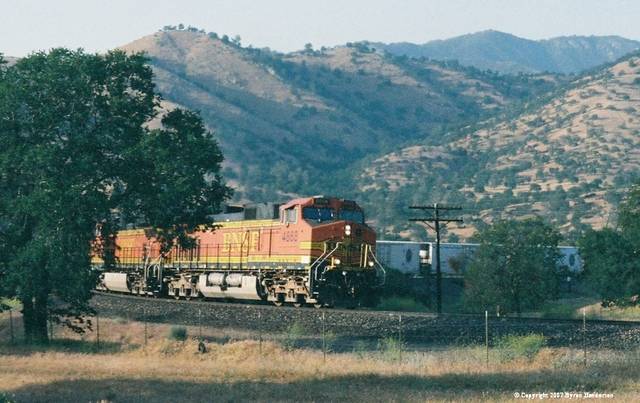 Anyway, I realize this mixed BNSF manifest is on its way toward the Loop … and as it happens, so am I! Back in the car, return to the Freeway and jump off again at Keene, wind along down to Tunnel 9 on the famous Loop. This time I take the camera with me. The sun is on its way down, so there won't be a long wait one way or the other -- either a train will arrive or it will be dark. But soon enough I hear airhorns in the distance.
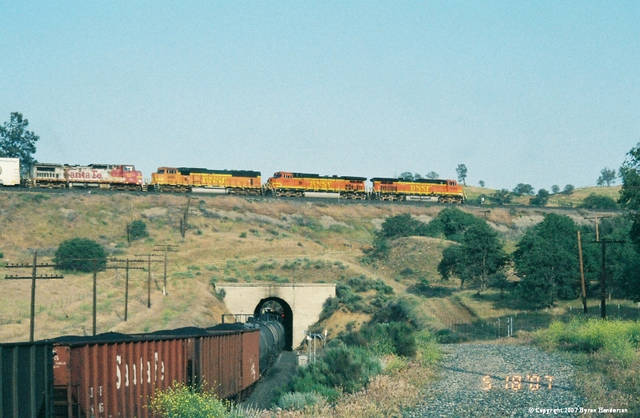 In the late afternoon light the same train I saw in Caliente is curving around the entrance to Tunnel #9 and the Loop. Quick photo or two and a friendly (I hope) horn blast from the engineer startles me as BNSF Techno-Toaster 4868 wheels its train of reefers, tankcars and coal or coke hoppers around the Loop. Oh, yeah, and I took the requisite crossover shot. OK, I'm still not sure I'm cut out to be a modern day railfan, but that was pretty neat.
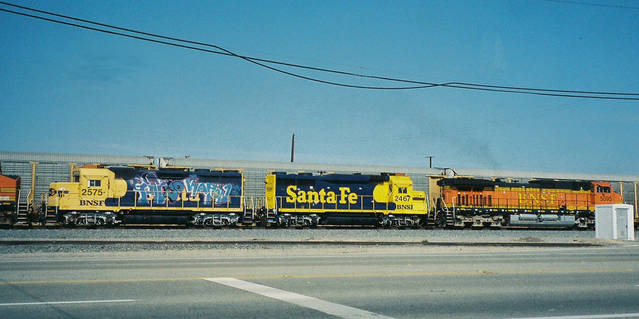 On the return leg to the bay area, I decide to be a little more organized about this. With a photo or two at the Loop already in the camera, I want to focus on some other areas. Couple of quick photos in Mojave to capture some neat things that might not be there for long (like the sign at White's Motel) and I see a BNSF train headed out of town toward Tehachapi. It's not often that I have seen a loco defaced with graffiti, but this GP-35 has received a vandal's unwanted attention.
On up over Tehachapi on a beautiful spring Sunday (mid-May). Returning to Caliente, I drive around for a few establishing shots that I need for the track plan. I was surprised to see a few cars parked at the (closed on Sunday) Post Office and a couple of guys standing around talking. Locals, I guess -- maybe this passes for an outing in Caliente on a Sunday afternoon.
Then I head just outside of town to my vantage point from a few days before. OK, this is a pleasant afternoon eating a sandwich the Moms packed in the shade of an old oak, but this railfanning outing seems to be more like a solitary picnic sans train. (Yes, I'm a wimp -- I did say I was only a slightly intentional railfan.)
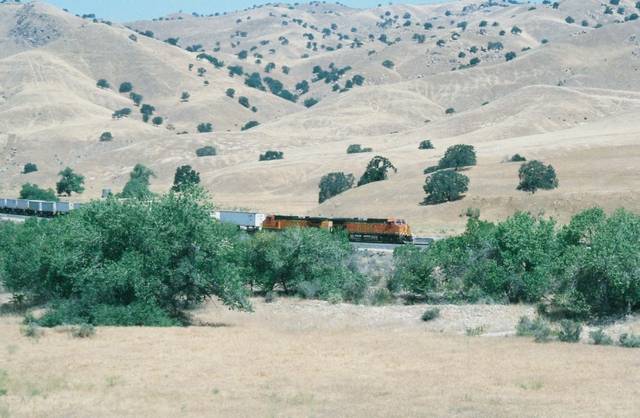 But then, airhorns. A BNSF TOFC (Trailer on Flatcar) train is working its way into Caliente. I catch it across the valley as it pulls in from the site of the former Tunnel #1/2. Soon the full train is laid out around the curve as BNSF 4597 rolls by my sidehill perch.
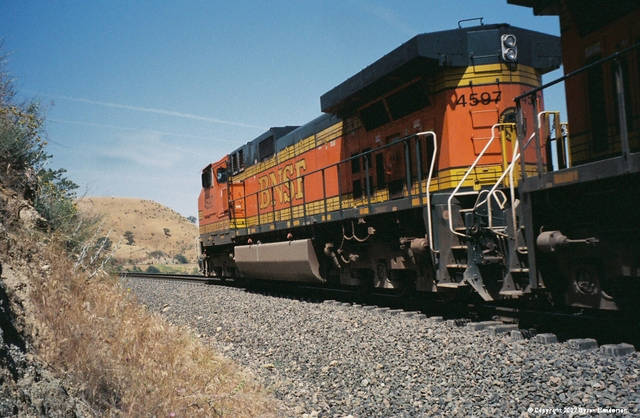 Just after the train pulls out of town, I start to do the same. Roaring past me at the intersection are the three cars that were parked at the Post Office. Railfans! (The intentional variety, no doubt.) From the layout design project, I know the BSNF train is headed to Bealeville, which I'll cross on the road out of Caliente.
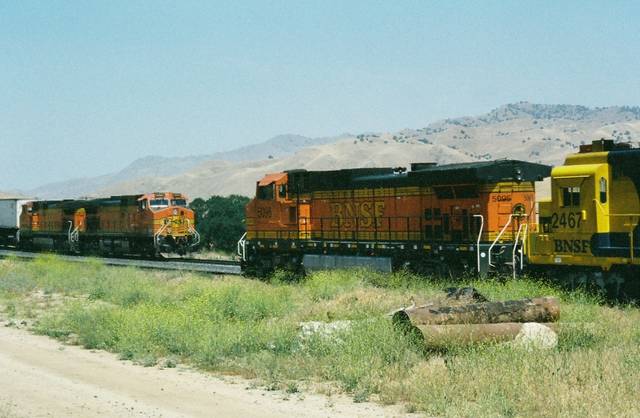 The more serious railfans are long out of sight as I wind up the hill to Bealeville. When I arrive, they are nowhere to be found, until I look up on the nearby hills where they have perched, tripods at the ready. Within minutes, the TOFC train we saw in Caliente has arrived, stopped, and dimmed its headlight. And in the other direction comes the same mixed consist I had seen earlier departing Mojave. This quick photo of the resulting Bealeville meet was the last on that roll of film, so my railfan excursion had come to an end. (My more serious railfanning comrades raced off to parts unknown to bag their next ream of images.)
All in all, a lot of luck, some very pleasant time spent in pretty country, useful research for my client's project, and a few photos to remember it all by. Not bad for a somewhat-less-accidental railfan …
Thanks for visiting, click here to see the latest posts
 Currently listening to Appalachia Waltz by Yo-Yo Ma, Edgar Meyer, and Mark O'Conner. This instrumental music has a timeless, evocative, instantly nostalgic feel that really needs no description except to say that it is truly beautiful.
Monday, June 11, 2007
Big Little News, Little Big News
There are certainly more products available than ever in model railroading. This is true in all scales (OK, except maybe TT), but I pay the most attention to N scale announcements. I found it interesting that two recent announcements were at more-or-less opposite ends of the scale. Kato's NW-2 and Athearn's Challenger.
Beginning with the latter, what is it with Challengers and Big Boys? What are there, four Big Boys in production in HO now? Athearn's N scale Challenger has been reasonably well-reviewed and comes with on-board sound. Of course, most N scale layouts lack the 16" or larger radii required for this monster to really look good ... and it's out of place on all but a few layouts set in relatively narrow eras (UP, D&RGW, Clinchfield). Obviously, a big engine is interesting as a novelty, to a collector, or to someone who operates an eclectic motive power fleet.
 Currently listening to The Derek Trucks Band's Joyful Noise. What a pedigree this guy has. Joined the Allman Brothers in his 20s, recently toured with Eric Clapton, married to blues artist Susan Tedeschi. This album is jazz, rock, blues, fusion, afro/cuban ... a little of everything with a southern rock thing bubbling to the top every so often. Great listening for something different.
Beginning with the latter, what is it with Challengers and Big Boys? What are there, four Big Boys in production in HO now? Athearn's N scale Challenger has been reasonably well-reviewed and comes with on-board sound. Of course, most N scale layouts lack the 16" or larger radii required for this monster to really look good ... and it's out of place on all but a few layouts set in relatively narrow eras (UP, D&RGW, Clinchfield). Obviously, a big engine is interesting as a novelty, to a collector, or to someone who operates an eclectic motive power fleet.
On the other hand, the prototype for Kato's NW-2 sold over 1,100 copies, probably ten times the number of units and at least that many more prototype RRs than the Challenger. These operated for decades, sometimes as used units with a wide variety of later owners. The NW-2 could be found on terminal operations and on Class 1s. The model is only available in three or four liveries so far, but more will likely be added. The little switcher runs great, truly amazing for its size, and operates on 9 3/4" radius curves, making it suitable for the vast majority of N scale layouts.
So which do you think got more play in the model press? And which do you think I believe is more useful to most of us? The answers are in the title of this blog entry.
 Currently listening to The Derek Trucks Band's Joyful Noise. What a pedigree this guy has. Joined the Allman Brothers in his 20s, recently toured with Eric Clapton, married to blues artist Susan Tedeschi. This album is jazz, rock, blues, fusion, afro/cuban ... a little of everything with a southern rock thing bubbling to the top every so often. Great listening for something different.
Wednesday, December 27, 2006
Notes from an accidental railfan
I hope everyone is having a pleasant holiday season. While returning from our Christmas visit to the ancestral homeland in Southern California, I had the chance to do a little accidental railfanning.
I grew up in Palmdale, less than a half mile from the SP (now UP) line from L.A. over Tehachapi *. As a kid, I often listened in the night to the passing trains blowing their horns for the crossings of Sierra Highway and Avenue P (yep, just a letter). During the summer we'd ride bikes into town and sometimes wait at the Sierra Highway crossing for a train to pass.
Then, as now, I wasn't much of a railfan. I do enjoy seeing real trains in their natural environment, but I generally have spent my hobby time in other ways. So much of what I like about railroading has passed out of existence that railfanning today's rail scenes doesn't generally hold a lot of interest.
But I thought it might be neat to travel home from Palmdale to the Bay Area along a different route than our usual path up Interstate 5. And what better path to take than to follow the passing trains to Tehachapi? (Sorry, no pictures, just words -- remember, I'm an accidental railfan. But here are some others on the web.)
We started out on Highway 14, which quickly leads to Mojave. Now made more famous by Pelle Søeborg's articles in the model press, Mojave is a bit grittier and larger than suggested by his well-done layout. Most of the neat railroad buildings of my youth are gone, but the small yard was full of UP and BNSF trains, including some Norfolk Southern run-through power in a BNSF consist. The yard may have been more crowded than usual since we were traveling the day after Christmas.
Turning onto Highway 58, we were treated to our first train, running Westbound (roughly compass Northwest) through the sweeping curve near Warren. Double stacks and trailers-on-flatcars, with a four engine head-end consist including three different variations of the disappointing (in my view) orange and green BNSF livery and one glorious Santa Fe super fleet unit still in silver-and-red warbonnet. (Nope, still no photos)
The big cement plant at Monolith (others' photos here and here) provided the opportunity for me to share details of its history and function with my wife and daughter, whose complete silence indicated their rapt attention. Or not.
Through Tehachapi, we passed another BNSF train of stacks and pigs, again Westbound. Near the fabled loop at Walong, a very long UP train auto carrier train came into view, including some of the giant "Auto Max" cars I had not seen before in real life. Armour Yellow everywhere, no heritage power on this high-priority movement. And yet another Westbound UP container train just beyond the loop. A great show on a beautiful clear day. Since I am working on a design project right now that includes the loop, it was fun to have a reminder of how spectacular the area is in real life.
Eastbounds were in the hole all along the way -- obviously the Dispatcher was fleeting the Westbounds to get things moving on this day after the holiday.
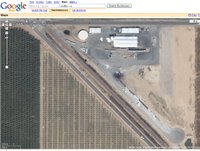 A quick stop for lunch in Bakersfield (geez, those Happy Meals are sure an effective marketing gimmick!), then over the (compass) west end of the former ATSF yard. As we were working our way across the San Joaquin Valley on 7th Standard Road, we encountered the neat small industry (shown at left in a view from Google Maps) along the former ATSF line south of Shafter. This is a place called "Crome" by the Santa Fe, and "Hights Corner" on other maps.
I don't happen to have the Santa Fe CLIC Book for this area and my auto mates didn't seem so keen on a stop, so I'm not sure what industry is located here now, but there was still rail activity. Definitely a modelgenic size and the angled intersection of the streets and rail lines made for an interesting configuration. There also seems to be a bulk unloading facility running along the aptly-named "Santa Fe Way" road slanting from top-left to bottom-right in the view.
Our travels then took us briefly on Interstate 5 until we could leave the hordes behind for a scenic jaunt through Coalinga (no search there for remnants of the SP, though) and on to the west on Highway 198. Just before joining Highway 101, I took a side trip through the burg of San Lucas on the former SP Coast Line. A large concrete elevator had attracted my eye in the past, but the industry seems now dormant. One forlorn and rusty covered hopper was spotted at another industry in town, so perhaps there is still some rail activity here.
Night and the rain began falling at about the same time, so that put an end to even my (very) casual railfanning. With relatives and friends in So Cal, I've traveled from north to south and back again many times in the past. I've sometimes focused on areas along the way that represented specific modeling interests, like the SP/ATSF Sunset Railway and the route of my proto-freelanced Midland Pacific. But my experience this week suggests that maybe I should have a slightly more open mind on my next trip …. and get out the camera! That is, for any trip I make without my family of reluctant railfans.
*For more on railroads in the Antelope Valley, I recommend Phil Serpico's book Railroading through the Antelope Valley. John Signor's fabulous Tehachapi book, along with Serpico's, gave me a real appreciation for what was passing by through those years of my youth.
I grew up in Palmdale, less than a half mile from the SP (now UP) line from L.A. over Tehachapi *. As a kid, I often listened in the night to the passing trains blowing their horns for the crossings of Sierra Highway and Avenue P (yep, just a letter). During the summer we'd ride bikes into town and sometimes wait at the Sierra Highway crossing for a train to pass.
Then, as now, I wasn't much of a railfan. I do enjoy seeing real trains in their natural environment, but I generally have spent my hobby time in other ways. So much of what I like about railroading has passed out of existence that railfanning today's rail scenes doesn't generally hold a lot of interest.
But I thought it might be neat to travel home from Palmdale to the Bay Area along a different route than our usual path up Interstate 5. And what better path to take than to follow the passing trains to Tehachapi? (Sorry, no pictures, just words -- remember, I'm an accidental railfan. But here are some others on the web.)
We started out on Highway 14, which quickly leads to Mojave. Now made more famous by Pelle Søeborg's articles in the model press, Mojave is a bit grittier and larger than suggested by his well-done layout. Most of the neat railroad buildings of my youth are gone, but the small yard was full of UP and BNSF trains, including some Norfolk Southern run-through power in a BNSF consist. The yard may have been more crowded than usual since we were traveling the day after Christmas.
Turning onto Highway 58, we were treated to our first train, running Westbound (roughly compass Northwest) through the sweeping curve near Warren. Double stacks and trailers-on-flatcars, with a four engine head-end consist including three different variations of the disappointing (in my view) orange and green BNSF livery and one glorious Santa Fe super fleet unit still in silver-and-red warbonnet. (Nope, still no photos)
The big cement plant at Monolith (others' photos here and here) provided the opportunity for me to share details of its history and function with my wife and daughter, whose complete silence indicated their rapt attention. Or not.
Through Tehachapi, we passed another BNSF train of stacks and pigs, again Westbound. Near the fabled loop at Walong, a very long UP train auto carrier train came into view, including some of the giant "Auto Max" cars I had not seen before in real life. Armour Yellow everywhere, no heritage power on this high-priority movement. And yet another Westbound UP container train just beyond the loop. A great show on a beautiful clear day. Since I am working on a design project right now that includes the loop, it was fun to have a reminder of how spectacular the area is in real life.
Eastbounds were in the hole all along the way -- obviously the Dispatcher was fleeting the Westbounds to get things moving on this day after the holiday.
 A quick stop for lunch in Bakersfield (geez, those Happy Meals are sure an effective marketing gimmick!), then over the (compass) west end of the former ATSF yard. As we were working our way across the San Joaquin Valley on 7th Standard Road, we encountered the neat small industry (shown at left in a view from Google Maps) along the former ATSF line south of Shafter. This is a place called "Crome" by the Santa Fe, and "Hights Corner" on other maps.
I don't happen to have the Santa Fe CLIC Book for this area and my auto mates didn't seem so keen on a stop, so I'm not sure what industry is located here now, but there was still rail activity. Definitely a modelgenic size and the angled intersection of the streets and rail lines made for an interesting configuration. There also seems to be a bulk unloading facility running along the aptly-named "Santa Fe Way" road slanting from top-left to bottom-right in the view.
Our travels then took us briefly on Interstate 5 until we could leave the hordes behind for a scenic jaunt through Coalinga (no search there for remnants of the SP, though) and on to the west on Highway 198. Just before joining Highway 101, I took a side trip through the burg of San Lucas on the former SP Coast Line. A large concrete elevator had attracted my eye in the past, but the industry seems now dormant. One forlorn and rusty covered hopper was spotted at another industry in town, so perhaps there is still some rail activity here.
Night and the rain began falling at about the same time, so that put an end to even my (very) casual railfanning. With relatives and friends in So Cal, I've traveled from north to south and back again many times in the past. I've sometimes focused on areas along the way that represented specific modeling interests, like the SP/ATSF Sunset Railway and the route of my proto-freelanced Midland Pacific. But my experience this week suggests that maybe I should have a slightly more open mind on my next trip …. and get out the camera! That is, for any trip I make without my family of reluctant railfans.
*For more on railroads in the Antelope Valley, I recommend Phil Serpico's book Railroading through the Antelope Valley. John Signor's fabulous Tehachapi book, along with Serpico's, gave me a real appreciation for what was passing by through those years of my youth.
Thursday, August 17, 2006
Good news / bad news
I was a little chagrined to see some of my website articles published in the July 2006 Dispatcher's Office magazine published by the Operations SIG. Don't get me wrong, I'm very happy to support the OpSIG in any way I can -- it's a great organization. I had offered the editorial staff use of any of the articles from my site that would be appropriate. And I even edited a couple of articles specifically for print. The two articles I reworked for print publication with some new material and sketches were "Forget the Fast Clock" and a "Little Love for the Yard". (The links take you to the original web versions.)
But when the magazine came out, a number of other articles from my website had also been printed, complete with the promotional language I use on the website. I was more than a little embarrassed to see that in print, since it was never my intention to use the OpSIG to promote my commercial enterprise. (Unlike the shameless plugs on this Blog!)
In addition, one of the articles I prepared for print was garbled somewhere in the production process and came out a bit unclear. To see the yard operations article in the form I originally intended, just click here.
Oh, well. In the end, the good news is that the OpSIG members had something interesting (I hope) to read. And I'll get over my chagrin ....

Currently listening to: Sixty Six Steps by Leo Kottke and Mike Gordon.
But when the magazine came out, a number of other articles from my website had also been printed, complete with the promotional language I use on the website. I was more than a little embarrassed to see that in print, since it was never my intention to use the OpSIG to promote my commercial enterprise. (Unlike the shameless plugs on this Blog!)
In addition, one of the articles I prepared for print was garbled somewhere in the production process and came out a bit unclear. To see the yard operations article in the form I originally intended, just click here.
Oh, well. In the end, the good news is that the OpSIG members had something interesting (I hope) to read. And I'll get over my chagrin ....

Currently listening to: Sixty Six Steps by Leo Kottke and Mike Gordon.
Subscribe to:
Posts (Atom)