Thursday, August 27, 2009

Talking Track Warrants

It was a pleasure to join the guys on the Model Railcast Show for another podcast (Show #76). While the primary topic was my recent article in the OpSIG's Dispatcher's Office magazine on Track Warrants and other operating forms, we also talked a bit about my bias toward layout designs that tell a story and a few other odds and ends.

Examples of Track Warrants and related forms from the Dispatcher's Office article are on my website.

Monday, August 17, 2009

The New 102

Kalmbach's recent publication of 102 Realistic Track Plans has much to recommend it. The track plans are generally much more practical than the chestnuts found in the 1950s‑era 101 Track Plans for Model Railroaders, since many of them reflect layouts that have actually been built. Beyond the track plans, the additional planning tips that have been included are useful and reasonably up-to-date (although there's no mention of model railroad CAD).

Because of this, 102 Realistic Track Plans will likely be much more helpful to most aspiring layout builders than 101 Track Plans. Many of the plans include more-current ideas such as prototype inspiration, staging, interchange, and larger industries (my Four Cornerstones) – so they are more likely to get a newbie started out on the right foot.

The track plans are selected from designs published in Model Railroader, Model Railroad Planning, and Great Model Railroads in roughly the last ten years. It may be that this coincides with the change to digital creation of track plan art at Kalmbach. Each plan is accompanied by a brief information box with the original publication citation and some new comments by an MR Editor.

One of my designs is included, the N scale 4X8 Houston Port Terminal Railway track plan from MRP 2002. This design has been republished in multiple places by Kalmbach, I guess because of the 4X8 "sacred sheet" format. From an author's standpoint, I think the ideas in the Alameda Belt Line (MRP 2005) or Santa Maria Valley (MRP 2004) layouts are more engaging, but that's just my opinion.

Interestingly, 102 Realistic Track Plans is published as part of the "How to Build Realistic Layouts" series, rather than as a stand-alone book like 101 Track Plans. Perhaps the thought is to publish these more often, which would be welcome.

For future versions, there are a number of changes I would strongly suggest. The first is better attention to detail: there are some unfortunate cut-and-paste typos that are very confusing if one has not seen the original MR article.

Much more importantly, I wish that Kalmbach had been wiling to use the new text as a way to highlight both the strengths and weaknesses of some of these plans. A number of the plans have flaws that would likely cause significant problems, such as too-sharp s‑curves on grades, an over-reliance on switchback industry spurs, and impossibly tight clearances for subterranean hidden tracks.

I understand that this is a tricky line to walk: too much criticism of a published design casts a bad light on the original planner (and on MR for including it). But the opportunity to provide more insight into the design process, trade-offs, and compromises is tremendous.

This new publication would also have been a chance to make use of some of the all‑new sections to highlight ideas that newbies find difficult to grasp but are nonetheless very important, such as staging -- but I recognize that there's only so much space that can be given over to expository text in a "track plan" book.

But those criticisms aside, 102 Realistic Track Plans lives up to its title in most respects. And it's a huge improvement over 101 Track Plans, in my opinion. I look forward to more of these. And I sincerely hope that Kalmbach will take advantage of future such publications to provide some background and instruction to readers through deeper discussions of re-published plans.

And while we're at it, might it not be time to re‑title the next printing of 101 Track Plans to alert readers to the realities (good and bad) of its content?

Thursday, July 30, 2009

Fixin' What Ain't Broke

When I was a young and enthusiastic first-time manager, one of my employees was an older gentleman originally from the Southern part of the US. After I described a complex new procedure we were going to put in place, he left the room muttering under his breath, "Fixin' what ain't broke …". As it turned out, he was absolutely right – the "old" way worked fine and my shiny new idea added nothing but complexity.

I often think of this when I read about people suggesting complex changes to the 4-cycle car-card-and-waybill (CC&WB) system. As regular readers of this blog and my articles in the Operation SIG's Dispatcher's Office (July 2007) know, I'm a big fan of the tried and true CC&WB. They are self-correcting, easy to get started and maintain, and they are used on so many layouts that most visiting operators know how to use them.

And yet, folks feel compelled to add more and more complications: three (or even four!) car card boxes for each industry, extra tags for cars that are still being loaded or unloaded, extra tags for cars that are off-spot, convoluted routing detail, etc., etc. Hey, if this seems like fun, knock yourself out! But the basic destination-based information on each cycle of the waybill can actually provide all of the car-routing sophistication needed with just one box per industry and reasonably complete information on the train instructions.

Not to say that there aren't some simple tweaks to the traditional system that can add interest. Bad Order, Icing, and Clean Out tags, for example, are simple to add but can enhance operating realism. And we should always be open to new ideas that provide a benefit in terms of easing reset overhead or improving the operator experience.

I find that many of the CC&WB permutations are suggested on Internet forums by theorists. They've rarely operated with CC&WB and have certainly never set up a session using the system, but they've got a lot of ideas for radical changes that are "needed". Maybe so. But "fixin' what ain't broke" might not be necessary when the basic system works so well.

Wednesday, July 15, 2009

Going Global

The Internet is an amazing thing. It's now possible to have one's attitude (and ancestry) questioned on forums all around the world! Before the Internet, it required people to actually have met me to form those kinds of opinions. Now that's progress!

I find it a lot of fun, actually …

Monday, July 13, 2009

Why I've Stopped Offering Advice

It's tremendously difficult for me not to try to help when someone posts to an Internet forum yet another mindless oval with an unworkable yard or a spaghetti-filled blob that should be called the Ragu Northern. But I've had to stop.

As the old joke goes, "Never try to teach a dog to sing. The results are poor, and it seems to annoy the dog." My endless exhortations for folks to step away from the CAD, learn some layout design principles, and develop a concept and vision for their layout before designing a track plan generally fall on deaf ears. (OK, there was one success recently, but it's the exception that proves the rule).

Instead, people just keep cranking out the CAD revisions – each new plan as infested with flaws as the last. Although the flaws often do mutate from revision to revision.

And what's worse, these neophyte designers often become understandably defensive about their precious track plan, no matter how hackneyed, impractical, or inaccessible. And then the forum chorus starts chanting, "Just build it, it'll be fine – it's your plan, do what you like" … talk about the blind leading the partially-sighted!

Anyway, finally, it's enough. As my wife often reminds me about other matters, "Byron, it's only 'help' if the other person wants it." So true.

Oh, I'll probably make an occasional exception for comments about published plans – not so much pride-of-poster-ownership there. Or I might suggest some better-thought-out plans for the same space from which the help-seeker might hope to learn. That way, I can perhaps accommodate my desire to be helpful without aggravating the help-seekers (and myself) so much in the process. We'll see ...

Update 18 July: Based on notes from a couple of you, I guess the forgoing could have been clearer -- especially the title. I'm still posting occasionally on Internet forums and offering general layout design and operations suggestions. What I've decided to stop providing is comments on the specific details of a poster-provided plan. And I'm still offering custom layout design services to those who are interested, of course.

Thanks for reading!

Wednesday, July 08, 2009

Alcos in the Alcove

There can be a lot of funny little nooks and crannies in houses. One of my layout design clients had a 5-foot-wide alcove where had set up a 24" deep plywood shelf. The original thought was to build an HO diorama in the space. But when the OK came for another adjoining shelf, the idea of an L-shaped switching layout took form.


The resulting design had to incorporate some specific kits and suggest a granger motif, so some challenging compromises and trade-offs were necessary. The resulting design is featured in the most recent edition of Model Railroad Hobbyist magazine (Q3 2009), always available for free download at the MRH homepage. You can also see the HO shelf switching layout track plan in my Layout Design Gallery.

Wednesday, June 10, 2009

Operating Forms Article

I'm pleased to have an article on Track Warrants and other operating forms in the most recent (June 2009) issue of The Dispatcher's Office magazine, published by the Operations SIG. Editor Bill Kaufman and Art Director Otto M. Vondrak did their usual fine job on my material.

The article covers the basics of Track Warrant Control (TWC), a couple of examples of the Track Warrant Form modified for model use, and some other forms that have proved useful in developing operating sessions. While TWC wasn't widely deployed on real railroads until the 1980s, I've had good luck utilizing it on model railroads set in earlier eras.

TWC is fast and easy to set up, easy for crews to learn, and doesn't impose special requirements on layout design, construction, or complexity (as opposed to TT&TO, which demands sufficient running length; or CTC, which requires a signaling system and associated electronics.) TWC is a great first step to get ops started on any layout, even if other traffic control schemes are contemplated for later. I'm all about reducing the MTTF (Mean Time to Fun) in getting ops started, and TWC is a great tool in that regard.

By the way, for anyone interested in model railroad operations, OpSIG membership has to be one of the best deals on the planet: memberships with on-line delivery of the magazine are as low as 5 bucks per year!

It was fun for me to see these ideas and examples in print – it makes the work to prepare an article worthwhile.

Saturday, June 06, 2009

Caricature, Copy, or "Close Enough"?

I've been working on quite a few prototype-based custom track plans lately. I enjoy these projects, but it's always a matter of making trade-offs between what was actually there on the real-life railroad and what we have room for on the model. There are sort of three ways to approach the challenge.

The first way was used a lot in the 1950s and 1960s and can be seen in older plans such as those in Kalmbach's 101 Track Plans. Want Newark, New Jersey on your HO layout in ten linear feet? No problem: just put in a siding, two stub-end yard tracks, a couple of industry spurs, and voila!, it's Newark!

Of course, this is barely adequate for Newark, TX (on the Rock Island), let alone Newark, NJ. Yet this caricature style of "prototype" track planning persisted through even some well-regarded published plans -- and widely in general use. These highly abridged scenes didn't look very much nor work very much like the real thing, but it did allow the designer to claim 300 miles of the prototype in a spare bedroom.

The other extreme has come into vogue recently with the wider availability of prototype information. That's to simply scale down the prototype element by whatever ratio necessary to fit a copy into the allotted space. The real yard is two miles long and you have 15 feet in HO? No problem: just shrink the real thing by a factor of eight. So what if it leaves you with body tracks three inches long? It's an LDE, don't cha know. What could be more accurate than that?

Of course, the best approach requires a lot more thought, and that's why it sadly eludes so many designers. We have to decide what balance of "looks like" and "works like" best fits the available space and layout concept. And then work toward capturing signature elements that suggest the real thing.

On a project I am completing now, one of the challenges is a scene that was about half of a mile long in real life. It needs to fit in about 600 scale feet of benchwork between two curves. While a simple 4-to-1 compression would theoretically fit, it wouldn’t capture the personality of the signature elements, which include a truly massive industry, a very modelgenic station, and a couple of smaller typical Midwestern rail-served businesses.

Fitting it all in while including a bit of the street grid that helped define the real scene required flipping one spur to point west instead of east and placing a station on a curve. This allowed the track configurations around the large plant to more strongly resemble their real life counterparts.

One of the keys is modulating the degree of prototype fidelity around the typical layout. Signature scenes in key locales get more focus (i.e., space), while others are more heavily modified. This process requires a firm grasp of the overall concept and vision, which then serves as a reference against which to judge the many trade-offs required.

Borrowing from W. Allen McClelland's "good enough" modeling motto, this "close enough" approach allows us to capture the most appealing and engaging scenes and elements in a way that communicates the atmosphere of the real thing to viewers and operators. Modulating fidelity and referring back often to the guiding layout vision helps create realistic scenes in reasonable spaces.

Saturday, May 30, 2009

Just the Same, Only Different!

I've had an interesting run of five spare-room-sized custom layout design projects recently. Although all were roughly 100 to 150 square feet in overall size, they spanned the country from the anthracite coal fields of Pennsylvania to the California desert and eras from the 1930s to nearly the present day.

While I'm usually too caught up in the design process on a particular project for much reflection, looking back now on the finished designs I am struck by the wide variety of ways to enjoy
model railroading. The choices and trade-offs required for model railfanning vs. operations vs. replicating a place and time (or balancing all three) makes for very different solutions to the challenge of a similar space. And all that is compounded by a variety of eras, scales, gauges and even design approaches (twice-around, multi-deck, etc.).

I think the resulting layouts will serve well their specific builder's particular interests and desires. But not one of them would satisfy any of the other owners' needs. And in my mind, that diversity is one of the best parts of my job and our hobby.

The next projects in process and in the queue are larger and bring their own unique challenges. But the breadth of these recent track plans reminds me that even a layout in a more-modest space can have a unique personality and tell a compelling story.

Sunday, May 10, 2009

Madera Flyer

I recently finished up an N scale layout design for a contemporary era shortline. One of the elements I wanted to include was a job that would require a shoving platform, since the real-life railroad serving as inspiration for this layout owns one.

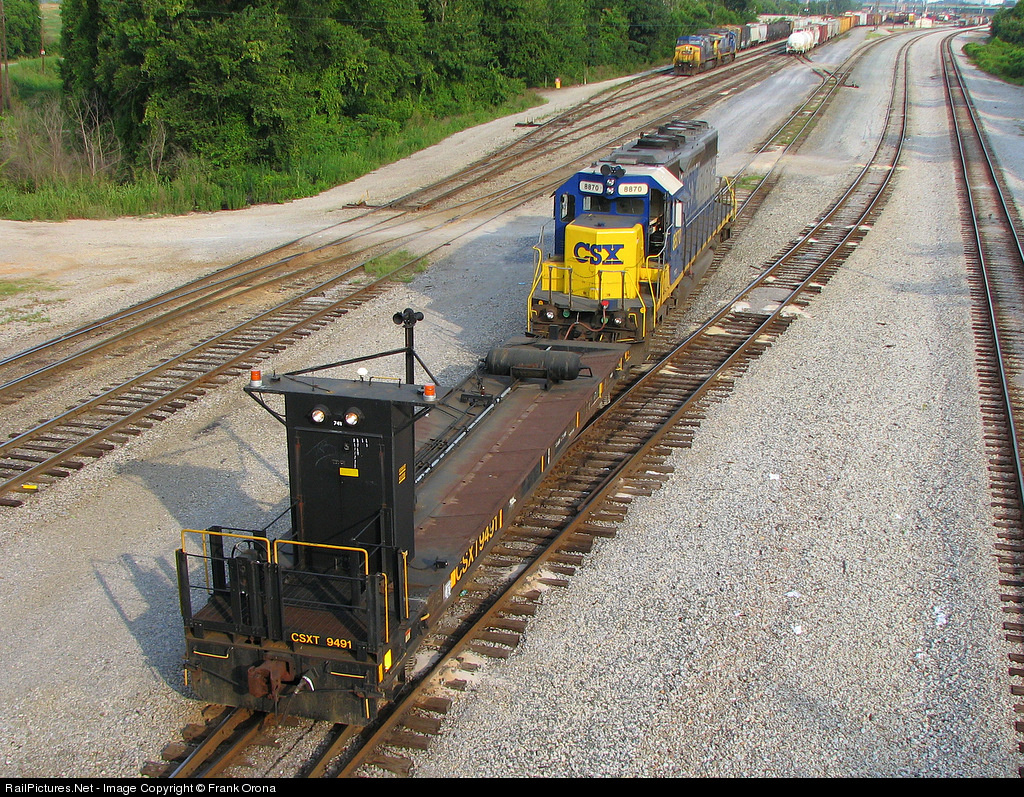
For those unfamiliar with the term, these cars are used at the end of trains for long shoving moves to give the crew a place to perch. This role was once served by cabooses, obviously, but those have pretty much gone by the wayside in modern railroading.


Photo from Frank Orona's Railpictures gallery

As seen by the photo above, some of the shoving platforms are pretty spartan, with barely any shelter for the trainmen. Others are ratty-looking older cabooses that have had little tender loving care over the years. Sometimes these old cabooses are gutted and welded closed, so basically only the platforms are usable.

Photo from the Cabooses of Alabama web page

Then there is the Madera Flyer. In May of 2008 I was driving between Southern California and the Bay Area and stopped at the UP's (former SP) Fresno Yard for a few minutes of casual railfanning. A lone diesel appeared, moving at a fairly fast clip with a single car and what appeared to be a bright Armour Yellow caboose in tow. While the crew started organizing a train from cars in the yard, I maneuvered for a slightly closer look.


Emblazoned on the side of a very spiffy-looking caboose that didn't seem to be of either UP or SP origin were the words "Madera Flyer". Shoving platform, indeed! In searching the web, I found Alex R.'s interesting write up of the ex-MoPac caboose and its duties. (Photos above and below are from his blog.)


Modern-day railroading has lost much of the atmosphere and character many of us strive for in our layouts. But there are still some real-life railroaders who are proud of their traditions, craft, and equipment, and it shows in examples like the Madera Flyer.