Saturday, August 04, 2012

S-2-pendous!

One of the major gaps in model locomotive rosters has been a quality mass-produced N Scale Alco S‑1/3 or S‑2/4, a fact with which I have bored readers before – and before that. S‑2s, in particular, were on hundreds of different railroads' rosters from 1940 to the present day.

So it was extremely welcome news from the National Train Show yesterday when Atlas announced its upcoming model of the Alco S‑2. In an embarrassment of riches, Bachmann also announced an S‑4 model in N scale at the same show. I would have made do with either, frankly, but the S‑2 is terrific. (Yes, some may grouse that one of the manufacturers could have kicked us down an S‑1/3 instead of similar-appearing S‑2 and S‑4 models – but let's not be bitter.)


 Depending on road names and liveries, I'll have some S‑2s on order as soon as possible. And maybe an S‑4 or two for good measure – they fit my 1955 modeling era as well.

But it does raise a question for me. I had considered modeling the prototype Alameda Belt Line (ABL), which was exclusively S‑2 powered in my era. But partially due to the lack of a mass-produced model of the Alco switcher, I developed a proto-freelance theme instead. Atlas is doing different versions of the S‑2, so one of them will probably be pretty close to the ABL's units (after some custom painting, of course)

So now … stay proto-freelance? … or ABL?

Wednesday, August 01, 2012

The Layout Design SIG

In my last blog post, I referenced my article from the Layout Design Journal (LDJ), published by the Layout Design SIG (LDSIG). I was surprised to receive a couple of emails from blog readers who were not aware of the SIG and its magazine, or didn't realize that the SIG was still active and vital. So here is a bit more information about the LDSIG.

For anyone interested in model railroad track planning and layout design, I think the LDSIG is a fabulous resource and well worth membership (full disclosure, I edit the LDJ). Besides the quarterly magazine, the SIG also sponsors programs at regional and national meetings.

"Samplers" of a few pages from recent issues are available for free download as Adobe Acrobat (.pdf) files. I'd encourage those who aren't yet SIG members to take a look – there are many interesting layout design ideas in every issue. Back issues of the LDJ are also available.

LDJ-47, Summer 2012
- Planning the Newcastle-Fassifern Railway with Layout Design Elements (LDEs)
- Improving a Classic John Armstrong Plan in N Scale
- The Continuous Model Railroad: More Railroad than your Room Can Hold
- Proto-Freelance Midwest NYC Layout Inspired by Published Plans
- Weighing the Scales: Experienced Multi-scale Modelers Discuss Pros and Cons
- Benchwork and Fascia Ideas from LDSIG Tours

LDJ-46, Spring 2012
- Three Crossings at Newburgh, Ohio
- Small and Portable: Baltimore's Wicomico St. on the B&O
- Designing a Busy Chicago Passenger Terminal, Multi-deck HO
- Planning for Signals, Part 3: References
- Oakland, California's Howard Terminal in N Scale

LDJ-45, Winter 2012
- Breaking Marley’s Chains – On2 to S for CN Branch
- SP on a Shelf – Houston's Clinton Branch
- Heavy Switching Design Challenge from Tulsa 2011:
  - The Copper Belt Railroad in N Scale
  - Kansas City Southern in Neosho, Mo.; 1956
  - The Pittsburgh Transfer Railway
  - Johnstown and Union City – Mushroom "cut-and-paste" design in N Scale
  - The Terminal Dock Railroad – Northeastern Rail-Marine
  - Electrasteel Corporation
- Gooseneck, Bottoms and Bluffs – Multi-deck HO design for Kansas City's West Bottoms

LDJ-44, Fall 2011
- Sectional, modular and portable layout focus:
  - HO Sections Designed to Move – and Do!
  - HO/HOn3 FREMO Modules for Home and Road
  - Compact OO English Terminus Display Layout
  - N Scale Free-mo Modules as Layout Design Elements
- What would you do differently?: Tips from five successful layout builders

LDJ-43, Summer 2011
- Designing a “Three-way” Layout Design Element on the BN
- Lessons Learned: Phil Monat's Multi-Pass Delaware & Susquehanna
- Three stories on lightweight benchwork ideas from Gatorfoam™ and Luan
- Planning for Signals, Part 2: Model Implementations
- Signal Repeaters

LDJ-42, Spring 2011
- Designing the California, Oregon and Western
- Thoughts on Multi-Pass Design
- 90 Feet more Mainline on the Idaho-Montana Railway & Navigation (UP)
- Layout Design Challenge -- Road Warrior Revisited:
  - B&O’s 26th St. NYC Yard
  - Central California Traction in Stockton and Lodi
  - SAL, ACL, A&W in North Carolina, 1925
  - Timetable and Train Order “Trainer” Layout
- Design Considerations for Prototype-action Couplers

LDJ-41, Winter 2011
- The Ultimate 4X8? RGS in HOn3
- Garage Bay Passenger Ops Design Challenge: Calif. Bayside Commute and Reading Lines in Philadelphia
- Modeling a Mile: Layouts for W&LE / Nickel Plate; B&O; WM
- Planning for Signals, Part 1: Prototype Practices
- Design Ideas from Milwaukee 2010
- “This Column does not Exist": Support Column Ideas

Thursday, July 19, 2012

N Scale Howard Terminal in the LDJ


As many blog readers know, I edit the Layout Design Journal of the Layout Design SIG. Thanks to the contributions of our authors and editorial volunteers, every issue of the LDJ offers interesting ideas about model railroad layout design and track planning.

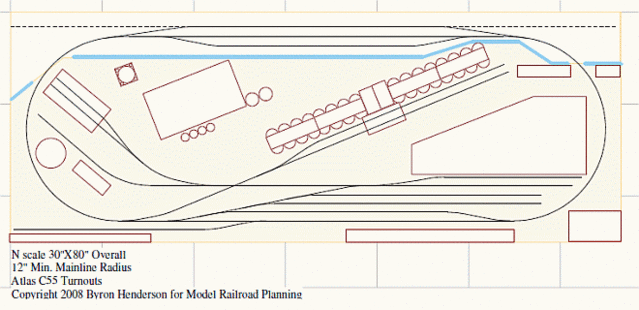
The Spring 2012 issue (#46) includes my article on the Howard Terminal, a terrific little "pocket" rail-marine terminal railroad in Oakland, CA. Beginning with the compact prototype, I developed plans for switching layouts to fit the ubiquitous N scale hollow core door (36"X80") and more-efficient shelf layouts using the same floor space as the hollow core door and its aisles.

This is one of four N Scale switching layouts featured in the article

You may download my six-page N scale switching layout article here as a free Adobe Acrobat file. (By the way, the download may take a minute or two, my ISP is slow at times -- please be patient.)

If you enjoy the article, I hope that you'll join the LDSIG. Members receive the LDJ quarterly and there are also LDSIG-sponsored events at regional and national conventions.

Thursday, February 02, 2012

Oh, the Irony


The January 2012 issue of Model Railroader magazine includes a track plan for an N scale switching layout inspired by railroads around San Antonio, Texas.

The unintended ironic point is the prototype file photo that MR's editors used to illustrate the article: an Alco S‑2, noting in the caption that the S-2 "is typical of the 1950s motive power … to use" on the N scale layout. Oh, indeed, an S-2 would be perfect for the layout, as well as for many others.

But of course, there's been no mass-market N scale S-2 available for a couple of decades. And that model, from Arnold, was pretty poor (to put it as kindly as possible).

An elusive (in N scale, at least) S-2, this one in the later livery of one of my favorite shortlines, the Alameda Belt Line. Photo by Richard Silagi.

Just to rub salt in the wound, Athearn's latest big announcement is an HO GP-38-2 in the Genesis line. Really? A nice model, I'm sure. A lot like all the other HO GP-38-2 models (Atlas, Bachmann, Walthers/Life-Like). Including the existing lower-end RTR HO-GP-38-2 model -- from Athearn itself!

As I've mentioned before, a quality mass-market N scale Alco S-1/3 and/or S-2/4 switcher model would likely sell tens of thousands of copies. Yet model railroad manufacturers continue to crank out "me too" HO models. I guess it works on someone's marketing spreadsheet. I can't see how it makes sense in the real world, though.

I suppose that we can't hold it against MR's full-time editors. Apart from David Popp, the rest are primarily HO scalers. And I'm sure none of them could possibly imagine that such a popular engine in real life could be completely missing from the second most popular modeling scale.

Epilogue August 2012: Happily, Atlas and Bachmann just remedied this long-time issue with S-2 and S-4 N scale models respectively.

Sunday, January 29, 2012

Two-Railroad Town in MRP 2012


Model Railroad Planning 2012 features one of my custom HO layout design projects for a mid-sized space. As you may read about in the article, my client was interested in a real-life setting in California's Central Valley, but it took some searching to find just the right candidate location that met his layout vision.

Reedley, California was the client's choice and I think that the final layout turned out very well. The Southern Pacific and Santa Fe paralleled one another through town, with some industries sandwiched in between the two main lines.


The final design included hidden stub-end "X-factor" staging tracks below and is just one more example of how an around-the room design is so often superior to the "sacred sheet" HO 4X8 track plan folks are tempted to plunk down in a room that would hold something much better.


Editor Tony Koester and the Model Railroader staff did a fine job on production (as always), and generous assistance from railroad author John Bergman, Dr. Jim Lancaster and John Signor provided classic images of Reedley to complete the article. Click here to see this layout in my layout design gallery.

Thursday, October 06, 2011

HO Logs and lots of Stripwood

As I write in the October 2011 issue of Model-Railroad-Hobbyist magazine, a guiding philosophy can help turn a variety of interesting elements into a cohesive track plan. The owner's long-standing dream for this HO layout was "Believable scenery with interesting operations."

Scenic inspiration came from the former D&RGW's famed "High Line" in Colorado, the operating theme of logging was informed by the craftsman kits the owner was building, and the room presented a few challenges and opportunities.


Click here to see this HO trackplan in my Layout Design Gallery or read the original article in the October 2011 MRH.

Once again, I resorted to my old stand-by of a spiral peninsula with one central "blob". Hey, I use it a lot because it works! This created a walk-in track plan with more running length and adequate aisles. The increased running length helped provide the variation in elevations the owner desired while keeping mainline grades to less than 2.5%.

Returning often to the touchstone of believable scenery and interesting operations helped maintain focus and eliminate unworkable configurations.

One of the ideas I touched on in the MRH article is the unrealistic state of many designers' model railroad engine service areas. Often they just plunk down a few undersized rectangles and call it a day.

But watering, sanding and coaling facilities take up significant room and demand specific track relationships in actual modeling. Better to deal with these requirements "honestly" than to sketch-and-hope.

The layout owner is a talented craftsman kit builder and we worked with the footprints of some of his prize-winning structures to create featured scenes on the track plan. A layout that will look good and work well comes out of adhering to a guiding philosophy.

Thursday, September 22, 2011

1 of 43

It's always interesting to me to see where the track plans I've had published in Model Railroad Planning magazine will turn up next. When Kalmbach buys an article, they generally buy all rights, so the material can be used in another Kalmbach publication without involving the author again.

As an author, this doesn’t bother me at all with Kalmbach – the copyright terms of the author agreement are very clear. My designs have been re-published in special booklets offered to new subscribers or shrink-wrapped with regular magazines, in Kalmbach books, etc.

So I thought that perhaps one (or a few) of my model railroad track plans might be featured in the recently-published 43 Track Plans from the Experts. But the intrigue is in guessing which plans might be selected from roughly the last ten years of Model Railroad Planning.

While I was hoping for designs to be included that I believe are a bit more innovative (or at least different), such as the Oahu Railway multi-decker from MRP 2008 or the folding Alameda Belt Line switching layout from MRP 2003, my suspicion was that it would be one or more of the island-style track plans.

Which in the end, it was: the hollow-core-door-sized N scale Katy layout from MRP 2010. Certainly a layout that I and my custom client were happy with, but not breaking a lot of new ground.


The editor(s) added some meaningful comments and found a slightly more useful prototype photo (since I couldn't clear copyrights on the best photos). All in all, I'm happy to have even one plan in the book.

Publishing a book of past plans such as this is a balancing act. While there are some innovative designs, other plans may have been chosen because they come from well-known authors or had great artwork, even if these track plans aren't exactly pioneering in terms of design (or even buildable!).

I also found the tagline on the cover slightly amusing. It reads: "Plans from 4X8 feet to a giant 38X82 feet". But of course, my 30"X80" hollow core door plan is smaller than 4X8. I guess that it's always hard to resist promoting the "sacred sheet" 4X8.

But that's the nature of the publishing business – first, it has to sell! I'm happy to have had a track plan included and I think readers who haven't seen all of the original MRP issues will receive a good exposure to a variety of designs through this book.

Monday, September 12, 2011

Victim Mentality

I'd been emailing with a potential client about a custom track planning project for a while. His vision was for a freelanced layout with a bit of everything, to be built with Kato Unitrack. No specific theme except to have fun and explore the hobby. So far, so good.

But then he began to have second thoughts. Basically his worries came about because he had "heard" that nitpickers and prototype modelers "don't like freelanced layouts or click track" and he didn't want to be criticized. Where had he "heard" that? Internet forums, of course.

Yes, the "Nitpickers pushed me down and took my lunch money" meme is alive and thriving on the Internet.

And pretty much only there.

Many of those posting about the "mean old nitpickers" have themselves never completed any layout, prototype or freelance, generic or specific. But they rave on about the sinister layout police who savage layout owners for failing to live up to some unwritten set of rules.

I recognize that playing the victim has powerful appeal in today's society. In model railroading, it helps some excuse years of inaction. It helps others gain some Internet fame and notoriety (trivial and childish as it is) through hundreds (or thousands) of whining posts.

And it's pretty much totally false.

In fact, I've seen just the opposite first hand multiple times. On one specific occasion I remember from years ago, I happened to be on a layout tour with some very well-known and highly-skilled prototype modelers. One of the layouts on the tour was a freelanced design built with Atlas SnapTrack. To be honest, the layout didn't offer much in visual appeal or operating interest to most, though it suited the owner's interests. But the experienced modelers visiting still took a few minutes to offer a couple of thoughts and thank the owner for being open.

No, the experienced folks didn't spend an hour there and I'm sure it wasn't their favorite layout of the day. But they were courteous, respectful and pleasant. Just as 99% of modelers would be.

The "evil nitpickers" rants on the Internet have done much more harm to potential layout builders than have any actual nitpickers. So forum trolls, please. I recognize that it’s asking way too much for you to be accurate or knowledgeable. But maybe you could at least some up with something fresh.

[By the way, the fellow I was emailing with went forward with the design project, actually built it with Unitrack, and is having a great time. Meanwhile, the forum trolls are … not.]

Sunday, August 28, 2011

A "Layout Vision" Fulfilled

Whew! I'm still recovering from the Sacramento X2011 West NMRA National Convention. It was fun to meet a number of blog readers in real life, along with the special treat of meeting some past custom layout design clients in person.

I also enjoyed presenting the Layout Design Bootcamp again with Layout Design SIG President Seth Neumann. Unfortunately, we had been placed into one of the smallest meeting rooms at the convention center, so it was standing room only for four hours! Thanks to those who hung in there with us.

It was a hectic week. When I returned home, my wife asked, "Well, did you have fun?"

"I don't know, I'll have to check my notes," I answered. Yep, it was that kind of week.

One of my favorite parts of any convention is the layout tours and I saw a lot of interesting layouts, large and small. But it was especially rewarding to visit one layout in particular that had been built from one of my plans.

Many of my custom layout designs are under construction by clients, but this one was unique in that it was constructed expertly and (relatively) quickly by custom model railroad builder Rick Fortin for his clients. I had the opportunity to develop the track plan based on an original design by Dan Murdock, the Metro Belt and Terminal, published in the April 2001 Model Railroader magazine.

To meet Rick's clients' space and interests, we mirror-imaged the design and added substantial hidden staging and a large working yard. You can see Dan Murdock's original plan, my adaptation, and photos in my Layout Design Gallery.

It was a unique pleasure to see the track plan beautifully brought to life by Rick's modeling talents. The metal fabricator scene, in particular, is just the way I had seen it in my mind.

Thanks to Rick Fortin and to his clients for allowing me to contribute to a terrific finished layout.

Tuesday, March 15, 2011

Relaxed and Realistic GN Ry. in HO

We often approach model railroad design projects with the goal of fitting in just as many layout elements as possible. And sometimes that's the right approach, potentially giving us more interest in a given space.

But it was refreshing recently when my client gave me very different instructions: include only about half the elements typical of a roughly 400 square foot space in HO. Rather than packing in more towns, he wanted to use the space for broader curves, more realistic scenes, and a longer run between elements.


The resulting design suggests nicely the wide-open-spaces of the upper Midwest along the Great Northern Railway's lines in North Dakota and Minnesota. Designed in sections, the layout can move to a new room without starting from scratch. And it should offer plenty of operating interest and scenic potential.

The full story of the concept and design of this layout was featured in the February 2011 issue of Model Railroad Hobbyist mediazine, always free for download on the web. You can also see the layout in my online model railroad layout design gallery.

"Relaxed and realistic" was definitely fun for a change!