The Internet is an amazing thing. It's now possible to have one's attitude (and ancestry) questioned on forums all around the world! Before the Internet, it required people to actually have met me to form those kinds of opinions. Now that's progress!
I find it a lot of fun, actually …
Wednesday, July 15, 2009
Monday, July 13, 2009
Why I've Stopped Offering Advice
It's tremendously difficult for me not to try to help when someone posts to an Internet forum yet another mindless oval with an unworkable yard or a spaghetti-filled blob that should be called the Ragu Northern. But I've had to stop.
As the old joke goes, "Never try to teach a dog to sing. The results are poor, and it seems to annoy the dog." My endless exhortations for folks to step away from the CAD, learn some layout design principles, and develop a concept and vision for their layout before designing a track plan generally fall on deaf ears. (OK, there was one success recently, but it's the exception that proves the rule).
Instead, people just keep cranking out the CAD revisions – each new plan as infested with flaws as the last. Although the flaws often do mutate from revision to revision.
And what's worse, these neophyte designers often become understandably defensive about their precious track plan, no matter how hackneyed, impractical, or inaccessible. And then the forum chorus starts chanting, "Just build it, it'll be fine – it's your plan, do what you like" … talk about the blind leading the partially-sighted!
Anyway, finally, it's enough. As my wife often reminds me about other matters, "Byron, it's only 'help' if the other person wants it." So true.
Oh, I'll probably make an occasional exception for comments about published plans – not so much pride-of-poster-ownership there. Or I might suggest some better-thought-out plans for the same space from which the help-seeker might hope to learn. That way, I can perhaps accommodate my desire to be helpful without aggravating the help-seekers (and myself) so much in the process. We'll see ...
Update 18 July: Based on notes from a couple of you, I guess the forgoing could have been clearer -- especially the title. I'm still posting occasionally on Internet forums and offering general layout design and operations suggestions. What I've decided to stop providing is comments on the specific details of a poster-provided plan. And I'm still offering custom layout design services to those who are interested, of course.
Thanks for reading!
As the old joke goes, "Never try to teach a dog to sing. The results are poor, and it seems to annoy the dog." My endless exhortations for folks to step away from the CAD, learn some layout design principles, and develop a concept and vision for their layout before designing a track plan generally fall on deaf ears. (OK, there was one success recently, but it's the exception that proves the rule).
Instead, people just keep cranking out the CAD revisions – each new plan as infested with flaws as the last. Although the flaws often do mutate from revision to revision.
And what's worse, these neophyte designers often become understandably defensive about their precious track plan, no matter how hackneyed, impractical, or inaccessible. And then the forum chorus starts chanting, "Just build it, it'll be fine – it's your plan, do what you like" … talk about the blind leading the partially-sighted!
Anyway, finally, it's enough. As my wife often reminds me about other matters, "Byron, it's only 'help' if the other person wants it." So true.
Oh, I'll probably make an occasional exception for comments about published plans – not so much pride-of-poster-ownership there. Or I might suggest some better-thought-out plans for the same space from which the help-seeker might hope to learn. That way, I can perhaps accommodate my desire to be helpful without aggravating the help-seekers (and myself) so much in the process. We'll see ...
Update 18 July: Based on notes from a couple of you, I guess the forgoing could have been clearer -- especially the title. I'm still posting occasionally on Internet forums and offering general layout design and operations suggestions. What I've decided to stop providing is comments on the specific details of a poster-provided plan. And I'm still offering custom layout design services to those who are interested, of course.
Thanks for reading!


Wednesday, July 08, 2009
Alcos in the Alcove
 There can be a lot of funny little nooks and crannies in houses. One of my layout design clients had a 5-foot-wide alcove where had set up a 24" deep plywood shelf. The original thought was to build an HO diorama in the space. But when the OK came for another adjoining shelf, the idea of an L-shaped switching layout took form.
The resulting design had to incorporate some specific kits and suggest a granger motif, so some challenging compromises and trade-offs were necessary. The resulting design is featured in the most recent edition of Model Railroad Hobbyist magazine (Q3 2009), always available for free download at the MRH homepage. You can also see the HO shelf switching layout track plan in my Layout Design Gallery.
Wednesday, June 10, 2009
Operating Forms Article
 I'm pleased to have an article on Track Warrants and other operating forms in the most recent (June 2009) issue of The Dispatcher's Office magazine, published by the Operations SIG. Editor Bill Kaufman and Art Director Otto M. Vondrak did their usual fine job on my material.
The article covers the basics of Track Warrant Control (TWC), a couple of examples of the Track Warrant Form modified for model use, and some other forms that have proved useful in developing operating sessions. While TWC wasn't widely deployed on real railroads until the 1980s, I've had good luck utilizing it on model railroads set in earlier eras.
TWC is fast and easy to set up, easy for crews to learn, and doesn't impose special requirements on layout design, construction, or complexity (as opposed to TT&TO, which demands sufficient running length; or CTC, which requires a signaling system and associated electronics.) TWC is a great first step to get ops started on any layout, even if other traffic control schemes are contemplated for later. I'm all about reducing the MTTF (Mean Time to Fun) in getting ops started, and TWC is a great tool in that regard.
By the way, for anyone interested in model railroad operations, OpSIG membership has to be one of the best deals on the planet: memberships with on-line delivery of the magazine are as low as 5 bucks per year!
It was fun for me to see these ideas and examples in print – it makes the work to prepare an article worthwhile.
Saturday, June 06, 2009
Caricature, Copy, or "Close Enough"?
I've been working on quite a few prototype-based custom track plans lately. I enjoy these projects, but it's always a matter of making trade-offs between what was actually there on the real-life railroad and what we have room for on the model. There are sort of three ways to approach the challenge.
The first way was used a lot in the 1950s and 1960s and can be seen in older plans such as those in Kalmbach's 101 Track Plans. Want Newark, New Jersey on your HO layout in ten linear feet? No problem: just put in a siding, two stub-end yard tracks, a couple of industry spurs, and voila!, it's Newark!
Of course, this is barely adequate for Newark, TX (on the Rock Island), let alone Newark, NJ. Yet this caricature style of "prototype" track planning persisted through even some well-regarded published plans -- and widely in general use. These highly abridged scenes didn't look very much nor work very much like the real thing, but it did allow the designer to claim 300 miles of the prototype in a spare bedroom.
The other extreme has come into vogue recently with the wider availability of prototype information. That's to simply scale down the prototype element by whatever ratio necessary to fit a copy into the allotted space. The real yard is two miles long and you have 15 feet in HO? No problem: just shrink the real thing by a factor of eight. So what if it leaves you with body tracks three inches long? It's an LDE, don't cha know. What could be more accurate than that?
Of course, the best approach requires a lot more thought, and that's why it sadly eludes so many designers. We have to decide what balance of "looks like" and "works like" best fits the available space and layout concept. And then work toward capturing signature elements that suggest the real thing.
On a project I am completing now, one of the challenges is a scene that was about half of a mile long in real life. It needs to fit in about 600 scale feet of benchwork between two curves. While a simple 4-to-1 compression would theoretically fit, it wouldn’t capture the personality of the signature elements, which include a truly massive industry, a very modelgenic station, and a couple of smaller typical Midwestern rail-served businesses.
Fitting it all in while including a bit of the street grid that helped define the real scene required flipping one spur to point west instead of east and placing a station on a curve. This allowed the track configurations around the large plant to more strongly resemble their real life counterparts.
One of the keys is modulating the degree of prototype fidelity around the typical layout. Signature scenes in key locales get more focus (i.e., space), while others are more heavily modified. This process requires a firm grasp of the overall concept and vision, which then serves as a reference against which to judge the many trade-offs required.
Borrowing from W. Allen McClelland's "good enough" modeling motto, this "close enough" approach allows us to capture the most appealing and engaging scenes and elements in a way that communicates the atmosphere of the real thing to viewers and operators. Modulating fidelity and referring back often to the guiding layout vision helps create realistic scenes in reasonable spaces.
The first way was used a lot in the 1950s and 1960s and can be seen in older plans such as those in Kalmbach's 101 Track Plans. Want Newark, New Jersey on your HO layout in ten linear feet? No problem: just put in a siding, two stub-end yard tracks, a couple of industry spurs, and voila!, it's Newark!
Of course, this is barely adequate for Newark, TX (on the Rock Island), let alone Newark, NJ. Yet this caricature style of "prototype" track planning persisted through even some well-regarded published plans -- and widely in general use. These highly abridged scenes didn't look very much nor work very much like the real thing, but it did allow the designer to claim 300 miles of the prototype in a spare bedroom.
The other extreme has come into vogue recently with the wider availability of prototype information. That's to simply scale down the prototype element by whatever ratio necessary to fit a copy into the allotted space. The real yard is two miles long and you have 15 feet in HO? No problem: just shrink the real thing by a factor of eight. So what if it leaves you with body tracks three inches long? It's an LDE, don't cha know. What could be more accurate than that?
Of course, the best approach requires a lot more thought, and that's why it sadly eludes so many designers. We have to decide what balance of "looks like" and "works like" best fits the available space and layout concept. And then work toward capturing signature elements that suggest the real thing.
On a project I am completing now, one of the challenges is a scene that was about half of a mile long in real life. It needs to fit in about 600 scale feet of benchwork between two curves. While a simple 4-to-1 compression would theoretically fit, it wouldn’t capture the personality of the signature elements, which include a truly massive industry, a very modelgenic station, and a couple of smaller typical Midwestern rail-served businesses.
Fitting it all in while including a bit of the street grid that helped define the real scene required flipping one spur to point west instead of east and placing a station on a curve. This allowed the track configurations around the large plant to more strongly resemble their real life counterparts.
One of the keys is modulating the degree of prototype fidelity around the typical layout. Signature scenes in key locales get more focus (i.e., space), while others are more heavily modified. This process requires a firm grasp of the overall concept and vision, which then serves as a reference against which to judge the many trade-offs required.
Borrowing from W. Allen McClelland's "good enough" modeling motto, this "close enough" approach allows us to capture the most appealing and engaging scenes and elements in a way that communicates the atmosphere of the real thing to viewers and operators. Modulating fidelity and referring back often to the guiding layout vision helps create realistic scenes in reasonable spaces.
Saturday, May 30, 2009
Just the Same, Only Different!
I've had an interesting run of five spare-room-sized custom layout design projects recently. Although all were roughly 100 to 150 square feet in overall size, they spanned the country from the anthracite coal fields of Pennsylvania to the California desert and eras from the 1930s to nearly the present day.
While I'm usually too caught up in the design process on a particular project for much reflection, looking back now on the finished designs I am struck by the wide variety of ways to enjoy
model railroading. The choices and trade-offs required for model railfanning vs. operations vs. replicating a place and time (or balancing all three) makes for very different solutions to the challenge of a similar space. And all that is compounded by a variety of eras, scales, gauges and even design approaches (twice-around, multi-deck, etc.).
I think the resulting layouts will serve well their specific builder's particular interests and desires. But not one of them would satisfy any of the other owners' needs. And in my mind, that diversity is one of the best parts of my job and our hobby.
The next projects in process and in the queue are larger and bring their own unique challenges. But the breadth of these recent track plans reminds me that even a layout in a more-modest space can have a unique personality and tell a compelling story.
While I'm usually too caught up in the design process on a particular project for much reflection, looking back now on the finished designs I am struck by the wide variety of ways to enjoy
model railroading. The choices and trade-offs required for model railfanning vs. operations vs. replicating a place and time (or balancing all three) makes for very different solutions to the challenge of a similar space. And all that is compounded by a variety of eras, scales, gauges and even design approaches (twice-around, multi-deck, etc.).
I think the resulting layouts will serve well their specific builder's particular interests and desires. But not one of them would satisfy any of the other owners' needs. And in my mind, that diversity is one of the best parts of my job and our hobby.
The next projects in process and in the queue are larger and bring their own unique challenges. But the breadth of these recent track plans reminds me that even a layout in a more-modest space can have a unique personality and tell a compelling story.
Sunday, May 10, 2009
Madera Flyer
I recently finished up an N scale layout design for a contemporary era shortline. One of the elements I wanted to include was a job that would require a shoving platform, since the real-life railroad serving as inspiration for this layout owns one.
For those unfamiliar with the term, these cars are used at the end of trains for long shoving moves to give the crew a place to perch. This role was once served by cabooses, obviously, but those have pretty much gone by the wayside in modern railroading.

Photo from Frank Orona's Railpictures gallery
As seen by the photo above, some of the shoving platforms are pretty spartan, with barely any shelter for the trainmen. Others are ratty-looking older cabooses that have had little tender loving care over the years. Sometimes these old cabooses are gutted and welded closed, so basically only the platforms are usable.
 Photo from the Cabooses of Alabama web page
Then there is the Madera Flyer. In May of 2008 I was driving between Southern California and the Bay Area and stopped at the UP's (former SP) Fresno Yard for a few minutes of casual railfanning. A lone diesel appeared, moving at a fairly fast clip with a single car and what appeared to be a bright Armour Yellow caboose in tow. While the crew started organizing a train from cars in the yard, I maneuvered for a slightly closer look.

Emblazoned on the side of a very spiffy-looking caboose that didn't seem to be of either UP or SP origin were the words "Madera Flyer". Shoving platform, indeed! In searching the web, I found Alex R.'s interesting write up of the ex-MoPac caboose and its duties. (Photos above and below are from his blog.)

Modern-day railroading has lost much of the atmosphere and character many of us strive for in our layouts. But there are still some real-life railroaders who are proud of their traditions, craft, and equipment, and it shows in examples like the Madera Flyer.
For those unfamiliar with the term, these cars are used at the end of trains for long shoving moves to give the crew a place to perch. This role was once served by cabooses, obviously, but those have pretty much gone by the wayside in modern railroading.
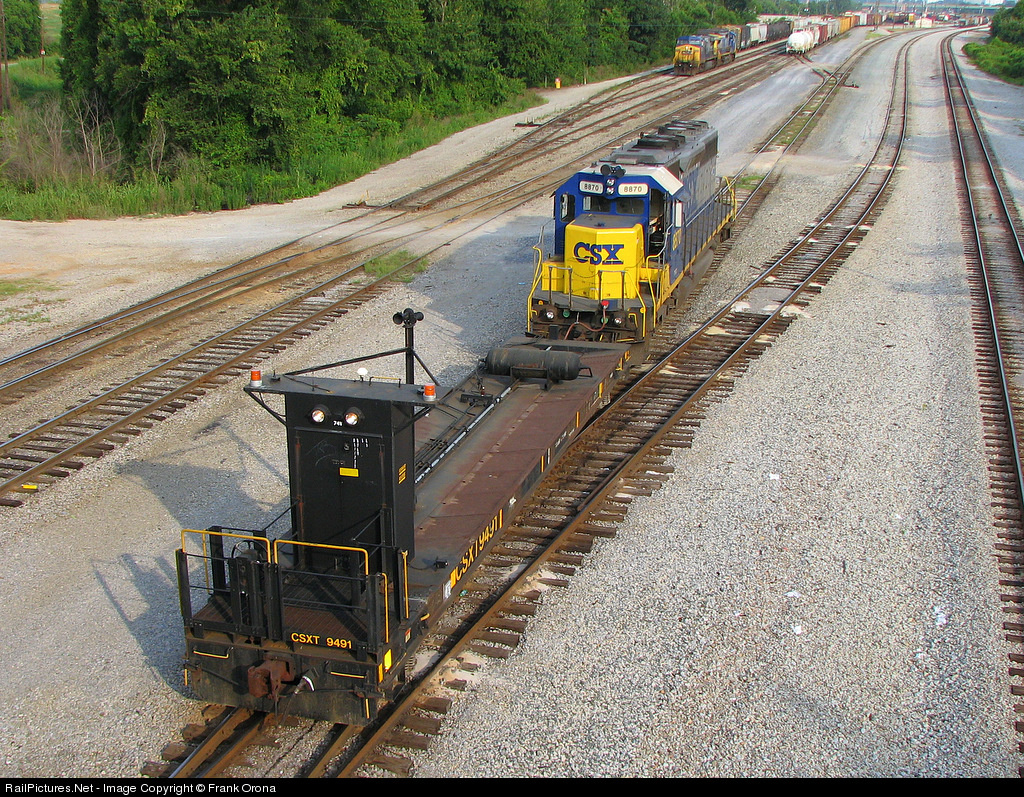
Photo from Frank Orona's Railpictures gallery
As seen by the photo above, some of the shoving platforms are pretty spartan, with barely any shelter for the trainmen. Others are ratty-looking older cabooses that have had little tender loving care over the years. Sometimes these old cabooses are gutted and welded closed, so basically only the platforms are usable.
Photo from the Cabooses of Alabama web pageThen there is the Madera Flyer. In May of 2008 I was driving between Southern California and the Bay Area and stopped at the UP's (former SP) Fresno Yard for a few minutes of casual railfanning. A lone diesel appeared, moving at a fairly fast clip with a single car and what appeared to be a bright Armour Yellow caboose in tow. While the crew started organizing a train from cars in the yard, I maneuvered for a slightly closer look.
Emblazoned on the side of a very spiffy-looking caboose that didn't seem to be of either UP or SP origin were the words "Madera Flyer". Shoving platform, indeed! In searching the web, I found Alex R.'s interesting write up of the ex-MoPac caboose and its duties. (Photos above and below are from his blog.)
Modern-day railroading has lost much of the atmosphere and character many of us strive for in our layouts. But there are still some real-life railroaders who are proud of their traditions, craft, and equipment, and it shows in examples like the Madera Flyer.
Wednesday, April 29, 2009
There should be warnings ...
There are some perfectly dreadful track plans being published on the Internet lately. If only these were required to carry a mandatory advisory:

If you won't stop the CAD for yourself, please, do it for the Newbees you are misleading.
Wednesday, April 22, 2009
A Railfan Sampler
 I've had the pleasure of having another article published in Issue #2 of the Model Railroad Hobbyist e-zine. The layout design project itself was a bit different from most for me in that it was a very specific railfan focus practically to the exclusion of any traditional operating elements.
There is one fairly large yard, but it's meant to be a place for consists to be changed or power swapped, not as a base of local switching operations. And the scenes are famous railfan locales (Tehachapi, Cajon, etc.) rather than the more common towns and industries found on many layouts. The overall layout is quite large, occupying a floor in a commercial building, but the effort to capture the essence of famous scenes like The Loop and the horseshoe curve at Caliente demands a lot of space.
Model Railroad Hobbyist is a free download here and you can see the track plan and read more about the design itself. While working on the project, I snapped some railfan style photos during a pass through the Tehachapi area on a "slightly intentional" railfan trip I wrote about here earlier.
You can also see two different approaches to large HO track plans featuring Tehachapi in my Layout Design Gallery.

It was an interesting project with a unique layout vision and concept and it's great to see it in the "pages" of Model Railroad Hobbyist.
 Over the weekend I happened to pluck the Georgia Satellites' eponymous 1986 debut release from a teetering stack of CDs. AC/DC meets Allman Brothers Band in a torrent of power chords and 12-bar blues! I suppose many would consider the band a one-hit-wonder, but there's a lot more here than just the radio-friendly "Keep Your Hands to Yourself". Lead guitarist Rick Richards shows off his "Dixie-fried" chops throughout, and the tunes where lead singer Dan Baird and Richards join voices are particularly effective, such as on Terry Anderson's "Battleship Chains" and the turn-it-to-eleven rocker "Can't Stand the Pain" (aided and abetted by Richards' stinging slide work). Unfortunately Baird left the band after two less-successful later releases, but Georgia Satellites shows they were really on to something for a while.
Saturday, April 11, 2009
Selective Obsession
We've often heard of "selective compression", the modeling concept of reducing the size of something (a structure, for example) to better fit the layout. A nine-bay factory building becomes five bays wide, for example. A concept I use fairly often is "compressive selection". This is choosing a smaller example of something because it's more achievable as a model. For example, if considering a mainline junction with a branch as a subject for a layout, I might focus on the branch and only suggest the heavily-travelled mainline for a more achievable scope.
But many folks fall prey to "selective obsession". This is where one idea, one element, one town, one industry becomes stuck in their minds and they refuse to consider any change. This leads to compromising the entire layout for this one prize, even though the end result is unsatisfying overall. The other elements are squeezed into less and less space; the operating connections become ever more convoluted; and any logical fit to the real-world exceedingly remote. Yet they hang on to that one idea, come what may.
This might be the guy who wants to handle forty-car grain trains on his HO 4X8, or the fellow who insists on a division point yard, even though it shrinks the rest of the layout so severely that the yard makes no sense operationally. Or the poor soul who clings desperately to an admittedly lousy design from an old book because he already built the benchwork.
Becoming too locked-in to anything too early in the design process restricts your flexibility and creativity just when you need it most. Balance is the key. When you find yourself resisting logical ideas and alternatives because you say to yourself, "But I can't give up Chicago!"; you may be a victim of Selective Obsession.
But many folks fall prey to "selective obsession". This is where one idea, one element, one town, one industry becomes stuck in their minds and they refuse to consider any change. This leads to compromising the entire layout for this one prize, even though the end result is unsatisfying overall. The other elements are squeezed into less and less space; the operating connections become ever more convoluted; and any logical fit to the real-world exceedingly remote. Yet they hang on to that one idea, come what may.
This might be the guy who wants to handle forty-car grain trains on his HO 4X8, or the fellow who insists on a division point yard, even though it shrinks the rest of the layout so severely that the yard makes no sense operationally. Or the poor soul who clings desperately to an admittedly lousy design from an old book because he already built the benchwork.
Becoming too locked-in to anything too early in the design process restricts your flexibility and creativity just when you need it most. Balance is the key. When you find yourself resisting logical ideas and alternatives because you say to yourself, "But I can't give up Chicago!"; you may be a victim of Selective Obsession.
Subscribe to:
Posts (Atom)
