Thursday, May 08, 2008

It was the Pantry

Yes, the pantry finally did it. When the previous owners remodeled the kitchen in our 40+ year old house some fifteen or so years ago, they chose the least expensive cabinets available. Pressed wood and staples -- and not enough of either. From the time we moved in, the cabinets have been slowly returning to their primordial state, that is to say, literally disintegrating.

Five-minute epoxy and aluminum mending plates have served to fix some of the major cabinet crevasses over the years we’ve been in the house, but a few months ago there was a huge crash from the kitchen. One wall of the pantry had decided to part company from its loosely-coupled companions and the large shelves crashed to the bottom like falling floors in a Warner Brothers cartoon. Off to the hardware store for threaded rod and metal plates (and more epoxy), and the pantry was soon back to some semblance of function. [Oh yeah, and company was coming that evening for dinner. No kidding.]

But that was the last straw for the lovely wife, who started using profanity like “kitchen remodel” and “push out that wall”. And so we’ve started down the long twisted path of major home improvement.

“What’s this got to do with model railroading?” one might reasonably ask. Some may remember the famous poem “For the Want of a Nail”, republished in Benjamin Franklin’s Poor Richard’s Almanack. The basic premise of the rhyme is that the loss of a nail leads to the loss of a horseshoe, then the horse and rider, then a battle and ultimately the loss of a kingdom – “all for the want of a nail”. The pantry collapse is sort of like that – the first step in a long sequence of events. With the pending remodel, the garage where my layout is situated could become quite crowded. If the remodel is just the kitchen, crude temporary cooking facilities and boxes of dishes, pots, and pans will fill the space. If the remodel is even more extensive, some furniture will be stored there. In any case, not much layout building will get done for a while, at least not in the garage.

I’ve known in the back of my mind that this was a likely scenario, but I was able to keep it way back there. But the impetus for layout construction has certainly diminished since the pantry’s unfortunate breakdown with the knowledge of what was likely. So what to do?

While pondering this question, I thought about advice I’ve given to my own model railroad layout design clients when faced with some unexpected space upheaval. “There’s always some way to build something,” I cheerily encourage them. I hate it when my words come back to mock me. But maybe there is a way. After all, friend Bart Thurber found a way to use a storage room at his business for a no-muss/no-fuss representation of ATSF’s Alice Street Yard on shelves above the storage.

Our guest room doubles as an office and has a couple of long walls. Hmmm. Perhaps a narrower desk, since I’ve moved from a CRT to a flat-screen monitor. Maybe a few sections of layout built on shelves along the walls with a bridge across the window. That could work. But what to put on those shelves? HOn3 Hawaiian railroad … no, back, away, foul spirit!! OK, so let’s stay with the Oakland Harbor Belt theme, era, and N scale so I can use the on-hand locos and rolling stock. Maybe sections of the layout that might even be useable in the garage later. (Or in a dedicated train room if the remodel turns extensive – or is that expensive?).

OK then, what to build? Fernside Yard and Alaska Basin could probably fit, but not in configurations that readily transfer to the ultimate garage plan. So how about Brooklyn Basin? (Click here for a better view of the Brooklyn Basin map.)


This proto-freelanced area sports some interesting possibilities, with a huge flour milling complex, canning company warehouses, a massive glass plant and a marine terminal. In real life, the SP (and now UP) served the area, but I’ve always imagined modeling coopetition here with the OHB and SP jockeying for customers.
Let’s see… the Fruitvale Ave. lift bridge (above, from Microsoft Live Earth), glass plant (upper left in the photo), and canning warehouses (lower left) along one short wall, narrow bridge for Glascock Street across the window, then the major milling complex and marine terminal along the long wall. As Gene Wilder’s Froederick Frankenstein screams in the movie Young Frankenstein, “IT … COULD … WORK!!!”

Stay tuned.

Sunday, April 06, 2008

John Armstrong's most lasting design legacy?

The March 2008 issue of Model Railroader magazine included John Armstrong's Canandaigua Southern as part of the "Landmark Layouts" series. The inclusion of this layout seems natural since it incorporated many of the concepts that have become part of the repertoire of most of today's model railroad layout designers. Many of the ideas were quite unique at the time, as pointed out in the MR article by Andy Sperandeo.

Some of these, like the "vertical turnout", reverted staging loops, and "dehydrated canal lock" seem to be used only occasionally in designs today. Others, like the "loads in / empties out" scheme are even a bit over-used. But it's easy to forget just how innovative were the narrow shelves and double-sided backdrops John used with his walkaround designs. Today, tyro designers routinely include these as part of their layout plans, but even John's own designs didn't usually reflect these features until later in his career. Armstrong designs from the 1940s and 1950s include many layouts with the broad scenes, duckunders and control pits, and multiple loops of track typical of the era. Many of these early Armstrong designs lacked backdrops at all and it was rare that they were used to separate scenes from viewers in different aisles.

Through the kindness of friend Jim Providenza, I was included in a visit to Armstrong's layout while visiting the area for an operating event some years ago. John was a very gracious host, and I enjoyed seeing so many elements of the Canandaigua Southern I had read about over the years. But the most striking aspect of the design (for me) was the way the narrow shelves, double sided backdrop, and winding aisles combined to give a sense of a long distance traveled from one end of the layout to the other and the isolation of, and focus on, individual scenes. We often take these elements for granted in current designs, but they were not found in the typical model railroad layout designs of the '40s and '50s. (As Andy Sperandeo pointed out in the MR article, walkaround control was not very viable in the period, so that certainly put a damper on designs that couldn't be viewed and operated from one or a few control panels.)

I've now had the chance to be involved with the construction, operation, or redesign of a few Armstrong designs, and the refinement of his ideas through the years is very intriguing. I hope one day to have the time to undertake a more organized study of John Armstrong's designs to examine the changes in his style over time. Certainly, though, we can see the design of his own Canandaigua Southern (planned circa 1950) as an important turning point in John's design style, although he didn't immediately abandon the more traditional design concepts in other projects.

The narrow shelf/backdrop-scene-divider/walkaround concept is commonplace today, but it wasn't always so. John's use and popularization of the idea was a key to its adoption by other layout designers and it contributes to the realism of many, many layouts today.

Sunday, March 23, 2008

Grandma Nellie and "Real" Time

When we shifted to Daylight Saving Time this last weekend, my Mother reminded me of a family story about my paternal Grandma Nellie. When Daylight Saving Time rolled around each year, apparently Grandma Nellie insisted on keeping one clock in the house set to standard time, which she called "real" time. No matter how often friends and relatives pointed out that it was confusing to have one clock out-of-sync with the rest of the Eastern Time Zone, Grandma Nellie persisted. She had been born before Daylight Saving Time began, and apparently always felt vaguely uneasy about the annual "spring forward" ritual. Having one clock set to what she felt was "real" time was reassuring.

When I heard that family anecdote, it rang true for me when it comes to model railroad operating sessions. I've written about the 1:1 alternative to fast clocks and how much more comfortable it is for me than watching the hands of a fast clock whirl around at a dizzying pace.

No doubt part of the reason is my preference for yard jobs and local switching roles. These model railroad job duties don't scale down with the fast clock -- they take about as long on the model as on the prototype. And I like to think about the steps, working to replicate some of the procedures of a real-life crew. One of the most enjoyable operating sessions I ever had was on Rick Fortin's ATSF 4th District layout. I teamed with friend Alan Cooper on the Kingsley Turn, a job that works an isolated branch well off the busy mainline.

Once safely situated on the branch, Alan and I used small post-it tabs to simulate the brakemen on the ground as we switched the town of Kingsley and the adjacent Cal Port cement plant. As real crews do, we tried to plan our moves to minimize walking for the crews on the ground as opposed to just blasting all over the tracks spotting and picking-up cars. Sometimes the seemingly obvious move is not the way a real crew would do it when you consider how long it would take for a real crew member to walk from one place to another to "pull the pin" on a cut of cars.

Alan I and I worked away for a couple of real-time hours serving the various industries on the Kingsley Branch. Rick's layout uses 1:1 time, so we didn't feel overly rushed by the pressure of an artificial time clock. Instead, we enjoyed the satisfaction of working more like a real-life crew, attending to safety and the needs of the "men on the ground".

So yeah, I like a more reasonable pace and the chance to replicate prototype concerns. But given my Grandma Nellie's one clock in the house that stayed on "real" time, maybe some of it’s genetic!


I was saddened to read news on the web of Jeff Healey's passing earlier this month. He was an amazing guitarist and signer. Blinded at a very early age by a rare cancer, he learned to play guitar in a most unusual style, holding it across his lap and fingering it from "above" the neck (opposite the typical method). Most famous for his first major label album See the Light and his appearance in the movie Roadhouse, Healey was a powerful presence in concert. Like many musicians, he later explored a different genre than the one that made him (modestly) famous, playing trumpet and guitar in jazz bands. A new album of blues covers, Mess of Blues, was recorded before his death and is a strong reminder of his dynamic style. By all accounts he maintained a full life despite suffering the continuing effects of the cancer, an inspiration to those of us who accomplish less with far fewer obstacles.

Sunday, February 17, 2008

Overlapping elements in layout design

I posted this in one of the forums, and as is usually the case with conceptual ideas in that environment, it fell with a resounding thud. So since I know at least two people might read and appreciate it if I post it here (thanks, Mike and Trevor!), here goes.

Real railroads are relatively long and skinny, and that's even true for terminal and switching areas, for the most part. The width of right-of-way might only be 100 feet or so (just over a foot in HO). But the length, of course, is tens, hundreds, or thousands of miles. What this means is that most model railroads have significantly more width (or depth) than length compared to the real thing.

The original question in the forum was regarding layout design for a small switching layout. But this principle applies to model railroad layouts of all sizes and configurations. So often, folks miss the opportunity to get more into the available space by neglecting to overlap some elements in the same running length of layout. Instead, they plop down things one after another in a linear fashion. Now it's true that real railroads are more or less arranged this way, but we're always so starved for length on the model that it can help to look for tricks that help compress the length with some judicious overlapping of elements.

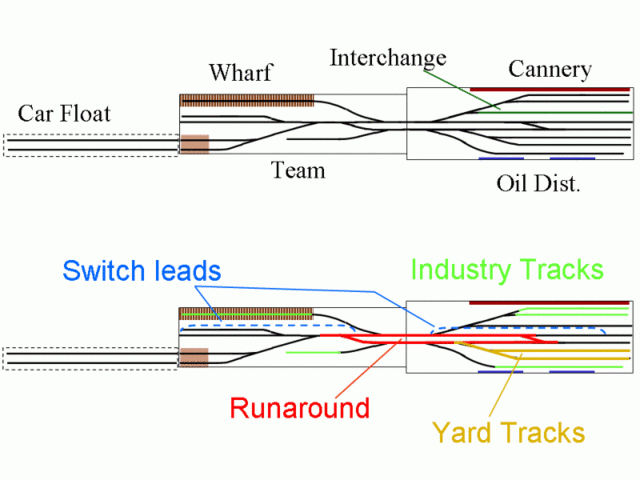
Now this does not necessarily meaning placing one "town" behind another on the same shelf, but to look for places where some elements in the same area can overlap, taking advantage of our relatively deep scenes (compared to the length). Here's a small shelf-style layout (about 2'X12' in HO plus the removable car float), but it illustrates the way the different functions (yard, switch lead, industries, runaround) overlap to some degree in the same linear space.

For a better view, click here

Note how each element overlaps some other element. The industry tracks (bright green) serve a series of flats, both against a backdrop and toward the aisle ("fascia flats"). Of course, when there is a little more depth, one can mix in larger 3-D industries as well. But there can still be overlap with yard tracks, switch leads, etc.

An improved version of this concept was published as a folding 1'X6' N scale design in Model Railroad Planning 2005. It's inspired by the erstwhile real-life Alameda Belt Line. Here's the version I submitted to MRP, their artwork was much nicer.

Read more about this design here

So look for chances to overlap where it doesn't compromise the operating potential or appearance of a scene. (And I don't mean the overlap above your belt … we all need to get rid of those …)

Wednesday, February 06, 2008

Track Plan Analysis Indexed

I recently wrote a series of posts on the dozen-or-so steps I use in analyzing a track plan. A couple of readers mentioned to me that it can be hard to follow because of the inverse chronological nature of a blog and the way blogger manages archives, so here's an index to those posts.

Part 1 covered Seeing the Space, not a Table, Trackplan Schematics, and Staging

Part 2 talked about Reality-based Rendering, Train Capacity and Balance, and Leads, Runarounds, and Switchbacks

Part 3 described considerations for Yards

Part 4 included the Four Cornerstones of Layout Design and "PICS" for Model Railfanning

Part 5 finished up with Layout Vision, Story Telling, and Synchronicity

Sunday, January 27, 2008

Death of Discourse

For years, I was part of a thoughtful on-line forum. The conversation and some of the participants went way back, even before the Internet was available commercially … to bulletin boards on AOL and Compuserve when the latter offered only numerical email addresses. Then the discussion moved to a private email server and then to the series of commercial start-ups that were eventually swallowed whole by an Internet giant.

At first, it was a great place to talk about model railroad layout design and operations. There were many knowledgeable practitioners on the list. Some of these were authors in the commercial press, some were real-life railroaders, many were less-known but thoughtful and eloquent modelers. Most contributed meaningful ideas and respectful points to the discussion. The forum was not widely known, so it was a layout design and ops discussion on the Internet rather than just another Internet forum nominally about model railroading.

Over time that changed, partly owing to its growing popularity. It started to take on all the familiar unpleasant aspects of an Internet forum, equal parts boorishness and banality. The snipers came first … boosting their own petty egos by taking shots at better-known modelers and hobby institutions. They pontificated and postured and

chipped

chipped

chipped


… away at the more thoughtful posters, until many of these reasonable participants departed.

Next came the bullies and the blowhards. They raged and ridiculed, posting incessantly about trivial typos and perceived slights. The empty-headed self-proclaimed experts came next, churning out scores of wildly impractical suggestions that drowned out the thoughtful and experienced ideas by sheer number of posts -- never mind the fact that these savants had no actual experience with anything they were recommending. Finally the size of the audience attracted the peddlers and shills, hawking their products at every opportunity. Although there are still short-lived bursts of thoughtful discussion, sadly this forum sometimes seems only to be

BRAGGADOCIO

Bloviating

Bon Mots

... and the persistent
tap

tap

tap

… on the reader's shoulder by the peddlers with their wares.

When I worked at an Internet company, people talked about how the Internet was just like real life, but with the volume turned up to eleven and running at septuple-speed. If that's true, perhaps this once-thoughtful discussion has simply been undone by the egos and ill tempers that eventually destroy discourse in other arenas. Still, it's a shame.

Wednesday, January 16, 2008

One Lost Weekend Redeemed

I wrote a while back about some of the "lost weekends" I have spent with different layout concepts, prototypes, scales, and gauges before returning to my Oakland Harbor Belt. Usually, there's not much to show for the effort except some increased knowledge, though that in itself is not a bad outcome.

One of the more feverish lost weekends was spent trying to coil a Hawaiian-themed HOn3 model railroad into my garage. This had been inspired by learning some history and seeing some remnants of Maui's Kahului Railroad while on a family vacation, followed hard on the heels by the publication of Jim Chiddix' and MacKinnon Simpson's Next Stop Honolulu! about the Oahu Railway and Land Company. (Great book, by the way.)

For the most part, this Island (Railroad) Fever passed quickly, although I have had a couple of brief relapses. But I wanted to do something with the background I had learned and the enthusiasm I felt about these Hawaiian prototypes. So I proposed an article to Model Railroad Planning magazine about the Oahu Railway. It's been a couple of years in the making, but that effort has finally borne fruit in MRP 2008.

As usual, the Kalmbach editors and artists did a great job with my material. I chose the roughly 12-foot-square "MRP bedroom" and employed non-connected staging- and ops-linked decks to get the most out of that space in HOn3.

Based on early feedback, some readers are still having trouble grasping the idea of decks that are not physically connected, but are related to one another through the movements of trains on each deck. The concept doesn't work for everyone, but I find it's often a neat way to employ multiple decks without losing valuable layout space and running time to a helix or 'round-the-room ramp. I wrote in detail about the idea in Layout Design Journal #28 (Spring 2003), published by the Layout Design SIG.

All in all, I'm pleased with the MRP article and especially happy that one of my formerly "lost weekends" has found some expression.

Friday, January 11, 2008

Marketing Math

What kind of a bizarre parallel universe is it where 7 is greater than 117? 23 greater than 1500? 7 months longer than 10 years? Wherever that strange universe may be, it's apparently where model railroad product managers dwell. How else to explain the recent decisions by Athearn and Atlas to develop new HO scale models of the GP‑40X and RS‑36 respectively, but not to offer the Alco S‑2/4 in N scale?

For those trying to keep score at home, here's how it breaks down. A mere seven railroads purchased RS‑36s new, compared with 117 who bought S‑2s. And with the resale market, there might be another 100 or more prototypes that rostered S‑2s at some time.

The GP‑40X sold even more poorly in the real world -- a mere 23 units vs. over 1500 S‑2s. And the GP‑40X's ephemeral production span of seven months does not compare favorably with the S‑2's ten-year production run. (Throw in the similar S‑4 and that expands to 21 years -- about 36 times longer than the GP-40X!)

So how can tooling-up and producing these new HO models of pretty rare prototypes be seen as a better business decision than releasing a quality S‑2 in N scale*? HO chauvinists will point to the smaller market for N scale. OK, maybe … but here's where the math gets interesting. If a recent survey by a model railroading market participant is correct, there are about 2.79 times more HO scale buyers than N scale buyers. Let's give HO'ers the benefit of the doubt and round up to three.

OK, now let's apply this to the numbers above. If there were 1500 real-life S‑2s produced versus 23 GP‑40Xs (and we apply the 3X HO vs. N ratio), the market for N scale S-2s is a whopping 2000%+ larger. But maybe numbers produced isn't the best measure. OK, let's take number of road names for the marginally more successful of the two prototypes, the RS‑36. If 117 prototype railroads bought S‑2s new and just 7 bought RS‑36s (and remembering to apply the 3-to-1 HO market size advantage), the N scale S‑2 market size is still more than 500% greater than is the HO scale RS‑36 market size. That's even before considering the many hand-me-down owners of S‑2s over the years.

Yes, I understand that bringing out a new model requires more than just the tooling for a new body shell: the availability of an appropriate drive train and chassis is also a factor. And the S‑2 is a physically small model in N scale (though not smaller than Kato's recent successful N scale NW‑2), increasing the design challenge.

Estimating market sizes is difficult. I often make market estimates for my technology marketing consulting clients and there are always uncertainties. But a 500% to 2000% larger market potential seems like a pretty straightforward decision to me. Why do model railroad manufacturers stubbornly leave this money on the table? You'll have to ask them -- and I hope that you do.

*No, I haven’t forgotten about the old Arnold S‑2 (although I'd like to). But these are of very old design, suffer from cracked gears, and most samples run like rusty meat-grinders. No offense to the meat-grinders. I have one of these in custom SP paint that has had hours of custom care and rebuilding by an expert. It still runs like a train-set Tyco. And even that's a huge improvement over the out-of-the-box performance.

Tuesday, January 08, 2008

Purple Mountain Majesties

When poet Katharine Lee Bates penned these descriptive words after a rugged trip to the summit of Pikes Peak in 1893*, I'm pretty sure that she was not thinking about model railroading. But this phrase from the anthem America the Beautiful came to my mind recently while reading Bruce Petty's interesting article about backdrop painting in the January '08 issue of Model Railroader.

Bruce was inspired by the idealized illustrative style of fruit crate label art. Bruce (and the crate label artists) noticed that distant hills take on a blue or purple tinge (which happens due to the differential scattering of light through the atmosphere). I've always enjoyed fruit crate art and have a number of examples hanging in my home. The art is highly stylized and very effective in evoking a mood of a time and place for me.

Bruce's backdrops work especially well for me, then, at least partly because they tap in to my own feelings and visualizations of southern California. It helps that he has a talent for rendering these backgrounds with "just enough" detail and takes the additional step of blending the shelf scenery colors with the lowest edge of the backdrop. But fundamentally, one of the reasons I respond so positively to these scenes is my own experience from living in the area and the memories and feelings inspired by the fruit label art.

Bruce also shows how a minimal palette can be shaded and mixed to create very effective distant mountains and valleys. The interplay of light and shadow give a real feeling of depth, but without overpowering the relatively simple modeling in the foreground. Bruce's narrow shelf layout is greatly expanded through his very fitting backdrop painting.

The article has me wondering if other shared memories and experiences might be the basis for experiments in backdrop art. For World War II era layouts, would backdrop painting techniques that subtly echo those used in WWII home front posters help to set the mood? For pre-war years, would Edward Hopper's impressionistic style help create a feeling of time and place?

[John Armstrong's Canandaigua Southern layout included a model scene that replicated the moody impressionistic café in Edward Hopper's Nighthawks (c. 1942). In turn, the Layout Design SIG and others in 1995 commissioned railroad artist Ted Rose to create a painting commemorating John that included the scene (MR, August 1996). Art imitating modeling imitating art imitating life?]

Obviously, it would be easy to go too far and create a backdrop that is too detailed (or too poorly-rendered) so that it becomes a distraction to the modeled scene. But Bruce's article shows us that backdrops can be more than attempts at pure realism -- they can help create an atmosphere that enhances the modeled layout.

* Some sources indicate that Ms. Bates was in fact inspired by her railroad trip from the east coast to Colorado Springs to accept a teaching position (e.g., the "Alabaster City" of Chicago's 1893 World's Columbian Exposition, the wheat fields of Kansas, etc.). And although she had to travel in horse-drawn wagon and atop a mule to get to the top of Pikes Peak for her view of the "fruited plain", today a cog wheel railway climbs to the top. Even America the Beautiful is train-related if you look hard enough!

Although it sounds at first like mixing oil and water, Raising Sand by Robert Plant (yeah, the Zep' dude) and Alison Krauss is in fact a great listen. Producer/guitarist T Bone Burnett (of Brother, Where art Thou, among many others) creates an eclectic mix that sounds at various times like a 1920s speakeasy, a 1950s sock hop, and a soundscape from a troubled dream. Plant's celebrated vocal quirks rarely go over-the-top and Krauss provides a steadying melodic foundation with both her voice and fiddle playing. This release doesn't fit in any genre pigeonholes, but I think a wide variety of listeners would enjoy it.

Friday, December 28, 2007

Make those backups today

For your New Year's Resolution, set up the equipment and procedures to back up your computer often. I usually run a backup every couple of days (daily if I've done a lot of work that day). I've just weathered a failure that left me without a computer for a few days. And of course, my backup was three days behind when the PC failed, so I'm redoing that work now -- and wishing I had backed up my data every day. As I will from now on.

Experience is often the best teacher, but usually the tuition is high.