Tuesday, May 25, 2010

Track Plan Book Survey Results

Ever so slowly, I am building up chapters of what could be a track plan book of my custom layout designs along the lines of John Armstrong titles such as Twenty Custom Designed Track Plansand 18 Tailor Made Model Railroad Track Plans(Kalmbach, each out of print).

Please note that I am definitely not presuming to place myself on Armstrong's level by any means, merely using the format of these books as a point of reference. They have always been favorites of mine.

This book would join currently available single-author track plan books such as Iain Rice' Shelf Layouts for Model Railroads, Bernie Kempinski's Mid-Size Track Plans for Realistic Layouts, and Lance Mindheim's self-published 8 Realistic Track Plans For A Spare Roomand 8 Realistic Track Plans For Small Switching Layouts.

While I would like for my book to be distributed by a major publisher, I recognize that this may not be possible and I may self-publish in the end.

I would expect that the book would contain fifteen to twenty track plans, along with perhaps an additional chapter or two on some design principles. Each track plan would be accompanied by text describing the real or imagined prototype and explaining the design. I am looking for your input on what might interest you. (And of course, if the first book is somewhat successful, there's more where those plans came from!)
Survey Results

Thanks to all of you who took the time to participate in the track plan book survey, which is now closed. There were 99 or more votes for each question, so I'm very pleased with the response. Here are the results, in case anyone is curious.

Would you purchase a book of custom model railroad track plans as described?
60% Probably yes
33% Possibly
3% Probably no
2% Definitely no

Nice to know that the majority is interested! Of course, this only includes folks interested enough to respond to the poll, so there is significant sampling bias.

What should this book cost at retail?
18% $20-25
51% $15-20
10% Less than $15
18% Depends on content and quality

I thought this might be the "sweet spot". This might be more challenging in self-publishing, but it's good to know.

What about layout sizes in the track plan book?
55% A mix of layout sizes in one book is fine
45% Prefer separate books for large and small layouts

This one surprised me a bit. My favorite track plan books include a range of sizes, but that wasn't a strong preference among respondents.

Would track plan art similar to that on my Layout Design Gallery web pages be acceptable, or do you expect more in a book?
42% Layout Design Gallery art is fine
43% Book artwork must be better
14% Not sure / Don't know

I did not know what to expect with this question, but obviously I will consider the need for "prettier" track plan art in any self-publishing effort.

How do you feel about reprinting my previously-published track plans in this book?
57% A few previously-published plans would be OK
36% No, the book should be all-new material
7% Not sure / Don't know

This result was interesting to me. If the book is released through a publisher, they may choose to include some previously-published plans. For a self-publishing effort, I see that I might want to include only a very few previously-published plans that are particularly illustrative of a general concept.

I also appreciate those of you who took the time to contact me directly regarding this poll, whether the comments were positive or negative. I was a little confused by the one fellow who wrote to tell me how much he hated my first book and he would be sure to tell his friends not to buy my next book.

Unless he somehow received my teacher's copy of The Pesky Puppy, which I wrote and illustrated as a class assignment in the 4th grade, I think he must have me confused with someone else.

And, no, The Pesky Puppy is not in my plans to publish.

Monday, May 17, 2010

One Track Mind

I've been doing quite a bit of work on operating ideas for my custom track planning clients lately. I didn't realize how focused I had become in my thinking until I stopped by the dry cleaners today with clothes in one hand and a laundry ticket in the other.

"Some to pick up and some to set out", I told the clerk.

… the quizzical look on his face told me he's not a model railroader.

Monday, May 03, 2010

Canadian Prairie Crossing

My latest article in the commercial press describes an interesting custom HO scale layout design consultation project. It's found in the May/June 2010 issue of Model Railroad Hobbyist mediazine (always available free at the preceding link).

The client's concept, space, and even basic footprint had been well thought-out: a pair of proto-freelanced Canadian branch lines crossing in the Alberta prairie, with grain elevators the primary signature industries.

His original footprint ideas were for an around-the-room arrangement with a movable benchwork section. Although that was certainly workable in the roughly 11 1/2' X 15' space in HO, I always like to at least try for a walk-in footprint. In this case, we were just a little shy on space and the client's original footprint was the better choice.


Click the image to see this plan in my layout design gallery
The MRH article includes some great photos of the region, as well as the track plan and a bit of description on the track planning process and trade-offs. There are even a couple of photos of the benchwork, which is well underway. It was an interesting project and I hope that readers will enjoy the article.

Sunday, April 18, 2010

More fun, no puzzle!

Readers who have visited my website will already know that I am no fan of switching puzzles such as the "classic" Timesaver or Inglenook. While they carry a railroad theme, too often the artificial constraints of these puzzles amount to no more than moving an empty slot around – like a sliding block puzzle.

More authentic operating challenges can be developed in small spaces by using the real-life challenges of "sure spots", seasonality, shifts, etc., as I mention in my web pages.

Sure spots, in particular, are often overlooked by newcomers to model railroad operations. Sure spots are specific locations on a track where cars are to be delivered. This might be a specific loading door, a grain dump, a discharge spout, etc. So with sure spots, a single track may have several switching positions. I used this to good effect on my small N scale switching layout and on many other layout designs large and small.

A good example of this on the prototype and a compact model is found on Jack Hill's blog page.

At first glance, this looks a bit like the two-turnout, three-track Inglenook puzzle. But two things make it different and realistic: enough length to switch out the cars efficiently; and sure spots for placement of commodities within specific cars.
The author is apparently a real life railroader, and his approach to modeling in a small space (in O scale, no less!) is to build on these prototypical challenges for engaging operations.

Sure spots can even add variety to a seemingly generic set of cars. Real-life railroader Jim Lincoln wrote about such a situation in describing a modern corn syrup transloading terminal in Model Railroad Planning 2010. Different grades and types of corn syrup in different cars must be switched in and out of the facility from a nearby yard. Similar activities take place with plastic pellets, chemicals, and grain in the modern era.

The concepts of sure spots, seasonality, and shifts (among others) can make any small layout more interesting than just another switching puzzle. Breweries, paper mills, auto plants, and many other real-life facilities can be themes for interesting switching challenges without artificial puzzle frustration.

Tuesday, March 30, 2010

Model Railroad Aphorisms

In talking to clients and trying to help folks on forums, a couple of pithy comments have been springing to mind recently:

It's no fun if the trains don't run.

and

If not drawn to scale, it’s liable to fail.

The first speaks to the importance of reliability in considering design options, the second to the tendency some have for flights of fancy about what can actually fit in a given space.

Hokey? Yeah, I guess. But how many misguided newbie layout design train wrecks (literally and figuratively) might have been avoided with the liberal application of these two ideas?

Monday, March 22, 2010

Status through Standards?

A thread on one of the Internet forums reminded me of an interaction I had with a fellow a couple of years ago. His room was just under 10'X10', HO scale, double-track mains, transition era. Not a huge space, but workable.

Then he told me about his standards: only #8 turnouts would be permissible, along with a 36" minimum radius. His reasoning? It would be more like a "real railroad" and he wanted his layout to be recognized as uniquely realistic.

Okey-dokee. But one doesn't have to be a very experienced designer to see that there is darned little straight track left after placing 36" circles around a 10X10 foot space.

I suggested modulating his standards -- perhaps one scene with broad radii and turnouts and then using more compact standards elsewhere. Nope, that just wouldn't do for him. We both recognized that I wasn't the right person for the job and he continued his quest for a designer who could alter the space-time continuum.

Layout design standards should not be status symbols. Broad curves and #8 or larger turnouts look great – but in the more modest spaces typical of most model railroads, they create the need to significantly reduce the number and size of other layout elements possible.

If reducing operating potential or the number of railfan scenes in exchange for broader curves and turnouts is an acceptable trade-off, more power to you. But as John Armstrong noted, too large a minimum radius can be just as deleterious to a design as a minimum radius that is too small.

Standards should follow the concept, purpose, and space available for a layout, not lead them. That's why I hate to see folks with more modest spaces declaring #8 or #10 turnouts as their sine qua non even before developing their overall vision for the layout.

Thursday, March 04, 2010

Kidding Yourself

I work on more layout designs and track plans than most people -- dozens and dozens, in fact, in the last six years. These plans are for many different spaces, concepts, and scales. And yet, I'm still sometimes surprised when I start a new project at how little of what my clients and I have conceptualized will actually fit -- when drawn to scale.

Curves, turnouts, straight sections to ease S-curves, horizontal and vertical easements, and on and on. Each of these takes more space than I would like. And certainly more than most people think.

That's why I just shake my head when I see what some people post in forums. They prattle on for months (or years!) about the fabulous layout design on which they are working: Steel mills, division point yards, car floats, auto plants. And all in 10'X10' in HO.

OK, that's a slight exaggeration, but only slight. Bottom line, if you haven't rendered the major elements to scale in some fashion, you're kidding yourself. That can be CAD, paper templates, or a to-scale sketching technique like John Armstrong's squares. Any of these can provide a quick (and usually sobering) reality check.

But these empire builders carry on, regaling their rapt forum audiences with tales of how great it's going to be. And they often illustrate their posts with photos of clutter-filled corners, stacks of unbuilt Blue Box kits, and horizontal "benchwork" surfaces piled high with soda cans, stacks of magazines, and other detritus.

Now there is a time, early in the design process, when it's a very good idea not to be constrained by scale. However, that's an early conceptual phase and reality must eventually be reckoned with.

So if you've been talking about your "design" for a couple of years, it's time to face the facts. If you haven't yet drawn your space and the major elements to scale, you're not working on a layout design; you're working on the idea of working on a layout design.

The Aqua Velvets' CD Nomad has been in heavy rotation lately at LayoutVision headquarters. A different take on modern instrumental surf music, with many of the tunes having a slightly darker tone (surf noir, if you will). Just for variety and whimsy, some other styles are mixed in, including what sounds like a rumba and a bit of reggae flavor. The playing is crisp and toneful, without the speed-for-speed's-sake that burdens some instro surf music.

And there are plenty of conventional surf sounds, too, played with a respect for the tradition but an eagerness to stretch a bit musically. The kind of surf music that might make you remember fondly those sunny days at Hermosa Beach -- even if you've never been out of Nebraska.

Monday, February 22, 2010

What He Said

I had an interesting project with a client a year or so ago. He was picturing a rectangular layout in a rectangular space that allowed only a minimum of space for rectangular aisles on three sides. Sound familiar?

We had a lot of discussion on the layout footprint and we were able to encourage him to accept a more "organic" shape. In this case, sort of a "boomerang" or "kidney" outline that fit into one corner of the room.

The curving benchwork gave him more room for construction, operation, and maintenance. And I thought it certainly a lot more interesting visually than yet another monolithic rectangle layout.

Although he had to work out some interesting challenges in construction (for example, adding a third L-girder a la Linn Westcott), my client reports that construction is well along; track is laid and wiring is underway.

And how does he feel now about that curvilinear benchwork? In his own words, "… it looks a lot better than a roundy-roundy rectangle!"

[Watch for the layout plan story in a future issue of the commercial press …]

Friday, February 19, 2010

The Double (Track) Cross

For the majority of readers who visit this blog (thanks, by the way), this post is of no particular use.

But I see this error over and over again on user-posted track plans, so if it helps only one or two folks before they permanently fasten down their track, it's worth it.


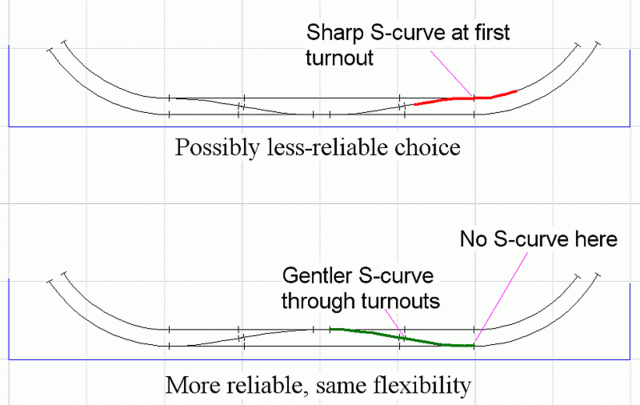
The top configuration in the drawing above is often seen on newcomers' double-track ovals and other areas where double tracks curve into a set of crossovers.

Because the tighter inner end curve feeds directly into an opposing crossover, it creates a possibly troublesome S-curve, especially when shoving longer cars through. The alternative arrangement on the bottom of the drawing offers the same routing flexibility but creates much gentler S-curves.

Note that the same problem can develop when newcomers place an off-the-shelf double-crossover too close to a tight curve, not realizing that one route creates a significant S-curve.

Yeah, I know it's kind of a basic point -- thanks for indulging me.

Friday, February 12, 2010

Does this yard make me look fat?

Some questions are basically unanswerable; the stereotypical classic is when your spouse asks, "Do these pants make me look fat?"

I have been reminded of these types of unanswerable questions in the last few weeks on various Internet forums. Folks post a track plan for a yard (often a simple mechanical transcription of one of John Armstrong's plans from Track Planning for Realistic Operation). Then they ask, "Is this a good yard plan?"

I dunno. Maybe. Maybe not.

There are quite a few facts not yet in evidence. Where is this yard located in relation to staging, junctions, branches, and other yards (if any)? How many trains will this yard serve in a session? In which direction will most trains run? Will this yard originate or terminate trains? How many trains? What types of trains? How much classification is needed versus simply block swaps? What era?

Without the answers to these and other questions, there's really no way to make an accurate judgment about the suitability of any yard design for a specific layout.

Of course, this doesn't stop the self-proclaimed forum experts from adding their two cents, advising various additions and changes that may (or may not) improve that yard's function in a specific layout.

While the classic Armstrong designs are better than 98+% of what most modelers dream up on their own, I hate to see this kind of unanswerable yard design question receiving so many pat (and patently incorrect) answers.

The right answer ("It depends, let's look at the rest of your layout design and your operations concept.") won't satisfy the typical immediate-gratification help-seekers -- but it is the reality of plausible, efficient, and engaging yard design.