Friday, February 19, 2010

The Double (Track) Cross

For the majority of readers who visit this blog (thanks, by the way), this post is of no particular use.

But I see this error over and over again on user-posted track plans, so if it helps only one or two folks before they permanently fasten down their track, it's worth it.


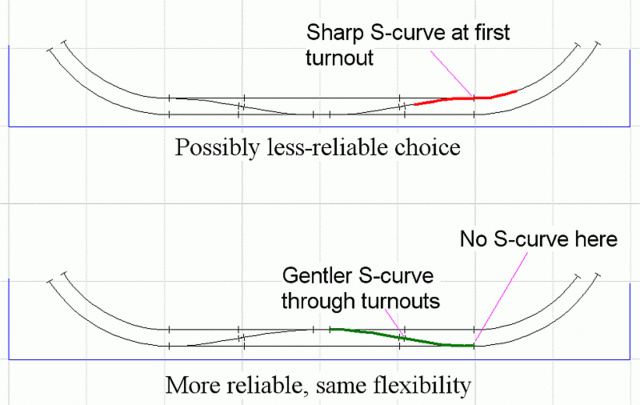
The top configuration in the drawing above is often seen on newcomers' double-track ovals and other areas where double tracks curve into a set of crossovers.

Because the tighter inner end curve feeds directly into an opposing crossover, it creates a possibly troublesome S-curve, especially when shoving longer cars through. The alternative arrangement on the bottom of the drawing offers the same routing flexibility but creates much gentler S-curves.

Note that the same problem can develop when newcomers place an off-the-shelf double-crossover too close to a tight curve, not realizing that one route creates a significant S-curve.

Yeah, I know it's kind of a basic point -- thanks for indulging me.

Friday, February 12, 2010

Does this yard make me look fat?

Some questions are basically unanswerable; the stereotypical classic is when your spouse asks, "Do these pants make me look fat?"

I have been reminded of these types of unanswerable questions in the last few weeks on various Internet forums. Folks post a track plan for a yard (often a simple mechanical transcription of one of John Armstrong's plans from Track Planning for Realistic Operation). Then they ask, "Is this a good yard plan?"

I dunno. Maybe. Maybe not.

There are quite a few facts not yet in evidence. Where is this yard located in relation to staging, junctions, branches, and other yards (if any)? How many trains will this yard serve in a session? In which direction will most trains run? Will this yard originate or terminate trains? How many trains? What types of trains? How much classification is needed versus simply block swaps? What era?

Without the answers to these and other questions, there's really no way to make an accurate judgment about the suitability of any yard design for a specific layout.

Of course, this doesn't stop the self-proclaimed forum experts from adding their two cents, advising various additions and changes that may (or may not) improve that yard's function in a specific layout.

While the classic Armstrong designs are better than 98+% of what most modelers dream up on their own, I hate to see this kind of unanswerable yard design question receiving so many pat (and patently incorrect) answers.

The right answer ("It depends, let's look at the rest of your layout design and your operations concept.") won't satisfy the typical immediate-gratification help-seekers -- but it is the reality of plausible, efficient, and engaging yard design.

Saturday, February 06, 2010

Plans of Steel

Over the years, I've had a few requests for layout designs that included some elements of the steel industry. While I have gleaned enough from back issues of the Railroad Industry SIG's publications and articles published in the commercial press to do a decent job, a couple of recent projects have demanded a more intense focus on the steel industry.

So I'm really grateful that the NMRA arranged for the reprinting of Dean Freytag's The History, Making and Modeling of Steel. It also helps that the book is very focused on the Walthers steel industry models in HO scale and N scale, since most of my clients want to at least start with these kits as a basis for their modeling.

(Between the time I started writing this blog entry and today, I discover that the book is sold out at the NMRA -- sorry about that. Perhaps interested readers will be able to find it from other sources or through inter-library loan.)

One of the nice things about Freytag's approach in the book is that he offers a lot of variations. Whether the modeler's preference is for detailed prototype replication or something more casual, lots of space dedicated to the steel industry or just a corner of the layout, Freytag offers useful advice for all. And he offers these suggestions in a positive and encouraging way that many modelers will find motivational.

Another very helpful part of the book is its focus on explaining in some (although not excruciating) detail the steel making process. Even this modest amount of background makes obvious the flaws in many steel-oriented published track plans.

I understand Bernie Kempinski has a book on the steel industry in the publication process and I'm sure that will be a good resource as well. But I wanted to take a moment to acknowledge Dean Freytag's excellent scholarship and spot-on writing tone, perfect for the modeler. Hopefully the book will become more readily available again.


I've written before about Allman Brothers member and recent Eric Clapton sideman Derek Trucks. I've been enjoying the Derek Trucks Band's most recent album, Already Free. Although the jazz and world music elements are still evident in Trucks' fabulous slide guitar sound, this album seems to me to have more blues and rock influence. Whether it's the easy acoustic shuffle that phases into a driving electric rock riff in "Down in the Flood" or the greasy slide that powers "Get What you Deserve", many of the tunes show a bit more muscle this time out.

Also welcome to my ears are the vocal contributions of Clapton bandmate Doyle Bramhall II (who also wrote and produced some songs on the album) and Trucks' talented wife Susan Tedeschi. While I enjoy regular vocalist Mike Mattison, I find the variety of vocal styles really accents the wide range of Trucks' playing in this, my favorite Derek Trucks album to date.

Monday, February 01, 2010

MRP 2010 -- The "Lost Photos"

I am very pleased to have two of my layout designs featured in Model Railroad Planning 2010. The first track plan is part of a very interesting article on the Richmond Pacific Railroad (RPR) by lead author Bill Kaufman.

The RPR was the subject of our Layout Design Challenge at the Bay Area SIG Meet in 2006. Different designers prepared versions of the RPR (or its predecessor Parr Terminal RR) for presentation and discussion at the meeting, in one of three defined areas. The MRP article combines a discussion of today's RPR with a number of those layout designs and a brief description of each by the designer.

My own contribution is a portable N scale switching layout based on the Parr Terminal and sized to fit on two standard folding banquet tables. Editor Tony Koester and the team at Kalmbach did a great job of turning a slightly clumsy collection of materials into a well-presented article.

For my second article ("Dallas on a Door") … well, let's just say that not all articles go even that smoothly. The compact N scale design captures key elements of the Missouri-Kansas-Texas ("The Katy" or M-K-T) in downtown Dallas on a hollow core door in N scale. Neat prototype, great client, nifty compact switching design. So far, so good.


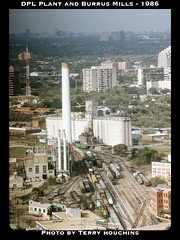
But finding photos to illustrate the article proved to be much more difficult than expected. There were plenty of images on-line (like the one to the right). But locating photographers, clearing copyrights, and obtaining high-quality versions of the images proved daunting.

In the end, Kalmbach had to substitute some on-file material to help illustrate the article. Frustrating! (Now, I'm sure it's not just me that Editor Koester is writing about in his MRP 2010 editorial when he admonishes prospective authors about having their photos lined up before submitting. At least, I hope it's not just me!)

Oh, and sorry about that, Tony!

Tuesday, January 12, 2010

Track Plan Triage

For about the last year, I have been working on a web-based introduction to track planning and layout design. Because this is a low priority and I've been busy with clients' projects, it may be another year (or more!) before it's published.

But as part of this effort, I've been thinking more about what newcomers to the hobby and to layout design are really asking for when they pop up on forums and elsewhere looking for help. (I'm talking about absolute newcomers here, not folks who've been around the hobby for a while and have learned about their own preferences, even if they don't yet have a layout.)

What makes a layout interesting varies

Like many others, my tendency is to try to help these complete newbies understand what makes a layout more engaging in the long run and explain why an oval with one siding and two spurs may soon prove tedious. As I've said before, I've seen a lot of these "Plywood Pacifics" gathering dust in a corner of the garage or basement after their builders abandoned them due to an excess of boredom and a shortage of fun.

My take-away is this: For many people, there needs to be more than just the most basic layout to offer interest and challenge to make the hobby rewarding in the long term. So my advice to newcomers has always been oriented toward pushing them in the direction of more potential and flexibility in a layout selection or the layout design process.

But I must recognize that not everyone needs the long term challenge of a layout designed for purposeful operations or even realistic scenery. Some people really do want to watch a couple of trains orbit around and around. Maybe occasionally build a new train in the yard or drop off a car here and there, but mostly just watch trains running round and round.

"No, more operation"

This became even clearer to me a few months ago when a fellow emailed me asking about "adding more operation" to one of the layouts in my layout design gallery. He is a friend of a friend, so I invested some time in suggesting adding more staging, or looking at additional car-spotting challenge with "sure spots".

But he seemed puzzled by my suggestions. "No," he said, "what I want is more operation -- more trains running at once." Then the light went on for me. When I suggested that we add a second main-line route so that he could have two trains orbiting simultaneously, he was thrilled and happily went off to build.

Track plan "triage"
So perhaps what's needed when we offer advice and suggestions to an absolute newcomer is to do a sort of triage on the request. Somehow we need to determine which requesters really will be happy in the long term with two trains running laps like obsessive-compulsive Olympians and which ones are asking for that only because they've never been exposed to the more engaging alternatives.

Some folks (probably a small minority, but maybe not) simply need to be pointed toward a decent multi-loop plan, offered a brief description of the more interesting alternatives for future reference, and then encouraged to go forth and orbit. Weighing these happy loopers down with discussions of staging, operations, and LDEs is probably not helping them enjoy the hobby the way they wish to enjoy it.

Others, whose interest may be piqued by opportunities for realistic scenes and/or purposeful operations, should be encouraged to look beyond the simple ovals and dogbones for a layout design that will offer more long-term involvement.

That process of triage, of quickly sorting the different help-seekers from one another, is the challenge -- one I haven't yet fully thought through. But perhaps all of us who offer advice to newcomers should try to be more sensitive to where these newbies are coming from and to whence they aspire. One size does not fit all.
Wednesday, January 06, 2010

Black Diamonds and Beer

My latest article in the commercial press is a track plan for a modern-era shortline in N scale. The Schuylkill Haven Railroad is a proto-freelanced modern-day anthracite hauler in east-central Pennsylvania.

The model layout is inspired by the real-life regional railroad Reading & Northern (RBMN). Proto-freelancing offered some welcome flexibility in combining attractive elements from the good-sized regional into the available space.

The track plan, photos, and a description of the design are found in the January/February 2010 issue of Model Railroad Hobbyist media-zine, always free for download here. View the track plan in my Design Gallery.

The design is based on a hybrid loop-to-oval out-and-back schematic, with key industries (coal tipple and truck dump, a plastics manufacturer, and a large brewery) located on branches from the main continuous running track. The RBMN operates tourist passenger service on some parts of its system, so that's also an option for some variety.

My client was already wisely looking at along-the-wall designs (rather than rectangles) when he contacted me, so the final design makes great use of the layout space. It was a fun project to develop with him and it's great to see it "in print" in MRH.

Friday, January 01, 2010

Theory vs. Practice #1 -- Yard Leads

The first in an occasional series of postings on what Internet blowhards say vs. what has actually been found to work. [Many of these "experts" haven't built their layout yet, of course, so they are free to opine without the inconvenient reality of experience.]

Theory: Many real-life railroad yards did not have separate yard leads, so they don't belong on model yards. Anyone who uses yard leads is simply following what other modelers have done like a bunch of brainless lemmings.

Practical experience: After one has helped build layouts, design layouts, and operated on many layouts, one will observe that most model railroaders run much larger numbers of trains in a given period of time through a given physical plant than would the real-life railroad. Yard leads are thus a concession to this density of traffic, necessary to keep these high levels of traffic flowing through yards and onto our always-too-short main lines.

The presence of yard leads on many successful layouts is an indication of their utility, not a case of mindless lock-step copying.

Verdict: Except for very low-density one- or two-train-per-day branch lines and terminal switching layouts, yard leads are often worth considering to ease traffic flow and allow more operators to have more fun on a given physical plant in the model -- especially given our short main line runs.

---

Hey, if you want to model bollixed-up yards and have your operators standing around twiddling their thumbs, more power to ya'. I'd rather have the traffic flow -- call me crazy!

Don't know what constitutes a yard lead?


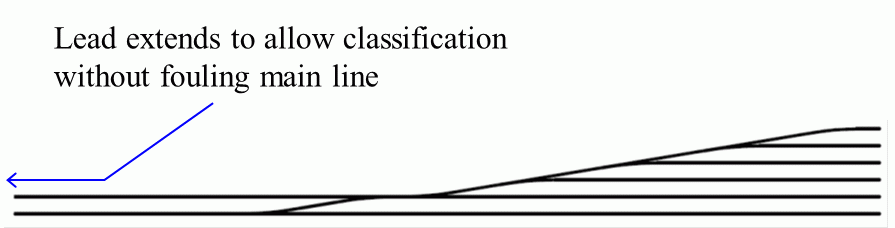
A yard lead extends the opposite direction from a yard ladder, allowing a switcher to work without fouling the main. Note the crossover that allows trains to enter/exit the yard from the main.

The yard lead may connect back into the main at the far end (to the left in this sketch) to allow an additional path into and out of the yard when things are congested, but that is optional.

  Craig Bisgeier's site explains in more detail.

Thursday, December 31, 2009

A Better Start for Beginners

As I noted a while back, the searches that lead folks to my website, as well as threads on model railroad forums, suggest that there are a lot of newcomers to the hobby at this time of year. In addition, many people seem to find their way back to the hobby around the holidays. That's certainly understandable and a positive thing – we need new (and returning) blood to keep the hobby going.

But we seem to have some challenges in helping these newbies find their bearings and get started. Often, these folks are led to an HO 4X8 from 101 Track Plans, an Atlas track plan book, or similar sources. Or worse yet, encouraged to download a CAD program and design their own layout.

I am asking myself if these are really the best paths we can offer to newcomers. The first part of this question is, should we be recommending that absolute newcomers immediately start building a layout? That's always been the "standard" procedure, but does it serve everyone well? Some of these newcomers don't even have an idea of what scale they wish to pursue, let alone type of layout, era, prototype, etc.

Could it be that some might actually benefit from some more exposure to the hobby before beginning their own home layout? This could come formally through club membership or informally by helping out at an in-process layout. They might learn more (and more quickly) if they weren't trying to figure everything out from scratch. And if they were part of a modular club, they could get hands-on experience and a chunk of layout that could possibly be used later at home.

And if they are bound and determined to build a layout as a first step, would these newbies not perhaps be better-served by being directed to one of the start-to-finish layout books such as Marty McGuirk's new N scale layout-building guide -- or a Model Railroader magazine project?

Even though I have been critical of the track plans chosen for some of these efforts (and still am frustrated by some of them), perhaps these soup-to-nuts guides are a better choice, track plan warts and all, than sending the newbie down a path that ends with a neglected half-finished Plywood Pacific covered in dust in the corner of a basement.

I've seen quite a few of those forlorn abandoned HO 4X8s over the years. And it makes me wonder if there isn't some better path. I certainly don't have the answer, but I think it's worth considering before we send another complete beginner down a layout-building path.

Sunday, December 06, 2009

Bending the Mold

The new layout project beginning in the January 2010 Model Railroader magazine doesn't exactly "break the mold" -- but there is some welcome bending of project layout practices. Dick Christianson's track plan is not strictly rectangular and it's designed so that at least the mainline curves are broader then the bare minimum for the scale. It's nice to see an N scale, modern era, western U.S. project as well.

The lack of staging is a frustration, and purists may be critical of the use of KATO Unitrack. But it's the kind of layout a newcomer can relate to and undertake without a lot of experience or background.

Kudos to Christianson and to MR for exposing their readers to something slightly new and different.

Wednesday, November 04, 2009

Searching for the Sacred Sheet

It is interesting to analyze the keyword search activity that brings visitors to my website. Each Fall for the last few years, the percentage of searches including some variation on the words "HO 4X8 layout track plan" increases significantly. This percentage is substantial throughout the year, perhaps 20% of all searches that lead visitors to my web pages.

But in the Fall, this percentage grows. For September, it was 38% -- and if the past holds true, it will grow to 45% or more into the Winter*. As a point of reference, just 8% of searches in September included variations on "shelf layout" and 7% contained variations on "switching layout".

Since most of those "4X8"-related searches lead visitors to my argument against the traditional "sacred sheet" HO 4X8 layout, one might wonder if these searchers leave frustrated. But rather than a "bounce-off" (the web marketer's term for a one-and-done visit that lingers only briefly on a single page), many of these visitors seem to spend some time on that page. And more than half look deeper into the site.

I draw two conclusions from these data points. First, the idea of the HO 4X8, for its many demonstrable faults, is deeply rooted in the prospective model railroader's mind. Decades of magazine articles and layout books devoted to the good ol' HO 4X8 have created the perception that it is the ideal beginner's layout. Of course, this is far from true, but it shows how powerful that notion has become.

[I assume that many of these searchers are folks who are beginning in the hobby or returning to it after an absence, since the percentage increases so noticeably leading into the year-end holidays.]

But secondly, there is also a strong interest in alternatives to the HO 4X8 layout, if those are presented on equal footing with the sacred sheet. One can see this in how deeply many of these "4X8" searchers go into my site.

The decades-old fascination with the HO 4X8 sacred sheet is strong -- many are drawn to it like moths to a flame. The commercial press recognizes this and has catered to that interest (or pandered to it, depending on one's perspective). But a large part of the attraction of the HO 4X8 is due to the perception of its suitability that is created by the commercial publications' past over-promotion. I'll leave it to the reader to decide whether the resultant cycle is virtuous or vicious.

I hope that my small effort to educate folks on the alternatives helps at least some find a path that better suits their needs than the one-size-fits-few HO 4X8. In the same floor space, alternative layout footprints usually offer broader radii, better access, more engaging operations, and improved scenic opportunities. I'm glad to be playing a small part in telling that story.

* Update: It was just over 48% in December, 2009. The desire for the Sacred Sheet remains strong.