The first in an occasional series of postings on what Internet blowhards say vs. what has actually been found to work. [Many of these "experts" haven't built their layout yet, of course, so they are free to opine without the inconvenient reality of experience.]
Theory: Many real-life railroad yards did not have separate yard leads, so they don't belong on model yards. Anyone who uses yard leads is simply following what other modelers have done like a bunch of brainless lemmings.
Practical experience: After one has helped build layouts, design layouts, and operated on many layouts, one will observe that most model railroaders run much larger numbers of trains in a given period of time through a given physical plant than would the real-life railroad. Yard leads are thus a concession to this density of traffic, necessary to keep these high levels of traffic flowing through yards and onto our always-too-short main lines.
The presence of yard leads on many successful layouts is an indication of their utility, not a case of mindless lock-step copying.
Verdict: Except for very low-density one- or two-train-per-day branch lines and terminal switching layouts, yard leads are often worth considering to ease traffic flow and allow more operators to have more fun on a given physical plant in the model -- especially given our short main line runs.
---
Hey, if you want to model bollixed-up yards and have your operators standing around twiddling their thumbs, more power to ya'. I'd rather have the traffic flow -- call me crazy!
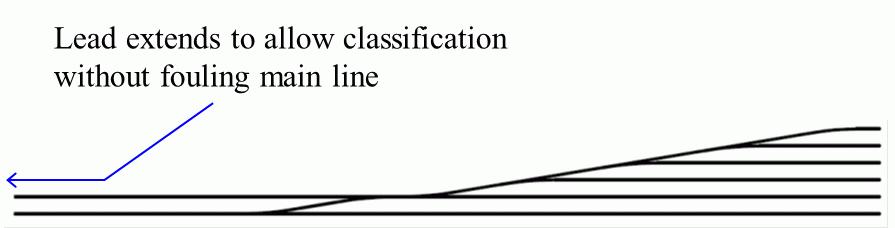
Don't know what constitutes a yard lead?
A yard lead extends the opposite direction from a yard ladder, allowing a switcher to work without fouling the main. Note the crossover that allows trains to enter/exit the yard from the main.
The yard lead may connect back into the main at the far end (to the left in this sketch) to allow an additional path into and out of the yard when things are congested, but that is optional.
Craig Bisgeier's site explains in more detail.
Friday, January 01, 2010
Thursday, December 31, 2009
A Better Start for Beginners
As I noted a while back, the searches that lead folks to my website, as well as threads on model railroad forums, suggest that there are a lot of newcomers to the hobby at this time of year. In addition, many people seem to find their way back to the hobby around the holidays. That's certainly understandable and a positive thing – we need new (and returning) blood to keep the hobby going.
But we seem to have some challenges in helping these newbies find their bearings and get started. Often, these folks are led to an HO 4X8 from 101 Track Plans, an Atlas track plan book, or similar sources. Or worse yet, encouraged to download a CAD program and design their own layout.
I am asking myself if these are really the best paths we can offer to newcomers. The first part of this question is, should we be recommending that absolute newcomers immediately start building a layout? That's always been the "standard" procedure, but does it serve everyone well? Some of these newcomers don't even have an idea of what scale they wish to pursue, let alone type of layout, era, prototype, etc.
Could it be that some might actually benefit from some more exposure to the hobby before beginning their own home layout? This could come formally through club membership or informally by helping out at an in-process layout. They might learn more (and more quickly) if they weren't trying to figure everything out from scratch. And if they were part of a modular club, they could get hands-on experience and a chunk of layout that could possibly be used later at home.
And if they are bound and determined to build a layout as a first step, would these newbies not perhaps be better-served by being directed to one of the start-to-finish layout books such as Marty McGuirk's new N scale layout-building guide -- or a Model Railroader magazine project?
Even though I have been critical of the track plans chosen for some of these efforts (and still am frustrated by some of them), perhaps these soup-to-nuts guides are a better choice, track plan warts and all, than sending the newbie down a path that ends with a neglected half-finished Plywood Pacific covered in dust in the corner of a basement.
I've seen quite a few of those forlorn abandoned HO 4X8s over the years. And it makes me wonder if there isn't some better path. I certainly don't have the answer, but I think it's worth considering before we send another complete beginner down a layout-building path.
Sunday, December 06, 2009
Bending the Mold
The new layout project beginning in the January 2010 Model Railroader magazine doesn't exactly "break the mold" -- but there is some welcome bending of project layout practices. Dick Christianson's track plan is not strictly rectangular and it's designed so that at least the mainline curves are broader then the bare minimum for the scale. It's nice to see an N scale, modern era, western U.S. project as well.The lack of staging is a frustration, and purists may be critical of the use of KATO Unitrack. But it's the kind of layout a newcomer can relate to and undertake without a lot of experience or background.
Kudos to Christianson and to MR for exposing their readers to something slightly new and different.
Wednesday, November 04, 2009
Searching for the Sacred Sheet
It is interesting to analyze the keyword search activity that brings visitors to my website. Each Fall for the last few years, the percentage of searches including some variation on the words "HO 4X8 layout track plan" increases significantly. This percentage is substantial throughout the year, perhaps 20% of all searches that lead visitors to my web pages.
But in the Fall, this percentage grows. For September, it was 38% -- and if the past holds true, it will grow to 45% or more into the Winter*. As a point of reference, just 8% of searches in September included variations on "shelf layout" and 7% contained variations on "switching layout".
Since most of those "4X8"-related searches lead visitors to my argument against the traditional "sacred sheet" HO 4X8 layout, one might wonder if these searchers leave frustrated. But rather than a "bounce-off" (the web marketer's term for a one-and-done visit that lingers only briefly on a single page), many of these visitors seem to spend some time on that page. And more than half look deeper into the site.
I draw two conclusions from these data points. First, the idea of the HO 4X8, for its many demonstrable faults, is deeply rooted in the prospective model railroader's mind. Decades of magazine articles and layout books devoted to the good ol' HO 4X8 have created the perception that it is the ideal beginner's layout. Of course, this is far from true, but it shows how powerful that notion has become.
[I assume that many of these searchers are folks who are beginning in the hobby or returning to it after an absence, since the percentage increases so noticeably leading into the year-end holidays.]
But secondly, there is also a strong interest in alternatives to the HO 4X8 layout, if those are presented on equal footing with the sacred sheet. One can see this in how deeply many of these "4X8" searchers go into my site.
The decades-old fascination with the HO 4X8 sacred sheet is strong -- many are drawn to it like moths to a flame. The commercial press recognizes this and has catered to that interest (or pandered to it, depending on one's perspective). But a large part of the attraction of the HO 4X8 is due to the perception of its suitability that is created by the commercial publications' past over-promotion. I'll leave it to the reader to decide whether the resultant cycle is virtuous or vicious.
I hope that my small effort to educate folks on the alternatives helps at least some find a path that better suits their needs than the one-size-fits-few HO 4X8. In the same floor space, alternative layout footprints usually offer broader radii, better access, more engaging operations, and improved scenic opportunities. I'm glad to be playing a small part in telling that story.
* Update: It was just over 48% in December, 2009. The desire for the Sacred Sheet remains strong.
Thursday, October 29, 2009
In Name Only
I repeatedly make the mistake of wading into discussions of Timetable and Train Order on Internet forums. TT&TO is certainly the flavor of the month in model operations right now. Many are attracted to it because of the publicity from some well-known modelers who are TT&TO enthusiasts.
That's fine, except that folks are now going through all kinds of mental gymnastics to justify naming whatever compromised and bastardized version of the operating rules they adopt "TT&TO".
Some of these schemes are little more than sequence timetables that are set up to extend as trains run late. Others are Track Warrant Control in disguise … having none of the flavor of individual crew decision-making that so typify TT&TO.
But folks are obsessed with the Timetable and Train Order "badge of honor" -- so they call these weird hybrids "TT&TO" and are hyper-defensive toward any thoughtful consideration of what they are planning (or viable alternatives). No matter how much they corrupt the concept, they fight fiercely to keep the TT&TO moniker.
Bottom line, there are some circumstances of layout infrastructure, crew desires and capabilities, desired train densities, etc. that just don't work well with TT&TO in the model environment. But instead of facing that reality, these folks cling to the cachet of TT&TO -- even if in name only. Oftentimes, it seems to me they would be better off with another method of train control, even if slightly anachronistic for the modeled period, to more smoothly handle the high traffic volumes folks tend to run on model railroads. But no, it's TT&TO sine qua non.
I enjoy operating on TT&TO layouts (if the infrastructure and concept can support it) -- I've even helped set up TT&TO sessions on some layouts. So I've got nothing against TT&TO in principle. But it does bug me when people delude themselves and others with their ersatz schemes by labeling them "TT&TO". Choosing a train control method as a status-seeking exercise is a mistake, in my opinion.
Monday, October 19, 2009
Looking Back: the Ventura County Ry.
Things have been pretty hectic at LayoutVison Intergalactic HQ recently, so I haven't had time for a lot of blog posts. But I did finally put up another of my "might have been" layouts.
This one was based on the Ventura County Railway, which interchanges with the UP (formerly Southern Pacific) in Oxnard, CA. I lived nearby in Southern California at the time and it would have been a neat N scale switching layout in the oversized finished garage of the house I owned there (1989-1990 or so).

Click here for more on this track plan in my Layout Design Gallery
Bruce Morden wrote a great article on the Ventura County Railway in Layout Design Journal #26, Spring 2001, published by the Layout Design SIG. I reworked my design in 2001 for the article and looking at it again now confirms that it would have been an interesting layout to build and run, even if I would make a few changes if designing it today.
Monday, October 12, 2009
Slim Rails in Stages
It is great to see another of my custom layout designs published in the commercial press. The latest article in Model Railroad Hobbyist October, 2009 (issue #4) describes an HOn3 layout based on S.P's famous narrow gauge Keeler Branch (former Carson and Colorado). The track plan had to be designed in stages, since the room could only be occupied a bit at a time. Model Railroad Hobbyist is always free to download here.
Click here for a better view of this this track plan. For the full description of the track plan and operations, and great photos of the real-life railroad, download Model Railroad Hobbyist magazine, October 2009 (issue #4).
The article is thoroughly illustrated through the generosity of railroad historian and author Joe Dale Morris. Mr. Morris has recently published an extensive history of the last decades of the real-life line, Southern Pacific's Slim Rails in the Sunset: 1940-1960 (Southern Pacific Historical and Technical Society, 2008). The book is again available from the SPH&TS site or at dealers.
Unfortunately, I completed the design quite a while before Mr. Morris' book was available, it would have helped with some nagging questions. He is truly an expert on the topic.
The Laws Railroad Museum and Historic Site in Laws, CA has preserved some of the equipment and buildings of the S.P. narrow gauge, and also generously made photography available.
The approval to publish photos of long-gone railroad scenes is sometimes very difficult to obtain. But when the copyright holders are as generous as they were in this case, it wonderfully enhances the final product.
Thursday, October 01, 2009
With Scenery, no Less
I've heard from a few folks over the years that they are building one of my published plans from an article or the website. My own small N scale switching layout has been done a couple of times in different scales.
Ben Earp sent along a photo of his recently completed version. Different era and locale, but it was fun to see what his version looks like. Modeling and photo by Ben Earp.

If any blog readers have ever built one of my published track plans or used a segment of one of my designs as a portion of your layout, I'd enjoy seeing a photo and reading how it turned out.
Wednesday, September 23, 2009
Power Failure
Why is there such a lack of decent-running affordable steam for Southern Pacific and Santa Fe in HO and N, yet the parade of Big Boys, 4-12-2s, and other oddball rarities (a Triplex?!) goes on and on? This question came up recently from one of my custom layout design clients. The neat transition-era California central valley HO layout we designed for him will lack decent SP and ATSF steam models appropriate for the layout's size and concept.
The conspiracy theorists (who are massively over-represented on model railroad forums) blame sinister plots dreamt up by evil marketers to force-feed us monster engines. But my technology marketing experience tells me that it's rare that marketing makes people buy something they absolutely don't want. I think the answer is simpler, but unfortunately still not hopeful for those looking to buy small-to-medium sized engines (especially of western oil-burning prototypes).
Let's take all the folks willing to buy a typical SP-style oil-burning 2‑8‑0, for example, in HO or N scale. Sure, there are plenty of SP modelers who would jump at one, but there's probably not a large general interest in the broader market. Just too plebeian for the masses.
SP 2‑8‑0 #2562 at West Oakland in 1954. Tom Gray photo from the Tom Dill collection. This locomotive is preserved and on display at the Arizona Railway Museum in Chandler, AZ. More locomotive info and photos here.
On the other hand, a Big Boy appeals to many more than just the UP modelers. I've seen these monstrosities running on generic 5X9s, Maine Central layouts, everywhere. (And looking silly in the process, but that's just me.) And of course, thousands of Big Boys reside in boxes or on shelves because modelers just had to have one, but it won't run on the tight curves of their HO 4X8 (or they don't have a layout at all).
Our hobby seems to be intrigued by the biggest, the fastest, the most powerful. The manufacturers build these big engines (and multiple releases and competing models of them) because they do sell. More's the pity, but it seems to be the case.
So if I'm a manufacturer, which market segment will I go after: the badly-needed offering for a smaller segment; or the "me too" Big Boy that has a chance at a small piece of a larger segment? The flashy rarities seem the safer bet in our upside-down modeling world, where the mass market does not have an interest or understanding of the realism gained by modeling typicality. But I wonder if that's really true?
If just one myopic model railroad product manager would instead consider the actual trends in the hobby, they would see that the interest in accuracy in modeling rosters is growing. And this is especially true among those building operating layouts – which by their nature usually need more than one of a particular locomotive type.
No, there aren't as many modelers overall as in the "gotta have a Big Boy" segment, but there are fewer competitors. And each of the operating modelers would probably buy multiple copies of the mid-sized to smaller steam locomotives needed to fill out an operating roster.
Why do I believe this? Because modelers buy the diesel equivalents in very large numbers. SP 2‑8‑0 Consolidations were the GP-7s of their day -- and Geeps are popular year-in and year-out because of their usefulness on a variety of layouts. Yes, the odd (literally) DD40AX will sell, but tens of thousands more modelers buy Geeps.
So whaddaya say, model railroad manufacturers? How about one decent oil burning western prototype small-to-midsize loco?
No, I'm not holding my breath.
The conspiracy theorists (who are massively over-represented on model railroad forums) blame sinister plots dreamt up by evil marketers to force-feed us monster engines. But my technology marketing experience tells me that it's rare that marketing makes people buy something they absolutely don't want. I think the answer is simpler, but unfortunately still not hopeful for those looking to buy small-to-medium sized engines (especially of western oil-burning prototypes).
Let's take all the folks willing to buy a typical SP-style oil-burning 2‑8‑0, for example, in HO or N scale. Sure, there are plenty of SP modelers who would jump at one, but there's probably not a large general interest in the broader market. Just too plebeian for the masses.
SP 2‑8‑0 #2562 at West Oakland in 1954. Tom Gray photo from the Tom Dill collection. This locomotive is preserved and on display at the Arizona Railway Museum in Chandler, AZ. More locomotive info and photos here.
On the other hand, a Big Boy appeals to many more than just the UP modelers. I've seen these monstrosities running on generic 5X9s, Maine Central layouts, everywhere. (And looking silly in the process, but that's just me.) And of course, thousands of Big Boys reside in boxes or on shelves because modelers just had to have one, but it won't run on the tight curves of their HO 4X8 (or they don't have a layout at all).
Our hobby seems to be intrigued by the biggest, the fastest, the most powerful. The manufacturers build these big engines (and multiple releases and competing models of them) because they do sell. More's the pity, but it seems to be the case.
So if I'm a manufacturer, which market segment will I go after: the badly-needed offering for a smaller segment; or the "me too" Big Boy that has a chance at a small piece of a larger segment? The flashy rarities seem the safer bet in our upside-down modeling world, where the mass market does not have an interest or understanding of the realism gained by modeling typicality. But I wonder if that's really true?
If just one myopic model railroad product manager would instead consider the actual trends in the hobby, they would see that the interest in accuracy in modeling rosters is growing. And this is especially true among those building operating layouts – which by their nature usually need more than one of a particular locomotive type.
No, there aren't as many modelers overall as in the "gotta have a Big Boy" segment, but there are fewer competitors. And each of the operating modelers would probably buy multiple copies of the mid-sized to smaller steam locomotives needed to fill out an operating roster.
Why do I believe this? Because modelers buy the diesel equivalents in very large numbers. SP 2‑8‑0 Consolidations were the GP-7s of their day -- and Geeps are popular year-in and year-out because of their usefulness on a variety of layouts. Yes, the odd (literally) DD40AX will sell, but tens of thousands more modelers buy Geeps.
So whaddaya say, model railroad manufacturers? How about one decent oil burning western prototype small-to-midsize loco?
No, I'm not holding my breath.
Thursday, September 17, 2009
"Prototype designs are easier" -- Baloney!
One of the oft-repeated truisms about model railroad track planning is: "It's easier to adapt a prototype design than to freelance one". But I can tell you, that ain't always true!
I'm working on a few different designs right now. Some are fairly strictly prototype-based, others very freelanced. And the freelanced ones are a little easier. Here's what I mean:
In one design, for example, the real-life branch upon which the layout is based fits reasonably well into the somewhat challenging available space. And there's a terrific long stretch where a yard would fit so perfectly.
Unfortunately, it's not at all close to the relative location where the actual yard was located in real life. And no amount of contortion and contrivance magically transform the real-life branch. The design is working out OK in the end, but it's been a lot of work (most of it enjoyable).
On one of the freelanced projects, by contrast, I can move the yard to the best spot in the space relative to the room, to staging, and to other desired features. Because I have seen enough segments of real-life railroads and learned about how they work, I have a good foundation of knowledge for making the judgments about plausible locations for the various elements.
And that's the key -- for a neophyte without some background knowledge, freelance designs are more difficult to get right. So in that light, maybe the "Prototype is Easier" conventional wisdom is correct much of the time.
Programming note: Now that Fall is nearly here and readers' thoughts are turning back to model railroading, I'll be publishing blog updates more often again.
One of my favorite audio streams lately has been Texas Hellkitten Radio on Live365. The stream's motto of "… a little rockabilly, a little surf, a little blues …" is certainly accurate. It's interesting to hear nuggets from the past alongside more polished modern music that pays homage to those pioneers. And then there's the Psychobilly and Voodoobilly you just don't often hear that often anywhere. (OK, sometimes with good reason.) But overall, a fun trip to a Texas honkytonk -- without the smoke and the unnervingly sticky floor.
I'm working on a few different designs right now. Some are fairly strictly prototype-based, others very freelanced. And the freelanced ones are a little easier. Here's what I mean:
In one design, for example, the real-life branch upon which the layout is based fits reasonably well into the somewhat challenging available space. And there's a terrific long stretch where a yard would fit so perfectly.
Unfortunately, it's not at all close to the relative location where the actual yard was located in real life. And no amount of contortion and contrivance magically transform the real-life branch. The design is working out OK in the end, but it's been a lot of work (most of it enjoyable).
On one of the freelanced projects, by contrast, I can move the yard to the best spot in the space relative to the room, to staging, and to other desired features. Because I have seen enough segments of real-life railroads and learned about how they work, I have a good foundation of knowledge for making the judgments about plausible locations for the various elements.
And that's the key -- for a neophyte without some background knowledge, freelance designs are more difficult to get right. So in that light, maybe the "Prototype is Easier" conventional wisdom is correct much of the time.
Programming note: Now that Fall is nearly here and readers' thoughts are turning back to model railroading, I'll be publishing blog updates more often again.
Subscribe to:
Posts (Atom)
