Showing posts with label My Layouts. Show all posts

Monday, October 19, 2009

Looking Back: the Ventura County Ry.

Things have been pretty hectic at LayoutVison Intergalactic HQ recently, so I haven't had time for a lot of blog posts. But I did finally put up another of my "might have been" layouts.

This one was based on the Ventura County Railway, which interchanges with the UP (formerly Southern Pacific) in Oxnard, CA. I lived nearby in Southern California at the time and it would have been a neat N scale switching layout in the oversized finished garage of the house I owned there (1989-1990 or so).


Click here for more on this track plan in my Layout Design Gallery

Bruce Morden wrote a great article on the Ventura County Railway in Layout Design Journal #26, Spring 2001, published by the Layout Design SIG. I reworked my design in 2001 for the article and looking at it again now confirms that it would have been an interesting layout to build and run, even if I would make a few changes if designing it today.

Thursday, October 01, 2009

With Scenery, no Less

I've heard from a few folks over the years that they are building one of my published plans from an article or the website. My own small N scale switching layout has been done a couple of times in different scales.

Ben Earp sent along a photo of his recently completed version. Different era and locale, but it was fun to see what his version looks like. Modeling and photo by Ben Earp.


If any blog readers have ever built one of my published track plans or used a segment of one of my designs as a portion of your layout, I'd enjoy seeing a photo and reading how it turned out.

Sunday, March 01, 2009

Progress is Being Attempted

There's finally a small bit of progress to report on the N scale Brooklyn Basin Oakland Harbor Belt layout in the office. My friend Bart Thurber and I (and the trusty laser level) installed the wall brackets that will support Brooklyn Basin and the lower deck layout early in February. Not much has happened in the meantime, since our whole family has been down with a nasty virus. But it's great to have a bit of visible evidence that something is developing.


Bart does the precision eyeball work below while I prepare to supply the brute force with the drill motor

What's going on the lower deck, you may ask? We'll talk about that next time.

Sunday, December 14, 2008

A Layout Grows in Brooklyn

Or, more accurately, from Brooklyn. And not Brooklyn, NY, but the Brooklyn Basin* area of Oakland, California. I wrote a while back that my layout building efforts in the garage had been waylaid by impending home remodeling. So I decided to focus for now on a shelf layout in our spare bedroom home office.

My proto-freelanced Oakland Harbor Belt's Brooklyn Basin District represents a mix of real-life and imagined industries. In real life, the actual industries were served by the Southern Pacific (now Union Pacific). In my version of reality, the OHB also curves along Oakland's Inner Harbor, serving some industries jointly with the SP and some on its own.


The N scale shelf layout will be built on wall standards, providing space for desks and office equipment below. There may be a few small changes to the track plan before construction, but I think this will be pretty close to the final configuration.


You can read more here about my imagined enhancements to real life and my N scale layout plans for Brooklyn Basin. Hopefully the New Year will bring some actual layout construction updates.

*I'm not sure how the area came to be called Brooklyn Basin, but the name dates back at least to the late 19th century. The area at one time was apparently more of an actual drainage basin, but there has been substantial building on fill since then.

Saturday, August 23, 2008

Remembering the First

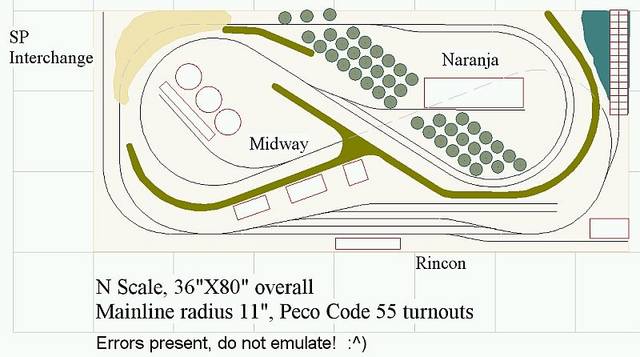
Ah, young love. So intense, at times so misguided. I was reminded of one of my first model railroad "crushes" the other day. Going through some old papers, I found a printout of my first serious layout design. It was done with crude turnout templates in Powerpoint(!) and probably dates from about 1989-90. I describe the plan as "serious" and not "good" because there are definitely some issues. But I remember being intensely focused on the concept for a few weeks. As with any old flame, some memories are more than a little embarrassing, but there are some warm thoughts, too.

I sketched out the plan in 3rdPlanIt and (remarkably) everything fits – but I resisted the urge to correct or improve anything. Twenty years later, some of the details are a little hazy anyway. The overall track locations were suggested by a layout I had seen in an NTRAK publication, which had a sort of a hilly pretzel overcrossing configuration separated by a backdrop from a narrow yard area along one long edge. Benchwork was to be a hollow core door. I had only just started thinking about the hobby again after a long time away and was considering N scale for the first time.


I had recently lived in Carpinteria, CA and the design vaguely suggests that area. The pier or wharf near Rincon was inspired by a short, high pier the Chevron company owned near Carpinteria to load men and equipment onto boats for transfers to the offshore oil platforms nearby. In my reimagining, this pier would somehow serve railcars. An interchange connection was imagined to the SP (which actually runs through the area) and the main on-line industries were citrus packing and some sort of oil-related industry. Both were important industries in the region. I tried to divide the small footprint into a few different scenes, although the backdrops might have proved a little tricky in actual construction.

I see a number of obvious things I would do differently today. The stub-ended yard tracks should point in the opposite direction, at least given where the interchange connects and where "Midway" is located. I think I may have imagined this as a shortline that would work the interchange, build a train, run out to Midway and Naranja, then runaround and return (or was it the other way around?). Too many tracks are parallel to the edges of the benchwork, and the model railroad cliché of "an industry track in every corner" is well-represented.

Hidden or secluded sections completed a continuous run and the roughly 2% grade should have been workable. I don't remember what I was thinking of calling it, but the "Rincon Northern" might have been appropriate (the California coast runs roughly East-West in the area). I also don't recall if I simply wasn't thinking of staging at that point or had purposely left it out in favor of the shortline-with-interchange idea.

This little plan was never built. I became involved with a friend's layout based on the Santa Maria Valley Railroad (see Model Railroad Planning 2004 or view the layout plan online here) and my own interests turned to more prototype-inspired designs. Looking back, I think it would have been a great boost for my own modeling if I had taken the time to build and operate this simple little project, even with the flaws. In any case, it was fun to revisit a past infatuation. [And a great way to procrastinate on the clean-up I was supposed to be doing the day I rediscovered this track plan.]


Speaking of firsts, I was enjoying Gillian Welch's album Time (the Revelator) last week. Her haunting bluegrass/folk/alt-county style with musical partner David Rawlings is well displayed in this album, which includes the slightly melancholy reminiscence "My First Lover". Welch might be best known for her work on the soundtrack to the movie Brother, Where Art Thou, but her music is a very intriguing mix and not limited to old-timey tunes. Rawlings adds sparse but moving fills and creative leads on acoustic guitar that build the atmosphere of each tune. Great record!

Thursday, May 08, 2008

It was the Pantry

Yes, the pantry finally did it. When the previous owners remodeled the kitchen in our 40+ year old house some fifteen or so years ago, they chose the least expensive cabinets available. Pressed wood and staples -- and not enough of either. From the time we moved in, the cabinets have been slowly returning to their primordial state, that is to say, literally disintegrating.

Five-minute epoxy and aluminum mending plates have served to fix some of the major cabinet crevasses over the years we’ve been in the house, but a few months ago there was a huge crash from the kitchen. One wall of the pantry had decided to part company from its loosely-coupled companions and the large shelves crashed to the bottom like falling floors in a Warner Brothers cartoon. Off to the hardware store for threaded rod and metal plates (and more epoxy), and the pantry was soon back to some semblance of function. [Oh yeah, and company was coming that evening for dinner. No kidding.]

But that was the last straw for the lovely wife, who started using profanity like “kitchen remodel” and “push out that wall”. And so we’ve started down the long twisted path of major home improvement.

“What’s this got to do with model railroading?” one might reasonably ask. Some may remember the famous poem “For the Want of a Nail”, republished in Benjamin Franklin’s Poor Richard’s Almanack. The basic premise of the rhyme is that the loss of a nail leads to the loss of a horseshoe, then the horse and rider, then a battle and ultimately the loss of a kingdom – “all for the want of a nail”. The pantry collapse is sort of like that – the first step in a long sequence of events. With the pending remodel, the garage where my layout is situated could become quite crowded. If the remodel is just the kitchen, crude temporary cooking facilities and boxes of dishes, pots, and pans will fill the space. If the remodel is even more extensive, some furniture will be stored there. In any case, not much layout building will get done for a while, at least not in the garage.

I’ve known in the back of my mind that this was a likely scenario, but I was able to keep it way back there. But the impetus for layout construction has certainly diminished since the pantry’s unfortunate breakdown with the knowledge of what was likely. So what to do?

While pondering this question, I thought about advice I’ve given to my own model railroad layout design clients when faced with some unexpected space upheaval. “There’s always some way to build something,” I cheerily encourage them. I hate it when my words come back to mock me. But maybe there is a way. After all, friend Bart Thurber found a way to use a storage room at his business for a no-muss/no-fuss representation of ATSF’s Alice Street Yard on shelves above the storage.

Our guest room doubles as an office and has a couple of long walls. Hmmm. Perhaps a narrower desk, since I’ve moved from a CRT to a flat-screen monitor. Maybe a few sections of layout built on shelves along the walls with a bridge across the window. That could work. But what to put on those shelves? HOn3 Hawaiian railroad … no, back, away, foul spirit!! OK, so let’s stay with the Oakland Harbor Belt theme, era, and N scale so I can use the on-hand locos and rolling stock. Maybe sections of the layout that might even be useable in the garage later. (Or in a dedicated train room if the remodel turns extensive – or is that expensive?).

OK then, what to build? Fernside Yard and Alaska Basin could probably fit, but not in configurations that readily transfer to the ultimate garage plan. So how about Brooklyn Basin? (Click here for a better view of the Brooklyn Basin map.)


This proto-freelanced area sports some interesting possibilities, with a huge flour milling complex, canning company warehouses, a massive glass plant and a marine terminal. In real life, the SP (and now UP) served the area, but I’ve always imagined modeling coopetition here with the OHB and SP jockeying for customers.
Let’s see… the Fruitvale Ave. lift bridge (above, from Microsoft Live Earth), glass plant (upper left in the photo), and canning warehouses (lower left) along one short wall, narrow bridge for Glascock Street across the window, then the major milling complex and marine terminal along the long wall. As Gene Wilder’s Froederick Frankenstein screams in the movie Young Frankenstein, “IT … COULD … WORK!!!”

Stay tuned.

Sunday, September 23, 2007

Lost weekends

I've never been a big partier, so the title is not referring to some dissipative debauchery. Instead, it's describing the handful of weekends I've spent infatuated with a change in direction of what I plan to model. Most of these have been brief divergences driven by some off-hand discovery, article, or idea.

When I moved to the Bay Area in 1997, my plans were to build a proto-freelanced shortline/secondary mainline based on the proposed-but-never-built Midland Pacific. My layout design and operating plans for the Midland Pacific were covered in detail in the Layout Design SIG's Layout Design Journal # 35, December 2006.

Within a few years, I shifted concepts to a prototype-based Bay Area plan focused on San Jose and environs. I worked on this for a couple of years, until one day while on a walk I realized that San Jose was ten pounds of sugar in the five-pound sack that was my garage. The only way I could get all the things I really wanted into a layout was to proto-freelance. This led me to the Oakland Harbor Belt (OHB) layout currently under construction in the garage. I remain happy with this concept and I'm looking forward to it slowly taking shape.

But along the way, I've had ever-so-brief dalliances with other ideas, locales, eras, even scales. There was the one long holiday weekend (while my family was out of town) spent feverishly on the computer wrapping an HOn3 Hawaiian-themed proto-freelance layout into my garage space. Operations would have been somewhat limited with no interchange, but at least my HO-chauvinist friends could have read the car numbers. I decided I liked the OHB better, but I did get the germ of an idea for an article out of it, slated for publication soon in the commercial press. So that weekend wasn't really lost.

Another model RR crush was on the Central California Traction (CCT), an eminently modelable traction line turned diesel shortline. (Fan site here, the RR's official site here) This one was pretty serious, dropped only when I decided the lack of suitable models in N scale for the period in which I wanted to set the layout was going to be too difficult for me to overcome. Friend Dave Stanley has since written a terrific book on the CCT with Jeffrey Moreau. Fortunately, the book had not been published when I went through my brief CCT obsession, or who knows where I would have ended up! Once again, the focus was not wasted, because later I had the chance to do a custom proto-freelanced HO design for a client based loosely on the CCT and the neighboring Sacramento Northern.

One other weekend fling was with the Modesto and Empire Traction. This is a very neat little shortline that does some pretty big-time railroading in a few miles of industrial park in central California. In the end, my interest in rail-marine brought me back home to the OHB, but the idea of shoehorning some tight HO curves into the garage for a couple of Bachmann 70-tonners was good for some heated doodling. Eventually cooler heads (and some radius reality!) prevailed.

This last affair came to mind this month with the article by friend Trevor Marshall in the October 2007 Railroad Model Craftsman. Trevor does a great job outlining the present-day M&ET and offering a neat Free-Mo based layout design concept. It's a two-part article, so I am really looking forward to next month's issue. This is a very modelgenic prototype, especially for contemporary or near-contemporary layouts. No tangible results yet from my M&ET infatuation, but there is that long, empty wall in my office … and there are still some 70-Tonners around ….

Each of these brief flirtations has ultimately strengthened my focus on the OHB. The explorations of different eras, themes, even scales helps bring to light the reasons I made the choices and trade-offs that led to this concept. Hopefully these lost weekends will be fewer in number (and less intense in severity) as construction continues, but I'm glad for the perspective they brought along the way.

This weekend's guilty listening pleasure was Un-Led-Ed by Dread Zeppelin. Yes, a reggae band fronted by an Elvis impersonator doing Led Zeppelin covers. I can't explain why I enjoy listening to it … and I have even less justification for why I bought the CD in the first place. It was LA, I was young .... (alright, younger) This is definitely a once-per-decade listen -- but I liked it! (Talk about a lost weekend …)

Thursday, July 26, 2007

What's it worth?

Those Mastercard commercials are so ubiquitous that they've become shorthand in our culture. You know, the "insect repellent, 5 dollars; allergy medicine, 6 dollars; not spending your vacation scratching and sniffing? Priceless" commercials?

I was reminded of that as I surveyed my not-very-quickly-building layout domain in the garage. Because I changed the plan significantly post-first sawdust, I had to change the staging yard from one side of the garage to the other, then change the location of the loop in staging from one end of the yard to the other.

Throughout, I was trying to keep the forlorn and lonely body tracks of the original staging shelf. This led to an increasingly challenging series of mental and ladder gymnastics to try to make everything line up, even though I had flipped the whole thing end-for-end and side-to-side.

Then I realized, what was I actually saving? A piece of homasote and some flex track. Now it's true I hate to waste ... growing up with two parents who lived through and remembered vividly the Great Depression will do that to you. Oh, and I am what you'd call ... er ... stubborn.

But this had gone past frugality to stupidity. So in one swift motion, before I could change my own mind, I backed out the handful of screws holding homasote to plywood, broke the thing into chunks, and stuffed it into the trash can.

Not having to live for years with an earlier mistake? Priceless.

Friday, July 06, 2007

"Every day, in every way ...

… I'm getting better and better." Interesting aphorism, huh? Has sort of a '60s-'70s vibe, like "Have a nice day" and "I'm OK, you're OK". But in fact the saying and the concept are quite old, as I learned while re-reading a favorite book, The Lying Stones of Marrakech by the late paleontologist and essayist Stephen Jay Gould*. This self-help concept was developed in the 1920s by French physician Emile Coué, who found that patients who repeated this positive phrase daily along with receiving medication did better than those who received only medication.

Gould contrasted Coué's idea of incremental day-to-day improvements with the history of science, which tends to develop in discontinuous "bursts". Interesting how model railroad projects seem to benefit from both types of development: the half-hour-a-day squeezed out of a busy schedule as well as the multi-day building binge. (The latter usually in response to some sort of external deadline.)

Hopefully you're doing better at both the "every day, in every way" projects and the "big burst" projects than I've been able to manage recently. But the decks are reasonably clear this weekend, so I hope to make some progress. I'll let you know.

*Besides being a ground-breaking scientist and one of the best essayists in history, Gould was also distantly related to the railroading Goulds, Jay and George Jay, whose robber-baron efforts helped shape the railroad landscape of the late 19th- and early 20th century. Arguably, it's train related.

While building benchwork in the garage I've been listening to some older CDs that provide the right kind of intensity for the task. A fun re-discovery was Living Colour's 1988 album Vivid. Heavy guitar riffs, powerful vocals, and a solid funk-infused rhythm section. The group disbanded in 1995, but apparently has reformed for some concerts recently. Always one of my favorite music videos, although the late-'80s fashions are a tad dated (who would have dreamed Body Glove shorty jumpsuits weren't going to take off in the mainstream?)

Sunday, June 24, 2007

Sometimes it's bugging you for a reason …

Before I started designing layouts for others, I thought the process of layout design was inevitably fraught with roadblocks. But in the last few years, I've noticed that designing layouts for others is sometimes challenging, but there's always a way forward. I'm much more likely to be stymied working on my own design, however.

I think this is because there is always a process of concession and compromise in layout design. When working with someone else's "givens and 'druthers", it's relatively easy to prioritize between conflicting elements. But deciding which of my own precious desires to toss overboard is still challenging. And sometimes I make a decision on my own design that nags at me.

One of these was my plan for ATSF's Alice Street Yard*. This "pocket" prototype served a clutch of customers along Oakland's Inner Harbor with tracks that were otherwise unconnected to the Santa Fe except via a car float from Richmond. The Alice Street trackage, quite compact in real life, was spread out over an area about half-again the scale size of the real thing in twisting and turning things around in the garage. Holy selective expansion, Batman!

And it has bugged me.

So it's back to the drawing board for Alice Street. I'm not sure exactly where it's going to end up, maybe as a "Sklylobe"† over the car, but I feel more comfortable now that I will be exploring the essential cramped nature of the prototype.

Thanks for visiting, see my latest posts here

*Alice Street was covered extensively in W. W. Childers' article in the Third Quarter 2001 issue of The Warbonnet, the Santa Fe Railway Historical and Modeling Society's excellent magazine.

†I wrote about the Skylobe concept in the
LD SIG's Layout Design Journal, issues #28 and #35.

Saturday, June 16, 2007

Model motivation

Sometimes a particular model will give me a little boost and motivate me to work on the layout. One of these is a cool little SW-1 model built for me by "Crittermeister" Randy Gustafson, whose neat compact Hickory Valley RR was featured in the July 1995 Model Railroader. Randy has built all manner of small locos in N scale, fearlessly scrathbuilding and kitbashing shells and mechanisms.

This SW-1 is made from a shell casting pulled from Randy's custom mold and a modified Kato NW-2 drive. Custom brass handrails complete the switcher, which wears a "darned close" livery made up of decals pieced together from a couple of commercial sets. (All photos by Randy).

This little gem will be borrowed/leased power for the Howard Terminal segment of the layout, a separate section built as a flip-up portable island. The Howard Terminal will provide DC on the rails, so there's no decoder in the SW-1 -- we used the space for more weight. Looks great, runs great, makes me want to get more done on the layout. So why am I blogging … hmmm.

Randy posts quite often in the Atlas N scale forum, so I decided to drop in and comment on the thread where he described the process of creating the SW-1. Since I was in a forum anyway, I decided to look around the web and see if things have changed on the forum scene during my self-imposed exile.

Yeesh … that was a mistake. Not much has changed, least of all my tolerance for jerks and blowhards. Guess I'm not quite ready to venture back onto the forums.

Forum foolishness aside, the Internet is an amazing medium for connecting us to small companies and individuals (like Randy) that can provide modeling possibilities beyond our own personal skills. Even though it's only running on my interim switching layout now, Randy's SW-1 is a unique model that's giving me a good shot of inspiration.

Friday, April 27, 2007

Sandwich Spread*

Like many of you, my wife and I are part of what's sometimes called the "sandwich" generation: at the same time that we have a child in school, our aging parents are beginning to need more of our time and attention. For the last couple of months, the demands at both ends of this spectrum have been high and our family's been spread a little thin.

At times like this, I start to wonder about the practicality of having a hobby. I have made little or no progress on the layout for weeks and the prospects for the next few weeks seem no better. The NMRA Pacific Coast Region convention is coming up and not only won't I be attending, I'm not even ready to host a few friends who wanted to come by and see my progress on their way to- or from the event -- because there's darn little progress to show.

It's easy (for me, at least) to begin thinking it's foolish to spend time on the hobby when there are so many more pressing needs that demand my attention. Family comes first, of course, and clients can't be expected to wait forever for their projects. And then there's the news of the day that screams for attention and action. Maybe the idea of a hobby is just not compatible with today's world and my current time-of-life.

… so after wallowing in those happy thoughts for a few minutes, I had the good sense to take a step back and look at things in perspective. Play and recreation has been a part of human society for thousands of years. Early humans made art and played games of various sorts. Sociologists have documented puzzle and gambling games played by adults in Native American groups and remote tribes untouched by modern culture, as well as myriad paintings, carvings, sculpture, and other art. Surely these peoples had plenty to worry about just staying alive (food, shelter, avoiding hostile clans and critters, et al), yet they made time for recreation.

In more modern settings, Stephen Covey's 7 Habits of Highly Successful People stresses the need for renewal through, among other things, activities to boost mental creativity and social interaction. Winston Churchill was an enthusiastic painter in oils throughout his life, even during periods of immense time pressure and stress. Model railroading can certainly offer the same kind of creative outlet.

Nope, I don't have a lot of time right now, and there are many other demands on that time. But maybe carving out a little of that time for some creative renewal in actually modeling would be a good investment.

* Yes, there is such a thing as sandwich spread, a mayonnaise-and-relish concoction that's a bit like slightly sweet tartar sauce. It was a favorite condiment of my late Father, who used it on everything from bologna sandwiches to leftovers.

Friday, December 29, 2006

We have liftoff

Yeah, it’s just a simple wall outlet. Two sets of plugs, one controlled by a wall switch and one always on. High on the wall above these, another switched circuit for layout lights.

But it's what's missing that's important … a clunky surface mount box and a load of previous-owner-installed conduit that was at the exact location I needed for the Oakland Harbor Belt's main staging yard.

For a number of reasons, this has taken weeks, even months, to be completed. But now that the job is done, the last external constraint to continuing layout construction is removed.

There's still a lot of day job work on the schedule, two huge layout design projects to complete, and a bunch of smaller design projects in the backlog, so there won't be a lot of time in the next couple of months. But I'm excited … time to get moving!

Currently listening to Soundgarden's A Sides. When you're contemplating a big construction project, you need big metal!

Thursday, November 09, 2006

Saying my final good-byes to the Midland Pacific

Before I began working on the Oakland Harbor Belt concept for my layout, I was focused on a secondary mainline / branchline proto-freelanced concept called the Midland Pacific (MPC). I discussed the MPC briefly in an article in the Layout Design Journal (LDJ-28, Spring 2003). The real-life MPC was actually promoted in the early 1900s and a few miles of track were laid before the railroad vanished without a trace. It would have run from the Bakersfield, CA area to Port Hartford (now Avila Beach), as did my imagineered version. An article with a more complete discussion of the MPC is in production for an upcoming LDJ.

I had worked on the MPC concept for a few years, including buying appropriate equipment as it became available. Since I worked on the MPC concept for so long, that was an extended period of purchases. Many of the locos and rolling stock acquired for the MPC do not fit the OHB, so I've been selling them via eBay over the last few months. But the current "for sale" batch really signifies the end of the MPC concept. The MPC would have crossed and interchanged with parent Southern Pacific at Pismo Beach on the SP's Coast Line. I had envisioned a parade of SP through trains, including the famous "Overnight" freight service and the legendary "Daylight" and "Lark" passenger trains. Even though the limited-run nature of N scale is often frustrating, I had managed to acquire suitable consists and motive power for all of these trains.

But there's really no place on the OHB for any of these trains, except as static backgrounds for photos behind the Santa Fe Alice Street Yard or the Howard Terminal. The SP will still be represented on the OHB, of course, but it's the grittier workaday locals, not the glamorous mainline rockets. The Overnight cars went first. (For one thing, they are in more regular production now, so in the back of my mind I thought I could always replace them.) Then various other locos and cars went on the auction block.

But now it's the Daylight. And the Lark. These beautiful models from Kato are not "rivet-counting" accurate for the SP by any means, but their colorful liveries speak of an era and a place far better than words or (my) scenery ever would. Visions of these trains have been with me for a long time, through several layout plans and dreams: San Luis Obispo/Cuesta; Ventura County Railway (LDJ-26); the MPC; and the short-lived San Jose and environs concept.

Even though I'm a terrible pack-rat, there's only so much space even I'm willing to set aside for storage of models that won't fit on the layout. Sale of the ill-fitting equipment is also financing most (or all) of the track I'll need for the OHB. So I know this stuff has got to go. But like the end of any relationship, the parting is stirring up bittersweet thoughts of what might have been.